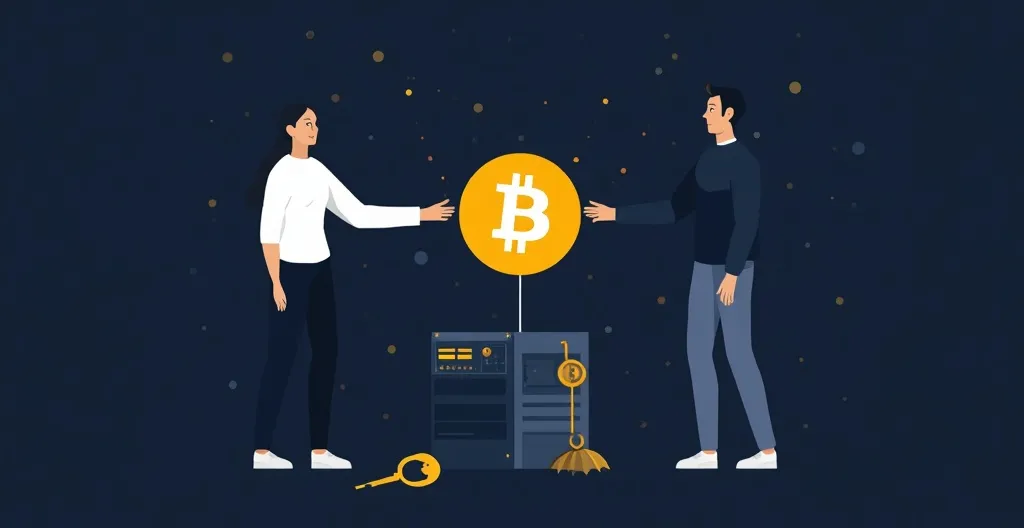
Bitcoin’s Whitepaper Anniversary: The Idea Behind Peer-to-Peer Electronic Cash
Published on October 31, 2008, Bitcoin’s whitepaper proposed a way to send electronic money without a trusted intermediary to prevent double-spending. The paper’s 18th anniversary falls on October 31, 2026. It’s a good moment to revisit what Bitcoin was designed to do, and what it does not promise.
- Whitepaper: “Bitcoin: A Peer-to-Peer Electronic Cash System”
- Byline: Satoshi Nakamoto, a pseudonym whose real-world identity remains unknown
- First block: Bitcoin’s genesis block was mined on January 3, 2009
- Supply: Bitcoin’s consensus rules cap issuance just below 21 million BTC
The problem Bitcoin set out to solve
Digital information can be copied. With digital cash, that creates a basic problem: someone could try to spend the same bitcoin in two conflicting transactions. Conventional payment systems rely on a trusted intermediary, such as a bank, to keep the records and decide which payment counts.
The whitepaper proposed a peer-to-peer system for agreeing on transaction order without a central record keeper. Bitcoin combines a public transaction history with proof-of-work, which makes adding or rewriting records computationally costly.
Miners use proof-of-work to propose blocks of transactions. Network nodes check those blocks independently and accept them only if they follow Bitcoin’s rules. Anyone can verify the transaction history by running a node. As more blocks build on a transaction, changing the accepted history gets harder. It is not impossible, but it becomes costly enough to help secure the system. This is the proof-of-work system that critics and advocates debate.
The design aims to let people make online payments without a trusted intermediary to prevent double-spending. That does not mean every Bitcoin user avoids intermediaries. Exchanges, custodians, and payment services remain common, and using them can bring back the counterparty risks that self-custody is meant to avoid.
From proposal to network
The whitepaper appeared before Bitcoin’s blockchain began recording transactions. Its first block, the genesis block, was mined on January 3, 2009. These are related but distinct milestones: the paper described a proposed system, while the genesis block began its recorded history.
A design on paper is not the same as a working network. Bitcoin’s early history took it from a technical proposal to software and a functioning peer-to-peer system. Participants could check transactions against shared rules instead of relying on a single operator.
What the 21 million limit means
Bitcoin’s supply limit is built into its issuance rules. New bitcoin enter circulation through block rewards, which are cut in half every 210, 000 blocks. These repeated halvings make total issuance approach, but not reach, 21 million BTC. “21 million” is the familiar rounded figure. The rules cap issuance just below it.
A fixed issuance schedule sets Bitcoin apart from currencies whose supply can be changed by central authorities. But scarcity alone does not guarantee stable purchasing power, demand, or adoption. The supply cap is part of Bitcoin’s monetary design, not a promise about its market price.
The cap also does not tell us how much bitcoin people can spend. Coins can become inaccessible when private keys are lost. Maximum issuance and the amount available to current holders are different measures.
The unresolved trade-off
Bitcoin’s anniversary is a reminder of a design choice: users can verify the system and hold their own keys, but that comes with responsibility. Lose the keys and there is no customer-service desk to restore access. Use an exchange or custodian instead, and convenience means relying on another organization.
That tension remains central to Bitcoin’s original aim. The protocol supports peer-to-peer settlement without a trusted payment processor, but many people still choose services that offer familiar account access and support. The technology changes who can keep the ledger. It does not remove every practical trade-off. Proof-of-work also requires significant computation and carries an energy cost.
Bitcoin whitepaper anniversary: key questions
-
When was the Bitcoin whitepaper published?
It was published on October 31, 2008, under the title Bitcoin: A Peer-to-Peer Electronic Cash System. Its 18th anniversary falls on October 31, 2026.
-
What problem did the whitepaper address?
It proposed a way to transfer electronic value without a trusted intermediary to prevent someone from spending the same funds twice.
-
When did Bitcoin’s blockchain begin?
The genesis block, Bitcoin’s first block, was mined on January 3, 2009, after the whitepaper was published.
-
Is Bitcoin’s supply exactly 21 million BTC?
The consensus rules cap issuance just below 21 million BTC. “21 million” is a rounded shorthand for that limit.
-
Does Bitcoin’s peer-to-peer design mean users never need intermediaries?
No. The protocol is designed to support payments without a trusted central processor, but users may still rely on exchanges, custodians, or payment services.