Bolivia’s Toyota dealer Toyosa has added Bitcoin to its payment options, extending a crypto checkout setup that already included USDT. The move matters not because it magically turns Bitcoin into money, but because it shows crypto edging further into normal commerce, where paperwork, settlement, and risk controls actually matter.
- BTC is now an option for Toyota purchases through Toyosa in Bolivia.
- USDT came first; the new rollout expands a crypto payment setup launched in 2025.
- Bolivia still has not made Bitcoin legal tender; the boliviano remains the only official currency.
- The real test is whether Toyosa holds BTC or converts it immediately.
The BTC option was announced on Sept. 18 at Expocruz 2026 in Santa Cruz, according to the rollout details. BitGo confirmed on Sept. 20 that BitGo Bank & Trust supplied the institutional-grade wallet infrastructure behind the Bitcoin payment service, while Towerbank handled transaction processing.
That is the part worth paying attention to. Crypto adoption in the real world usually runs on boring infrastructure: wallet providers, processors, compliance checks, and settlement rails. The headline is sexy. The plumbing is what decides whether the thing works or just looks good on a booth banner.
Toyosa’s payment menu now includes BTC, bolivianos, U.S. dollars, and Tether’s USDT. On paper, that gives buyers flexibility. In practice, it raises the questions that separate serious merchant adoption from marketing fluff: what wallets are supported, what confirmations are required, how is the exchange rate set, and are there fees or purchase limits? Those details were not publicly disclosed in the material reviewed.
That is not a minor omission. A merchant saying “we accept Bitcoin” is one thing. A merchant running a transparent and reliable BTC payment flow is another.
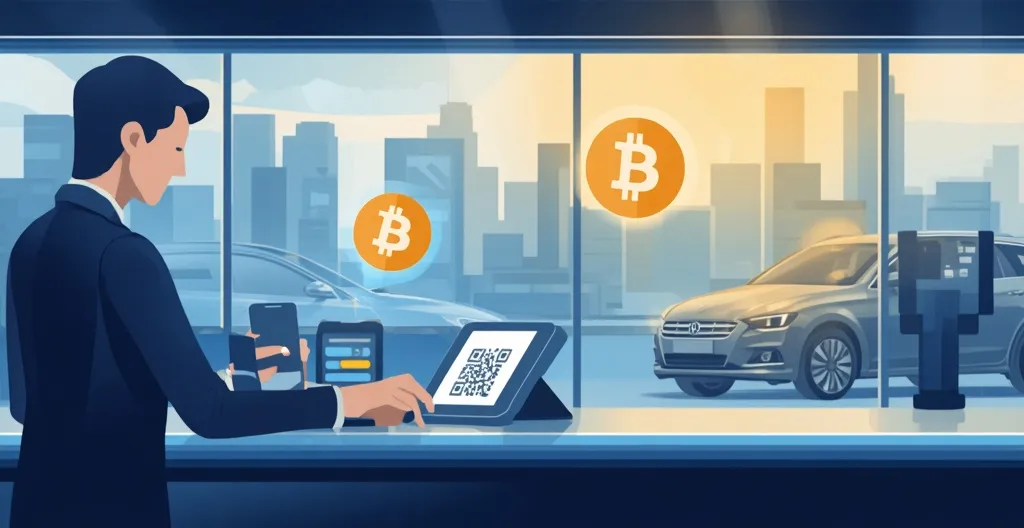
Toyosa’s earlier USDT rollout, launched in September 2025, offers a clue about how the crypto checkout may work. The company’s online payment page still describes a USDT process where customers first obtain a quotation, choose a supported blockchain network, and scan a QR code from a crypto wallet. The page lists Ethereum and Tron among the supported networks, and identifies Towerbank as the financial partner and BitGo as the blockchain technology provider.
That setup makes more sense for USDT than for BTC. USDT is a stablecoin, meaning it is designed to track the U.S. dollar. Bitcoin is not stable, and that volatility creates a different set of headaches for merchants unless they hedge or convert quickly.
And that gets to the central tension in merchant Bitcoin adoption. Businesses often like the idea of accepting Bitcoin more than they like actually holding Bitcoin. A dealer may accept BTC for the customer experience and the branding halo, then convert it right away to avoid being whipsawed by price swings. That is not scandalous. It is just commerce. But it is also not the same as a company building a Bitcoin treasury or making a long-term bet on the asset.
Bolivia’s regulatory shift helps explain why this is happening at all. In June 2024, the Banco Central de Bolivia revoked Resolution 144/2020, authorizing electronic payment channels and instruments for virtual-asset purchase and sale transactions. In plain English: the previous ban on processing crypto-related transactions through the financial system was removed.
That does not make Bitcoin legal tender. Bolivia’s boliviano remains the only legal tender, and nobody is legally required to accept virtual assets as payment. “Allowed” and “official money” are not the same thing, no matter how many crypto bros pretend otherwise.
The central bank’s own numbers show how much activity picked up after the rule change. In June 2025, the BCB reported that virtual-asset transactions using electronic payment instruments reached $294 million in the first half of 2025, compared with $46.5 million in the same period of 2024. The bank also put cumulative activity since the regulatory change at $430 million.
Those figures point to growing use, but they do not automatically prove broad retail adoption. The total may reflect trading, settlement, remittances, or concentrated activity from a relatively small group of users. Big numbers can still be real while telling only part of the story.
Bolivia’s financial regulator has also been warning that crypto is not a free lunch. ASFI published consumer guidance in January warning that crypto exchanges expose users to price volatility, counterparty risk, and potential losses. That is the unglamorous side of the market: prices move, counterparties fail, and the “easy money” crowd usually learns the lesson the hard way.
Bolivia has also started adapting its accounting and pricing machinery to the new reality. According to the central bank, an October 2025 ASFI resolution added virtual-asset accounts, income, losses, custody, and administration categories to the accounting manual used by regulated financial institutions. The BCB also publishes reference prices for virtual assets, including Tether, Bitcoin, and Ether, and has used Binance peer-to-peer trading data for its USDT reference calculation.
That matters because once regulators begin publishing references and accounting categories, they are no longer pretending crypto does not exist. They may still dislike it, but they are being forced to deal with it like a real financial asset class rather than an internet phase.
There is also a broader market point here: stablecoins usually do the heavy lifting in payments. Regional data cited in the notes showed stablecoins made up 40% of Bitso purchases versus Bitcoin’s 18% in Latin American crypto purchases during 2025. That is not Bolivia-only data, but it fits the pattern seen across many markets. Bitcoin gets the ideology; stablecoins often get the checkout counter.
Toyosa leaned into the symbolism with a quote from Edwin R. Saavedra, Toyosa Group’s artificial intelligence director:
“From the silver of Potosí to Bitcoin: Bolivia is once again at the forefront of the history of money.”
It is a strong line, and it taps into Bolivia’s long history with money, silver, and value transfer. But slogans are cheap. The real test is whether the payment system is usable, transparent, and secure.
And there are still a lot of unanswered questions. Does Toyosa hold the Bitcoin it receives, or convert it immediately? What wallet types are supported? How many confirmations are required before a sale is final? Are there minimum or maximum purchase amounts? What fees apply, and are they hidden in the exchange rate? Has the company already completed a first BTC vehicle sale, or is this still mostly an announcement with a shiny interface?
Those questions are not nitpicking. They are the difference between genuine merchant adoption and crypto theater.
Key takeaways
-
Why does Toyosa accepting BTC matter?
It shows Bitcoin moving one step closer to ordinary commerce in Bolivia, especially at a high-value merchant where payment rails have to be more than just a marketing stunt. -
Does this make Bitcoin legal tender in Bolivia?
No. The boliviano remains Bolivia’s only legal tender, and businesses are not required to accept virtual assets. -
Why keep USDT in the checkout menu?
Because stablecoins are easier for pricing and settlement. USDT is pegged to the U.S. dollar, which makes it far more practical for payments than a volatile asset like Bitcoin. -
Is Toyosa definitely holding Bitcoin after payment?
That has not been publicly disclosed. The most likely merchant setup is immediate conversion or processor-based settlement, but that is not confirmed here. -
Does this prove crypto adoption is booming in Bolivia?
It proves merchant acceptance is expanding, but not necessarily that everyday retail use is widespread. The scale depends on settlement structure, usage, and whether other businesses follow.
Bolivia’s rule changes have clearly made room for crypto to move through regulated channels, and Toyosa’s BTC option is another sign that the taboo is fading. Still, a checkout button is not the same thing as a Bitcoin conversion. The real story lives in the settlement details, and that is where the hype usually gets dragged back down to earth.
For anyone who still thinks crypto only exists on exchanges and social media, a Toyota purchase paid in BTC is a useful reality check. Bitcoin is not just a trading ticker anymore. In places like Bolivia, it is starting to show up where money has to be practical, compliant, and very real.
Further reading
A few related reads for the payment-rails crowd and the people keeping an eye on the bigger forces underneath all this.