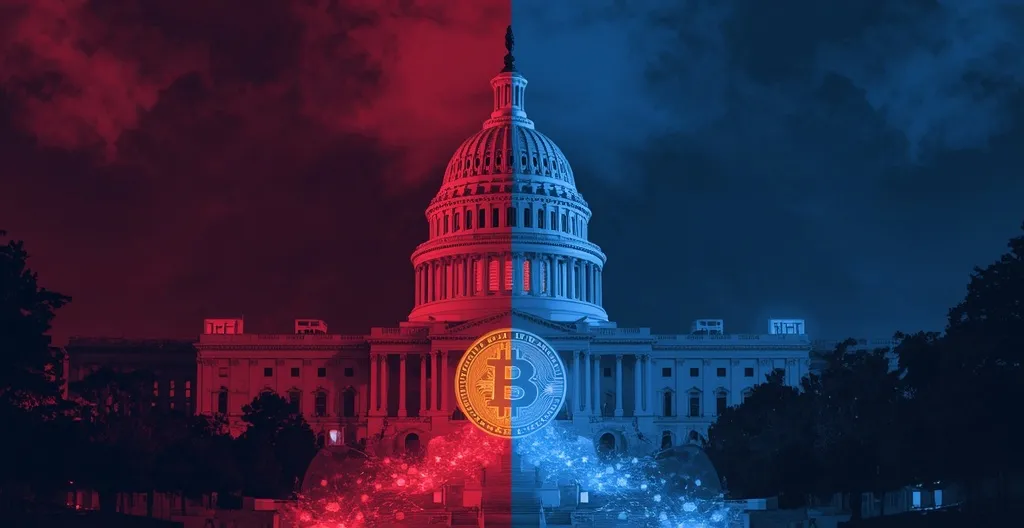
Washington is trying to put crypto market structure into a box, but the exact timing and chamber details are still murky. What is clear is that the CLARITY Act of 2025 is a real push to sort out who regulates what in U.S. crypto before lawmakers vanish for recess.
- Real legislation: The CLARITY Act of 2025 is tied to H.R. 3633
- Core fight: SEC, CFTC, or both?
- Big concept: “Mature blockchain system” rules
- Why it matters: Bitcoin, stablecoins, exchanges, DeFi, and token issuers all feel the heat
The headline urgency around a “5-day” Senate window should be treated carefully. The materials available do not verify that exact deadline, and they do not confirm that the Senate is the chamber poised to act right now. What they do show is a substantive crypto market-structure bill, and one that could matter a lot if Congress decides to stop punting and actually legislate for once.
At its core, the CLARITY Act of 2025 is trying to answer a question that has made the U.S. crypto market miserable for years: when is a token a security, when is it a commodity, and who gets to police the whole mess? According to the legislative text for H.R. 3633 and legal analysis from Arnold & Porter, the bill proposes to divide crypto assets into categories such as digital commodities, investment contract assets, basically tokens still treated under securities-style rules, and permitted payment stablecoins.
That split is the whole game. If a token falls under the SEC, issuers face securities-style disclosure and registration obligations. If it falls under the CFTC, it gets a far more commodity-like framework. Stablecoins would sit in their own lane under banking regulators. That is not just legal housekeeping. It determines whether a project gets a rulebook, a lawsuit, or both.
The bill seems aimed at ending the current “regulation by enforcement” circus. That phrase gets thrown around a lot, but the complaint is real: crypto firms have often been told what they did wrong only after the fact, through enforcement actions rather than clear rules. Regulators argue that ambiguity has also been a playground for fraud. They are not wrong. The current setup has been great for lawyers and even better for scammers. Less so for builders and users.
One of the more important pieces is the idea of a mature blockchain system. In plain English, that seems to be a threshold for deciding when a blockchain network has developed enough to move into a different regulatory bucket. The practical point matters: early-stage networks may face one set of obligations, while a more established system could face another. That is a sensible idea in principle. A tiny, founder-controlled network is not the same thing as a broad, decentralized system with real usage. But Washington has a talent for turning sensible ideas into loopholes with nice branding.
Digital Asset Market Clarity Act of 2025 also refers to post-maturity reporting requirements, which suggests the bill does not simply hand out a free pass once a network is considered mature. It looks like it would still require ongoing disclosure and compliance after that point. That is the right instinct if the goal is clarity rather than a regulatory escape hatch wrapped in patriotic language.
The bill’s mechanics get more concrete from there. The text includes intermediary rules, disqualification provisions, and registration requirements. It also says that certain intermediaries involved in exempt offerings would need to register with the SEC as a broker or dealer and become members of a national securities association. The SEC would also have a rulemaking deadline of 270 days after enactment for certain obligations and disclosures.
That kind of detail is what separates a serious market-structure bill from a press release with buzzwords. If Congress is going to rewrite the rules, it has to say who does what, when they do it, and what happens if they fail. So far, this legislation appears to be trying to do that.
For Bitcoin, the significance is pretty straightforward. Bitcoin’s commodity-like profile fits more naturally in a framework where the CFTC has a clearly defined role. Clearer market-structure rules could mean less legal nonsense around listings, custody, and secondary-market treatment. In other words: fewer headaches for serious businesses and less room for fraudsters to hide behind the fog.
The broader crypto market is a different beast. Ethereum-style networks, DeFi protocols, and token issuers all raise harder questions. Who is the accountable issuer in a decentralized protocol? What happens when a network is still evolving but already has a live market? How do you write rules for open-source systems without either crushing innovation or handing centralized projects a fake decentralization costume? Those are the kinds of questions Congress has to answer if it wants to regulate something real instead of just chasing headlines.
There is a real risk on both sides. A framework that is too generous could let centralized issuers dress up old-fashioned fundraising as “decentralization” and call it a day. A framework that is too rigid could freeze useful experimentation and keep the U.S. stuck in regulatory mud while other jurisdictions move faster. That is the tension here: clarity is good, but sloppy clarity is just a new set of loopholes wearing a suit.
The Senate timing claim should still be viewed with caution. The available research points to H.R. 3633 and the CLARITY Act of 2025, but it does not confirm a verified 5-day deadline or a specific Senate floor schedule. “Pass the bill” can also mean different things in Washington, Senate approval, a Senate amendment, or a longer bicameral negotiation before anything becomes law. In Congress, urgency is often just a fancy way of saying “we ran out of time again.”
Even with that uncertainty, the larger policy picture is unchanged. U.S. crypto market structure is still a mess, and the SEC-CFTC split remains one of the biggest unresolved issues in digital asset policy. That vacuum has fueled confusion, litigation, and expensive compliance theater. It has also left plenty of room for bad actors to pretend the rules are unknowable. That excuse needs to die already.
What makes this bill worth watching is that it is not just another vague “we support innovation” statement. It is a detailed attempt to draw lines. Those lines matter for token launches, exchange listings, stablecoin treatment, DeFi participation, and secondary-market trading. They also matter for investors who are tired of being told to trust the process while the process itself looks like a blindfolded accountant with a dartboard.
Congress Set to Bring CLARITY to Digital Asset Market is still the bottom line: crypto policy is moving from slogans to architecture. Whether Congress builds something workable or just another pile of lawyer bait will say a lot about how seriously Washington takes decentralized technology, and how willing it is to let builders build without a regulatory knife fight every five minutes.
The bottom line is simple: crypto policy is moving from slogans to architecture. Whether Congress builds something workable or just another pile of lawyer bait will say a lot about how seriously Washington takes decentralized technology, and how willing it is to let builders build without a regulatory knife fight every five minutes.
Key questions and takeaways
-
What is the CLARITY Act of 2025?
It is a crypto market-structure bill tied to H.R. 3633 that proposes clearer categories for digital assets and clearer agency roles for the SEC, CFTC, and banking regulators. -
Why does the SEC vs. CFTC split matter?
The agency in charge determines how an asset is issued, traded, disclosed, and enforced against. A clean split could reduce confusion; a bad split could just create new loopholes. -
What is a “mature blockchain system”?
It appears to be a legal threshold for when a blockchain network has developed enough to move into a different regulatory category. That matters because the rules for an early network and a more decentralized, established one should not be identical. -
Is the “5 days” Senate deadline confirmed?
No. The available material does not verify the exact timeline or confirm that the Senate is the chamber immediately acting on the bill. -
Why should Bitcoin users care?
Bitcoin generally fits more comfortably into a commodity-style framework. Clearer rules could mean less regulatory noise, better market infrastructure, and fewer opportunities for scammy nonsense to hide in the fog.
Further reading
A few extra angles on the CLARITY fight, for anyone keeping score in Washington’s latest regulatory knife fight: