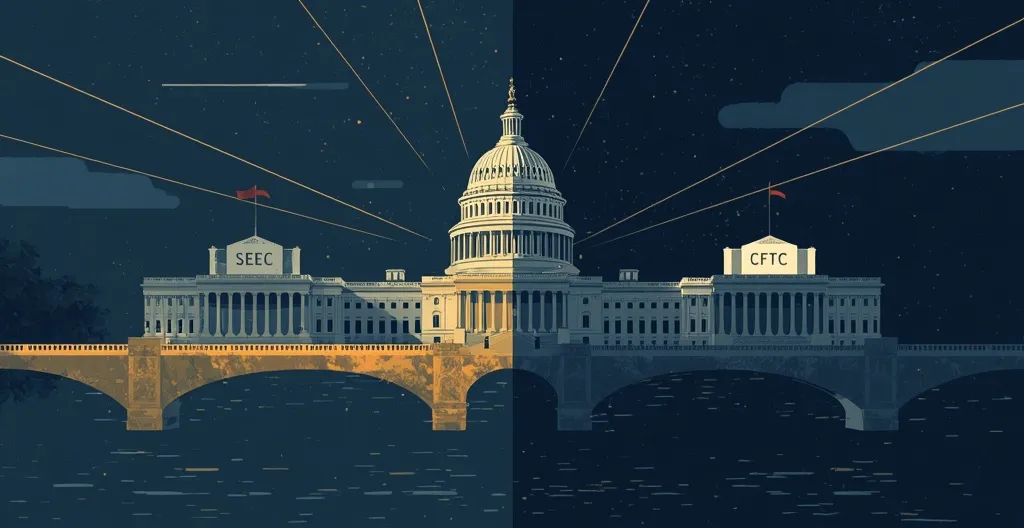
Congress still hasn’t handed crypto a clean U.S. market-structure framework, so the SEC and CFTC are filling the gap with interim relief while CLARITY Act talks revived as SEC, CFTC provide temporary keep limping forward.
- Congress stalled, regulators moved
- SEC issued an innovation exemption
- CFTC filed a no-action letter and sent a new proposal to OMB
- Temporary relief is not the same as real regulatory clarity
That’s the ugly little truth of U.S. crypto policy. When lawmakers can’t finish the job, the agencies start improvising. Useful? Sometimes. Durable? Not even close.
According to the reporting, the SEC has issued an innovation exemption that gives qualifying platforms a five-year path to offer onchain trading of certain tokenized stocks without registering as securities exchanges. At the same time, the CFTC has issued a no-action letter for certain software providers that connect users to regulated derivatives markets, and it has also sent a new proposal to the White House Office of Management and Budget for review.
That OMB step matters. It’s part of the federal rulemaking pipeline, a pre-publication review stage before a proposal can move forward. In plain English, the CFTC is trying to get something through the machinery, but it is not a finished rule yet.
The key point is simple. These are not some grand, unified “crypto clarity” package. They are separate, agency-specific moves meant to create breathing room under existing authority while Congress keeps dragging its feet on a broader market-structure law.
The CLARITY Act is meant to tackle one of the biggest messes in U.S. crypto regulation, who regulates what. The SEC usually approaches digital assets through securities law. The CFTC generally claims jurisdiction over commodities and derivatives. In between sits the industry, trying to figure out whether it’s building a lawful business or a future enforcement headline.
That overlap is why market-structure legislation matters. Exchanges, brokers, token issuers, wallets, and developers all need to know which rules apply before they ship products, raise capital, or list assets. Without that, every new launch is part innovation, part legal hostage negotiation.
The SEC’s move is especially notable because it involves tokenized stocks, traditional equities represented or traded through blockchain-based systems. That does not mean the shares themselves have magically escaped securities law. It means the trading wrapper is changing, while the underlying asset still sits inside the same legal reality as before. Fancy packaging does not erase the rulebook.
The CFTC’s no-action letter is narrower, but it still carries weight. A no-action letter means agency staff will not recommend enforcement action if a party follows specific conditions. It is not a law. It is not a permanent safe harbor. It is more like a temporary “we’re not coming for you if you stay inside these lines” signal.
According to the reporting, the CFTC relief covers certain passive software that lets users view markets and submit orders directly to registered firms, including through crypto wallets. Providers may market specific contracts and receive transaction-based fees, but they cannot hold customer assets, generate buy or sell signals, or control order routing and execution.
That distinction matters. The CFTC is not giving blanket permission to build whatever you want and call it innovation. It is drawing narrow lines around software that connects users to regulated markets, while keeping actual custody, execution, and investment advice off the table. Translation: build the plumbing, not the casino boss role.
The agency also appears keen to show it is not asleep at the wheel. CoinDesk reported that CFTC chair Mike Selig posted on X:
“The CFTC is locked in and ready to ship its rules for the new frontier of finance”
That’s a confident line, maybe even a little too polished, but the message is clear: the CFTC wants to be seen as active, not reactive. Whether it can actually deliver a durable framework is another matter entirely.
And that’s the real problem here. Temporary guidance can help firms keep building. It can reduce immediate legal friction. It can even open a path for new products. But it does not settle the jurisdiction fight between the SEC and CFTC, and it does not replace legislation that clearly defines the market structure.
So yes, this is progress. But it is the bureaucratic kind, the sort that comes with footnotes, conditions, and a short shelf life. Useful for builders? Absolutely. A substitute for actual law? Not a chance.
The broader lesson is unchanged: crypto does not need more vague promises or enforcement-by-surprise. It needs rules that are clear enough to build on, strict enough to shut down fraud, and stable enough that companies do not need a lawyer on retainer just to launch a product. Temporary relief can keep the lights on. It cannot build the house.
For more context on how Washington has been handling the split between agencies, see CLARITY Act Stalls as SEC and CFTC Fill the U.S. Crypto. Earlier efforts to define oversight boundaries also mattered, including the Senate Banking Committee Advances CLARITY Act to Split and the US House Passes CLARITY Act to Split Crypto Oversight.
The SEC has also laid out its own framing in Statement on the Innovation Exemption: A Bridge Toward. Different agency, different vocabulary, same old American hobby: regulating first and clarifying later.
Key questions and takeaways
-
Is the CLARITY Act actually moving forward?
Not in any clean or finished sense. The more accurate picture is that Congress has not passed a market-structure framework, while regulators are moving ahead with interim steps. -
Did the SEC and CFTC issue the same kind of guidance?
No. The SEC issued an innovation exemption, while the CFTC issued a no-action letter and sent a new proposal to OMB. Those are very different legal tools. -
Does this mean U.S. crypto regulation is finally clear?
No. This is temporary relief, not a durable rulebook. The core jurisdiction fight is still alive and well. -
Why does the CFTC no-action letter matter?
It gives some firms short-term comfort that staff won’t recommend enforcement if they stay within strict conditions. That can help products launch or keep running, but it does not create permanent certainty. -
What does the SEC tokenized stock exemption actually mean?
It gives qualifying platforms a path to offer onchain trading of certain tokenized stocks without registering as securities exchanges for five years. It changes the trading wrapper, not the basic legal status of the underlying equity. -
What’s the big picture for crypto builders?
The U.S. is still trying to regulate a new financial system with split authority and patchwork tools. That creates friction, but it also shows the sector is too important to ignore or bury under pure enforcement.