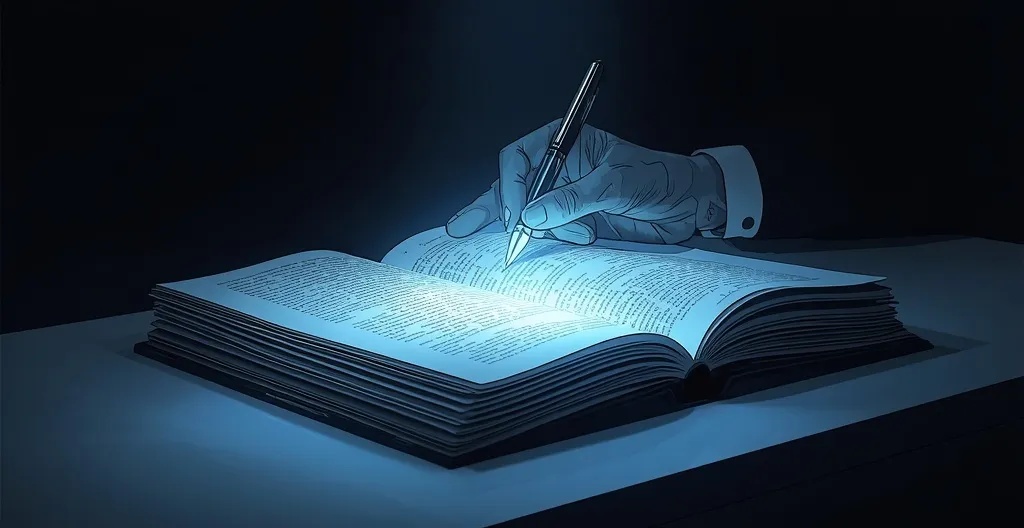
Artprice’s AI-Written Book Puts Human Responsibility on the Page
Thierry Ehrmann says he supplied the ideas and dialogue for a new book, while AI wrote the prose. The formula is clear. The details of how the book was made are not.
- Declared method: “Human Thought & Dialogue: thierry | Writing: 100% AI.”
- Human role: Ehrmann says he directed the work and accepts responsibility for its meaning.
- Open questions: The company’s announcement does not verify the writing model, the extent of editing or the reported download count.
Artmarket.com, the company behind Artprice, announced the French publication of Dialogue Between a Thinker and AI in a Paris press release dated October 16, 2026. The company says the dialogue first took shape in French. An English version had already circulated internationally as a “Raw Typescript, ” the project’s term for a complete text presented without conventional publishing polish.
Ehrmann says the experiment began in July 2026 and involved 40 days and nights of voice-only exchanges with AI. The release describes the dialogue as lasting more than 450 hours, but does not say whether that means recorded exchanges, total session time or something else. It also does not explain how the conversations were transcribed or how much Ehrmann edited the prose.
The announced print edition is approximately 1, 800 pages, according to the release. A Gemini assessment quoted by the company calls the work a 1, 518-page “codex.” The figures may refer to different versions or layouts, but the release does not clarify the difference.
What does “100% AI” mean?
Ehrmann describes the division of labor as “Human Thought & Dialogue: thierry | Writing: 100% AI.” In the preamble, titled “The Entrusted Pen” and identified as pages 19-26, he says he explains what he supplied, directed, corrected and rejected. The release identifies quotations and archival material as exceptions to the formula.
This is Ehrmann’s account of the process, not an independently verified description of every stage. The announcement does not name the system that generated the prose, list Ehrmann’s interventions or say how much editing the text received. Those details matter. AI-generated text that has been extensively rewritten involves a different process from prose that has only been lightly corrected.
“Writing is not merely holding a pen. It is answering for meaning. And I answer for the meaning of these pages.”
Ehrmann argues that authorship rests not only on producing sentences but also on originating ideas, directing their development, making choices and accepting responsibility for the result. He calls this cosa mentale, Italian for “a thing of the mind, ” and invokes conceptual artist Sol LeWitt’s 1967 line: “The idea becomes a machine that makes the art.”
The comparison offers one way to think about creative direction, but it does not settle whether prompting and selecting AI-generated prose count as authorship in every artistic or legal context. Ehrmann is making a philosophical claim about his work, not citing a legal ruling.
“AI frees me from the tedious mechanics of execution so that I can focus on what fundamentally matters to me: the concept.”
AI suspicion is not proof
Artmarket presents the book against a backdrop of disputes over AI use in literature. Its release says suspicion grew in France after Thélyson Orélien’s C’était ça ou mourir was removed from the Prix Goncourt selection. It separates the disputed suspicions of AI use from separate revelations about earlier plagiarism. Those are different allegations and should not be conflated.
Another case involves Simbarashe Steyn Kundizeza, who won the Caine Prize for African Writing on October 6 for “The Blue Fighter.” According to the release, Kundizeza denies using generative AI, and the prize opened an investigation without withdrawing the award. On October 14, James Folta discussed parallels between the Orélien and Caine Prize controversies in Literary Hub.
These cases show why suspicion needs to be separated from evidence. AI use alone does not prove plagiarism. Plagiarism concerns whether material was improperly copied or presented as original. An AI detector’s result also does not establish who wrote a passage.
The release refers to Stanford research on false positives involving essays written in English by non-native speakers, but does not identify the study or provide its methods, date or error rates. Without those details, readers cannot assess the specific claim from the information in the announcement. Detection scores should not be treated as verdicts.
Artmarket also describes several institutional responses. It says Canada’s Writers’ Trust and Giller Foundation have adopted restrictions on AI-generated texts, the U.S. Authors Guild has launched a “Human Authored” certification that allows certain minimal uses, and French philosopher Gaspard Koenig has advocated a “Livre sanctuaire, 100 % humain” label. The approaches differ, but the release does not provide enough detail for a close comparison of their rules.
Labels can help readers understand how a work was made, but only if they explain what AI actually did. A useful disclosure distinguishes, for example, between research assistance, suggested edits and generated passages. Ehrmann’s formula makes a bold claim about the writing. The missing production details make it harder for readers to assess that claim.
What nine AI systems said
Ehrmann submitted the work to nine systems for literary analysis: ChatGPT, Gemini, Grok, DeepSeek, Perplexity, Mistral, Qwen, Microsoft Copilot and a Meta model. The company calls the responses a “meta-reading, ” a collection of AI-generated interpretations of the book.
One Gemini assessment quoted in the release calls the work “a major anthropological and epistemological rupture in the history of contemporary textual thought.” That is a model-generated assessment, not an endorsement by Google. Artmarket also says the analyses should not be read as endorsements by the companies behind the systems.
The responses may offer perspectives on a very long text, but they do not independently establish its literary merit or how it was produced. The release does not explain how the systems were prompted or how their responses were selected and edited before publication.
Free access, a restricted license and a large download claim
Artmarket says the French and English versions, including a complete PDF, are available free under the Creative Commons Attribution-NonCommercial-NoDerivatives 4.0 International license. In general, the license permits noncommercial sharing of unmodified copies with attribution, subject to its terms. It does not grant blanket permission to publish translations or adaptations. The release says those require separate authorization unless an applicable legal exception applies.
The company reports 27.9 million downloads as of October 15, 2026, across 123 countries and 12 languages. It attributes the preliminary figures to Artprice and distribution partners, including PR Newswire/Cision. The release does not explain how downloads were counted or provide independent verification. The number should be understood as a company-reported figure, not a confirmed count of individual readers.
Questions readers are likely to ask
-
Who wrote Dialogue Between a Thinker and AI?
Ehrmann says he supplied the thought and dialogue while AI generated the writing, with quotations and archival material as stated exceptions. The release does not identify the writing model or fully detail the editing process.
-
Does AI use prove plagiarism?
No. AI use alone does not prove that material was improperly copied or presented as original, and a detector result does not establish who wrote a passage.
-
How long is the book?
Artmarket describes an approximately 1, 800-page print edition, while a Gemini assessment quoted by the company calls it 1, 518 pages. The release does not explain whether those figures refer to different versions or layouts.
-
Are the 27.9 million downloads independently verified?
Not in the release. Artmarket calls the figure preliminary and provides neither a counting method nor independent verification.
-
Does Ehrmann’s account settle legal authorship?
No. It sets out his view of human responsibility for the work, but the release reports no legal ruling on the book’s authorship or copyright status.
Ehrmann’s experiment does not settle who qualifies as an author when AI supplies the prose. It does raise a useful question: what does a human author contribute beyond the initial idea? His answer, direction, selection and responsibility, deserves consideration alongside the unresolved details of how those decisions shaped the text.
AI can make text cheaper and faster to produce. It cannot make responsibility disappear. As more of the writing process becomes automated, readers need precise, verifiable accounts of who did what. Artprice’s 2025 report also examines the company’s wider art-market context.