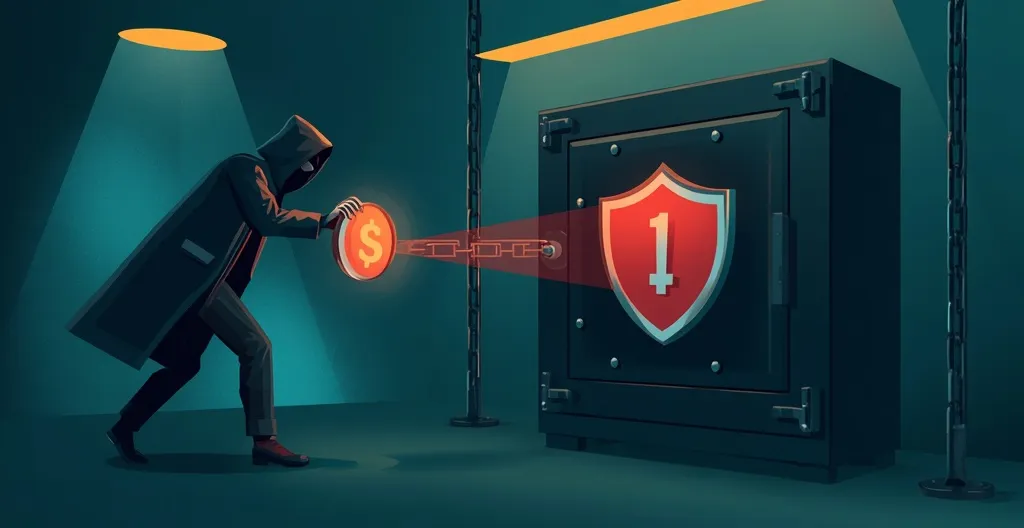
Binance says it detected a malicious DAO governance proposal in time to stop roughly $1.2 million in tokens from being exposed, but the claim rests almost entirely on Binance’s own account, with no independent on-chain evidence provided so far.
- Binance’s claim centers on a blocked governance attack
- No funds were reportedly lost, and the proposal was rejected
- The real weakness is DAO governance itself, not just code
According to Binance, its security team identified a malicious decentralized autonomous organization, or DAO, governance proposal on Aug. 18 that could have exposed about $1.2 million in tokens from an unnamed treasury. The exchange says it coordinated with the project and other centralized exchanges to close deposits for the affected token, and the project’s community voted the proposal down before execution.
That sounds neat. Too neat, if you care about verification.
The biggest credibility issue here is simple: Binance has not publicly identified the DAO, the token, the governance platform, the proposal ID, the contract address, or the relevant transactions. So while the reported attack is plausible and fits a very real pattern in crypto, outside observers cannot independently check the details from the information disclosed so far.
Binance said it detected the proposal with less than 48 hours remaining before execution. Jimmy Su, Binance’s chief security officer, said the threat was something that “no external security provider had flagged.”
That may be true. It may also be self-congratulatory marketing. In crypto, those two things often arrive in the same trench coat.
A DAO is supposed to be a token-governed project where members vote on treasury spending, upgrades, and other key decisions. In theory, that’s decentralization at work. In practice, it can become a soft target if proposal thresholds are low, quorum is weak, voting power is concentrated, or participation is thin.
That matters because an attacker does not always need to break the code. Sometimes they just need to use the rules against the project.
A governance proposal is a formal on-chain request that token holders or delegates vote on. The on-chain governance mechanism is the voting and execution system built into the protocol itself. If that system is poorly designed, a malicious proposal can act like a backdoor with a nicer user interface.
Binance said the attacker tried to exploit a weakness in the project’s on-chain governance mechanism. The company also suggested the proposal threshold was low enough to bypass intended protocol requirements. That is the heart of the problem: if creating a proposal is too easy, the treasury can be exposed by governance theater rather than technical brute force.
The deposit closures Binance coordinated with other centralized exchanges are best understood as containment, not a fix. Closing deposits does not stop a proposal from passing or failing on-chain. What it can do is make it harder for an attacker to move compromised tokens through centralized venues afterward, whether to sell, convert, or launder them. Useful? Yes. A cure? Not even close.
The project’s community ultimately rejected the proposal before it executed, and Binance said no funds were lost. That distinction matters. This was a blocked governance attack, not a confirmed theft. Crypto already has enough bad habits without turning “could have been stolen” into “was stolen.”
It also helps to be precise about the reported $1.2 million figure. Binance presented that number as an estimate of what could have been exposed, not as independently verified loss. Without public identifiers or transaction data, that estimate should be treated as Binance’s claim, not a settled fact.
The broader lesson is that DAO governance attacks are not some theoretical corner case. They are a known class of exploit. Attackers can accumulate voting power, borrow influence, buy support, or hide malicious intent inside proposals that look normal until the trap snaps shut.
That risk grows when the basics are sloppy:
Low proposal thresholds make malicious submissions easier.
Weak quorum rules let too few voters decide major outcomes.
Poor turnout leaves governance open to capture.
Concentrated delegates can make “community control” look a lot like a private club with a treasury.
This is also where the decentralization hype gets mugged by reality. Emergency authority can stop damage fast, but it also weakens the pure decentralization story. Centralized override is the seatbelt. Sometimes it saves the car. Sometimes it reminds everyone that the car was never fully autonomous to begin with.
Binance’s warning lands in a broader context of governance abuse across crypto. The notes tied this case to a prior attack on BonkDAO Faces $20M Governance Attack, Threatens Legal Action, where attackers allegedly drained about $20 million through a malicious proposal in July. That was a much more severe outcome, but the mechanism is the same: if voting systems are flimsy, a treasury can be turned inside out without touching the contract code in the classic “hack the smart contract” sense.
The notes also reference concerns about purchased voting power affecting DAO decisions on Arbitrum. That is another reminder that governance can be gamed when votes are cheap, turnout is weak, or power is overly concentrated. A DAO can look decentralized on the surface and still be vulnerable to the oldest trick in finance: buy influence, then take the money.
Binance’s account should be read with that skepticism in mind. The exchange says its team spotted a threat that others missed, coordinated with other centralized exchanges, and helped prevent the proposal from going through. That may all be true. But without the missing identifiers, the case remains difficult to audit from the outside.
That is the part worth sitting with. In crypto, the marketing phrase is often “decentralized governance.” The operational reality can be a lot less romantic: weak rules, sleepy voters, concentrated delegates, and an attacker looking for one bad threshold to exploit.
If Binance’s account is accurate, the response worked. If not, the deeper warning still stands. DAO security is not just about bug bounties and fancy monitoring. It is about governance design, execution delays, quorum, proposal thresholds, and whether a treasury is protected by serious rules or by vibes and hope.
For projects trying to avoid the same headache, there is no magic spell. Research such as Secure Governance Framework for Cross-Chain DAOs points to a simple truth: governance needs defensive design, not just optimistic branding. Treasury operations also need real process, which is why resources like DAO Treasury Management: Onchain Governance & Spend matter more than most moonboys would like to admit.
And yes, this isn’t some new problem that emerged last week. The original The DAO fiasco showed years ago that governance and smart contracts are only as strong as the people and rules behind them. The tech can be elegant; the politics can still be a clown car.
On Binance’s own side, the exchange has published its security account in a separate post, How Binance Security Prevented a $1.2M Governance Attack, while the news coverage version is also available as Binance Prevents $1.2M DAO Governance Attack. For readers tracking the broader market context, the site has also covered Bitcoin Tests $62K Support as Miner Deposits to Binance Spike to Four-Month High and the separate signal piece, Rare Binance Flow Signal Flashes as Bitcoin Struggles Below, both of which show how exchange flows and risk sentiment keep colliding with the same old market nerves.
Binance’s warning also comes as policymakers keep poking at the industry. In India, lawmakers have opened formal discussions around crypto rules in a development covered in India Parliament Opens Formal Crypto Regulation Talks with. That matters because governance failures, treasury attacks, and exchange coordination are exactly the kind of mess that gives regulators extra ammo. Fair criticism? Sometimes. Handing them a stick? Also yes.
Ultimately, the useful takeaway here is not “Binance saved the day, ” though maybe it did. The useful takeaway is that DAO governance remains a soft underbelly in crypto, and the industry still treats it like a side quest. It is not. If decentralized systems are going to hold real value, governance has to be hardened like infrastructure, not marketed like a community newsletter with a token attached.
Key questions and takeaways
-
Was the DAO treasury actually drained?
No. Binance says the proposal was rejected before execution, and no funds were lost. -
How much was at risk?
Binance estimated that about $1.2 million in tokens could have been exposed. -
What made the attack possible?
Binance says the attacker tried to exploit a weakness in the project’s on-chain governance system, but it did not disclose the exact flaw. -
Did exchanges stop the proposal?
Not directly. Binance says it coordinated with other centralized exchanges to close deposits and reduce exit routes if the proposal had succeeded. -
Why does this matter beyond one DAO?
Because governance attacks are a real crypto risk. A project can be attacked through voting rules and treasury controls, even if the underlying code is not “hacked” in the usual sense. -
Can this be independently verified right now?
Not fully. Binance did not disclose the DAO name, token, proposal ID, or on-chain transaction data, so outside verification is limited.