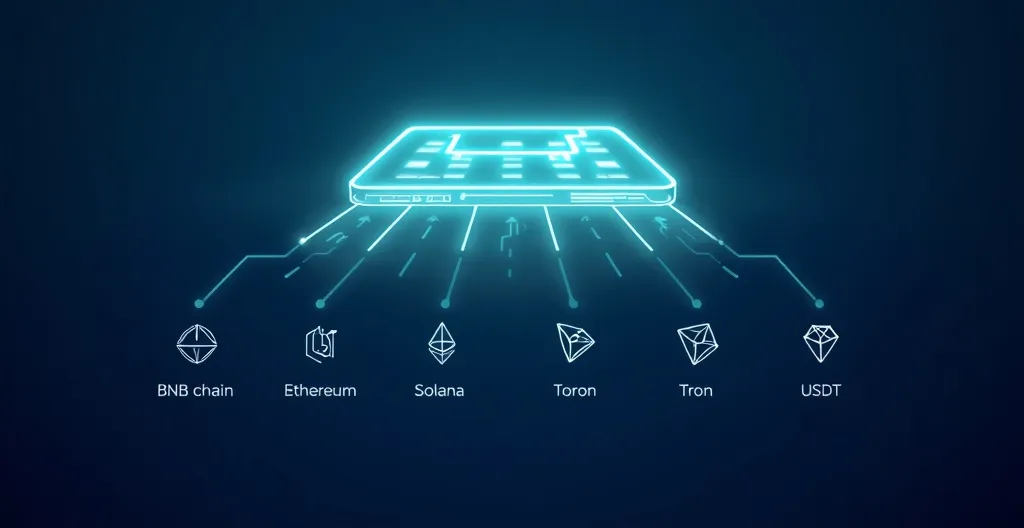
Binance Wallet now lets users pay gas fees in USDT on four major networks: BNB Smart Chain, Ethereum, Solana, and TRON. It’s a practical fix for one of crypto’s most annoying little traps, having the asset you want to move, but not the native token needed to move it.
- USDT gas payments are now supported on BNB Smart Chain, Ethereum, Solana, and TRON
- Network fees still exist and still go to validators or network participants, not Binance
- TRON promotion offers zero gas fees for eligible USDT and TRC-20 transfers through Dec. 22, 2026
- Wrong network selection can make assets unrecoverable
Binance Wallet added the new payment option on Sept. 25, giving users a way to cover transaction costs in USDT instead of scrambling for the chain’s native coin. That means no more hunting for BNB on BNB Smart Chain, ETH on Ethereum, SOL on Solana, or TRX on TRON just to get a transfer through. On the TRON side, the move lands on a network that already has a huge reputation for stablecoin movement, as seen in Tron Surges to Second in USDT Supply: Stablecoin Dominance.
For everyday users, that is a real usability upgrade. For crypto purists, it is a reminder that convenience and decentralization are not the same thing. Binance has not made gas disappear. It has simply made the checkout process less annoying.
Gas fees are the cost of getting a blockchain transaction processed. Normally, those fees are paid in the chain’s native token. Binance Wallet’s update changes the payment method inside the wallet interface, but not the underlying blockchain mechanics. Binance says the wallet calculates fees based on current blockchain conditions, and that “none of the network fee goes to Binance.” The fee still goes to validators or other network participants who keep the network running. For a deeper look at how TRON’s transaction model differs, see TRON.
That distinction matters. A lot of crypto hype depends on people pretending a smoother user experience means the network cost vanished. It didn’t. This is fee abstraction, not magic.
The practical benefit is easy to grasp. If you receive USDT on-chain and want to move it, you no longer need to keep tiny scraps of the right gas token around just to complete the transfer. That’s especially useful for newcomers, who often run straight into the old crypto classic: I have funds, but I still can’t send them. Nothing like a blockchain to make access to money feel like an escape room.
Binance says more networks will be added later, but it has not given a rollout timetable. For now, the supported chains are BNB Smart Chain, Ethereum, Solana, and TRON.
There is also a separate BNB payment path. Binance says users can pay gas with BNB from their Spot or Funding Account on BNB Smart Chain, Ethereum, and opBNB, as long as they have more than 0.01 BNB in the relevant account. In addition, eligible Binance Exchange balances can be used for gas with supported assets including BNB, USDT, USDC, ETH, and SOL, drawn from Spot, Funding, or Earn balances where available. Binance has also been pushing more wallet utility through product experiments like Binance Wallet adds USDT gas fees on 4 networks and Binance Wallet Enables PancakeSwap Pre-Access for Pre-IPO, showing the company is clearly trying to make its wallet a one-stop shop instead of a dusty keyring app.
That flexibility is useful, but it does not remove the usual danger zone. Binance warns that choosing an incompatible network when moving assets can make them unrecoverable. That is not a tiny edge case. It is one of the most expensive mistakes in crypto, and the chain will not care that you clicked the wrong dropdown.
TRON gets its own separate treatment in Binance’s support materials for a reason. TRON uses a different resource model involving bandwidth and energy, rather than the more familiar Ethereum-style gas setup. In plain English, that means transaction costs and processing resources work a bit differently there, which is why the network’s fee logic is not simply copied and pasted from the others. On the utility side, TRON has also been tied to real-world payments work, including Kolo and TRON Team Up for Lightning-Fast USDT Crypto Card, which is the sort of boring-but-useful integration that actually matters to regular users.
There is also a promotional side to the TRON rollout. Binance says a separate campaign began on Sept. 23, offering zero gas fees for eligible transfers of USDT and other TRC-20 tokens through Dec. 22, 2026. The promotion is supported by TRON DAO and is subject to available campaign spots. For more on the ecosystem behind that support, see JUST DAO's Profile.
After the promotional period ends, qualifying transfers are expected to receive a discounted fee of 1 USDT per transaction. That is not “free forever, ” despite what a marketing department might wish people to infer. It is a limited campaign, with terms, eligibility rules, and a finish line.
The bigger picture is straightforward. Binance Wallet is trying to remove friction from on-chain activity without pretending the network cost itself has vanished. That is a sensible product move. Crypto adoption does not need more slogans. It needs fewer stupid obstacles. The same no-nonsense logic applies when platforms start making climate or infrastructure claims, which is why users should read supporting material carefully, including Binance’s own Understanding the Impact of Climate Change on Global resources where relevant. Context matters, even when the headline is shiny.
Binance Wallet is described in its documentation as a self-custody product provided by Binance Barbados Limited. Binance also says wallet services are not supervised by the Financial Services Regulatory Authority or another regulatory authority. That is worth reading carefully. Self-custody means users control their own assets, but it does not mean the surrounding platform is some magical lawless zone where corporate structure and product risk no longer matter.
Binance has been actively expanding the wallet’s role beyond simple storage. The broader pattern is clear: the company wants Binance Wallet to be a place where users can do more of their on-chain activity without constantly bouncing between tools. That may be convenient, but it also concentrates more of the user experience inside Binance’s own product layer.
That tradeoff is the real story here. Paying gas in USDT is a win for usability and a modest win for adoption. It lowers one of the more irritating barriers to moving stablecoins and other assets around. But it does not change the basic truth of blockchains: fees still exist, the network still needs to be paid, and the wrong-network mistake is still very much alive and well. TRON’s sheer throughput is part of why this debate keeps coming up, especially after milestones like TRON Hits $7.9 Trillion in USDT Transfers in 2025.
Key takeaways
-
Why does paying gas in USDT matter?
It removes the need to hold each chain’s native token just to make a transfer. That makes wallet use easier for newcomers and for anyone moving stablecoins. -
Does this mean blockchain transactions are free now?
No. The network fee still exists. Binance says it goes to validators or other network participants, not to Binance itself. -
Which networks support USDT gas payments?
BNB Smart Chain, Ethereum, Solana, and TRON. -
Is there a TRON promotion?
Yes. Eligible USDT and TRC-20 transfers can have zero gas fees through Dec. 22, 2026, with support from TRON DAO and subject to campaign availability. -
What is the biggest risk users still need to watch?
Picking the wrong network. Binance warns that an incompatible network can make assets unrecoverable, and that warning should not be treated like fine print. -
Who benefits most from this feature?
Stablecoin users, newcomers, and anyone who regularly ends up short on native gas tokens. In other words, a lot of people who would rather move money than play token scavenger hunt.
Binance Wallet’s USDT gas-fee option is not a revolution, but it is useful. In crypto, useful beats loud every time. The industry loves grand narratives; users usually just want the transaction to go through without a headache.