
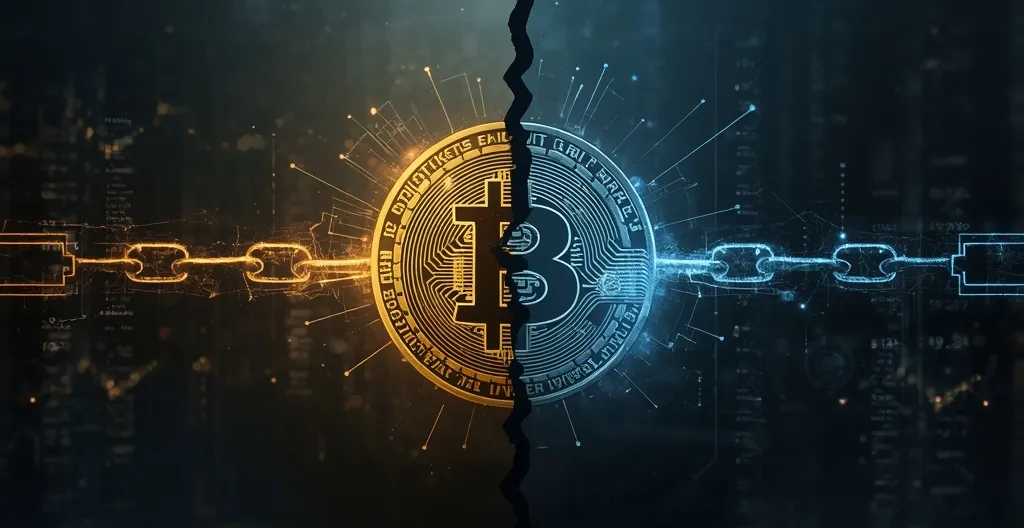
Bitcoin developers aligned with BIP-110 are preparing a separate BLAKE2b proof-of-work chain for a planned Sept. 1 launch, but the path is still conditional and the payoff is far from guaranteed.
- Sept. 1 target: a proposed BLAKE2b chain tied to BIP-110 supporters
- Earlier SHA-256 branch stalled: too little mining support to keep it alive
- No broad infrastructure backing: exchanges, wallets, and Lightning support are still missing
- Replay risk remains: users could be exposed if protections are weak or absent
- BTC itself is unchanged: the impact depends on whether the breakaway network gets real traction
This is not Bitcoin “activating” a neat little upgrade. It is a separate hard fork attempt with a different proof-of-work system, a different chain, and potentially a different asset if it actually survives. The distinction matters. Bitcoin’s main chain still runs on SHA-256d, the double-SHA-256 mining algorithm used today. The proposed network would use BLAKE2b instead, which is a very different animal. See the Bitcoin BLAKE2b fork faces Sept. 1 launch test for the broader launch context.
That means existing Bitcoin mining rigs do not simply flip a switch and start producing blocks on the new chain. Proof-of-work is the security layer of a blockchain. Miners spend computing power to earn the right to add blocks. Change the algorithm, and you change the hardware economics with it.
What BIP-110 was trying to change
BIP-110 was originally framed as a temporary soft fork aimed at restricting certain kinds of arbitrary data in Bitcoin transactions. In plain language, it was an effort to limit Bitcoin’s use as a storage layer for nonfinancial data.
The proposal included limits on large OP_RETURN outputs, certain script formats, and contiguous arbitrary data above 256 bytes. OP_RETURN is a Bitcoin opcode commonly used to attach extra data to a transaction. Supporters argued those limits would reduce storage demands on node operators and preserve Bitcoin’s money-first role.
Critics saw it differently. They argued that transaction fees and node policy, not hard-coded restrictions, should decide how block space gets used. That is a familiar Bitcoin fault line. One side sees defensive protocol design. The other sees overreach dressed up as stewardship. Bitcoin BIP-110 Debate: Saylor Warns of Protocol Risks Amid showed how deep that split runs, while Adam Back Warns BIP-110 Could Split Bitcoin Into a Minority captured the risk of a minority fork becoming the loudest kind of irrelevance.
There is a real argument here. Bitcoin is money, not a public trash can for every random data scheme people can dream up. But once a proposal starts deciding which uses are acceptable and which ones get shut out, the line between protecting the network and policing behavior gets thin very quickly.
Why the BLAKE2b plan exists
The BLAKE2b plan is what happens when a branch cannot carry enough hashpower on Bitcoin’s existing SHA-256 base. Crypto.news previously reported that BIP-110 entered its mandatory phase with only 2.53% miner support, and the enforcing branch that separated from Bitcoin’s dominant chain in August initially produced only two blocks.
That is not a strong launch pad. It is a warning flare.
With the SHA-256 route failing to attract enough miners, the project moved toward a separate BLAKE2b proof-of-work chain scheduled for a potential Sept. 1 launch. Some hardware built for Sia’s version of BLAKE2b may be compatible, but standard Bitcoin mining equipment cannot automatically redirect to the new algorithm. In proof-of-work, hashpower is the oxygen. Without it, a chain is just code with aspirations.
Developers said a successful test could be preserved in a Bitcoin Knots 29.4.1 release on Sept. 1. If technical problems show up, they may need another release candidate and a reset to the last SHA-256 block. That is a pretty clear sign this is still being stitched together rather than rolled out with confidence. Even Bitcoin Dev Martin Habovštiak Mocks BIP-110 with 66-KB had the kind of gallows humor that only a messy fork can inspire.
The final mainnet activation height had not been settled before the rehearsal. That means the block height at which the live network would switch over was still unresolved, which is not exactly the kind of detail you want floating around a protocol launch.
The support problem nobody can hand-wave away
No major exchange, mainstream wallet, or Lightning implementation had publicly committed to supporting the BLAKE2b chain before the proposed launch. That matters more than fork fans like to admit.
A chain can exist on paper and still be unusable in practice. If users cannot easily store it, send it, trade it, or route payments through it, then its real-world relevance is going to be thin. Forks live or die on infrastructure support, not on slogans.
The source also notes that existing light clients and indexers may not automatically recognize the new chain. Light clients are simplified wallets that rely on external data rather than downloading and verifying the entire blockchain. Indexers organize blockchain data for applications and services. If they do not know how to follow the fork, users and apps will be stuck waiting for software updates.
There is also the question of replay protection. If transactions remain valid on both chains, a transaction broadcast on one network could be copied onto the other. That can create accidental double-spends, confusion, and very expensive mistakes. Forks without replay protection have a way of turning ordinary wallet use into a bad day.
The Aug. 31 dispute added noise, not clarity
The proposed chain became the subject of a dispute on Aug. 31 between BIP-110 supporter Loogart and David Schwartz, the Ripple co-founder and former chief technology officer. Schwartz has no technical role in BIP-110, Ripple’s XRP Ledger, or the proposed chain itself. He was reacting to the framing of the discussion.
“Listen to yourself, ”
Schwartz also argued that the language being used pushed the conversation away from a good-faith disagreement and toward a caricature of one side as broken. That point is hard to dismiss entirely. Crypto debates have a habit of turning protocol disagreements into identity fights, which is a great way to generate heat and very little light.
Still, the real issue is not who won the argument on social media. It is whether the proposed network can actually launch in a stable way and attract enough miners and infrastructure to matter.
What this means for BTC holders
Bitcoin holders do not automatically get a new and improved BTC balance from this. BTC itself is not changing just because a breakaway chain is being tested. The dominant Bitcoin network remains on its existing rules unless the broader ecosystem chooses otherwise, and that is not what is happening here.
If the new BLAKE2b network launches, it would be a separate chain with its own rules and likely its own market dynamics. Whether that asset has value depends on whether miners, developers, exchanges, wallets, and users decide it deserves one. That is the part fork promoters always seem to discover after the loud part is over.
There is a broader philosophical point too. The BIP-110 fight reflects a genuine disagreement over how Bitcoin should treat nonfinancial data. Should the protocol impose hard limits to preserve storage efficiency and monetary focus? Or should block space usage be left to fees, policies, and market demand?
Bitcoin has room for hard questions like that. What it does not have is room for pretending a minority fork with thin support and no clear infrastructure backing is already some kind of triumph. It is a proposal under pressure, not a settled outcome.
Key questions and takeaways
-
Is BIP-110 activating on Bitcoin?
No. The BLAKE2b plan is a separate hard fork attempt, not a simple rule change on Bitcoin’s existing SHA-256d chain. -
Why does the mining algorithm matter?
Proof-of-work security depends on hashpower. Bitcoin mining hardware cannot automatically mine a BLAKE2b chain, so the network needs compatible miners to survive. -
Does the new chain have broad support?
Not publicly, at least not yet. No major exchange, mainstream wallet, or Lightning implementation had committed before the proposed launch. -
What is the main user risk?
Replay issues. If replay protection is weak or missing, a transaction on one chain may also be valid on the other, creating confusion and possible losses. -
Will Bitcoin holders automatically get something new?
Not on BTC itself. If the breakaway chain launches and gains value, it would be a separate asset, and any claim to it would depend on the rules of that new network. -
What decides whether this matters?
Miner support, infrastructure support, and actual usage. Without those, the fork is just a technical split looking for a reason to matter.
The next test is not whether the code can be argued over or ceremonially scheduled. It is whether people are willing to run it, mine it, list it, and use it. In crypto, that verdict is usually blunt.


