
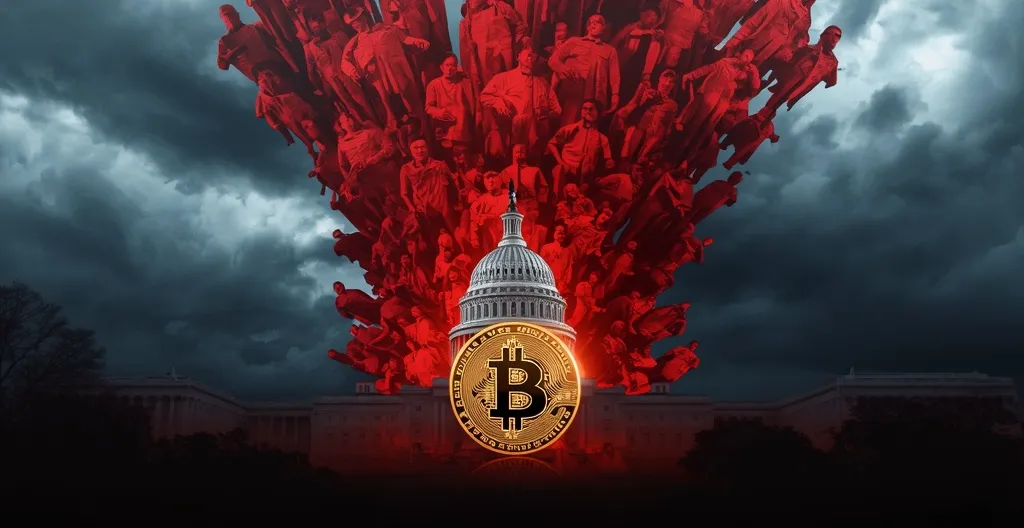
America’s federal debt has crossed $40 trillion, and Bitcoin bulls are treating that as more than a depressing headline. BlackRock’s Robbie Mitchnick says the swelling deficit load is strengthening Bitcoins bull case grows as U.S. debt tops $40T as investors look for assets outside the sovereign money system.
- Debt stress: Mitchnick says rising U.S. borrowing supports Bitcoin and gold.
- Bitcoin’s move: The asset logged its biggest three-day rally since 2023.
- Regulation split: The CLARITY Act matters more for broader crypto than for Bitcoin.
- Big caveat: Fiscal anxiety can shape the narrative, but it does not prove what caused the move.
According to the U.S. Treasury Department’s dataset, gross federal debt reached about $40.05 trillion on Aug. 18. Gross debt includes both debt held by the public and intragovernmental holdings, in this case roughly $32.3 trillion held by the public and about $7.8 trillion held within government accounts. For a plain-language breakdown, see Understanding the National Debt.
That is a hefty bill for a country already spending a growing chunk of its revenue just servicing old borrowing. U.S. debt has more than doubled since 2017, when it stood near $19.95 trillion. The Congressional Budget Office projects a $1.9 trillion federal deficit for fiscal 2026, and under current law that annual shortfall could widen to $3.1 trillion by 2036, equal to 6.7% of GDP. Net interest spending reached about $970 billion during fiscal 2025, according to the government’s financial report.
Mitchnick, BlackRock’s global head of digital assets, said in an Aug. 26 interview that “Debt and deficit levels are a major concern for markets.” His view is simple: if investors start worrying more about government borrowing and the long-term purchasing power of fiat currency, they may look harder at scarce assets such as Bitcoin and gold.
That is not some basement-dweller prophecy wrapped in laser eyes. It is a mainstream macro argument with a Bitcoin angle.
The timing explains why it is getting attention. Bitcoin posted its strongest three-day advance since 2023 during the previous week, rising from the low-$60, 000 range to nearly $80, 000 before giving back part of those gains. It remained below $80, 000 after the rebound, according to CNBC’s reporting. The broader Bitcoin's Role as a Hedge Against U.S. Fiscal Concerns narrative is getting louder, whether the market fully deserves the credit or not.
That kind of move invites people to force a neat explanation onto a messy market. Fiscal fear may have helped reinforce the bullish narrative, but it is a stretch to say debt data directly caused the rally. Bitcoin price action is usually driven by a cocktail of factors: ETF flows, positioning, liquidity, risk appetite, and the occasional collective market mood swing that makes everyone pretend they saw it coming. Even the market chatter tying the move to Bitcoin's Recent Rally Linked to the $40 Trillion U.S. Debt should be handled with a healthy dose of skepticism.
Mitchnick’s bigger point is about fiscal sustainability, whether government finances remain manageable over time. On that front, the U.S. is not exactly radiating confidence. Debt has more than doubled since 2017. Deficits remain stubborn. Interest costs keep climbing. At some point, markets stop treating that as background noise and start treating it as a real valuation input.
That is the core of the Bitcoin bull case here. Not “debt up, number go up.” More like: persistent fiscal deterioration can gradually push investors toward assets that do not depend on a government balance sheet. The same theme has been echoed in Lummis Ties Bitcoin to U.S. Debt as CLARITY Act Nears, where fiscal anxiety and policy uncertainty overlap in the same uncomfortable chart.
That is why Bitcoin keeps getting mentioned in the same breath as gold. Gold is the original scarce asset: familiar, boring, and annoyingly effective over long stretches of time. Bitcoin is the digital version of the same instinct, a non-sovereign asset with a fixed supply cap of 21 million coins, meaning new issuance falls over time through programmed halving events until no new supply is created.
But let’s not get carried away. Bitcoin is not a clean hedge in the traditional portfolio sense. Sometimes it behaves like digital gold. Sometimes it behaves like a high-volatility risk asset that gets tossed around by liquidity conditions. Calling it a store of value is more defensible than calling it a perfect hedge. The difference matters, especially when crypto Twitter starts lacing every chart with magical thinking.
Still, the institutional backdrop is very different from the one Bitcoin had before 2024. The SEC approved spot Bitcoin exchange-traded funds in January 2024, giving large investors a regulated on-ramp that does not involve fumbling around with private keys, exchange risk, or the kind of wallet mistakes that have turned more than a few “I am my own bank” speeches into expensive lessons.
Bitcoin also has a cleaner regulatory profile than most of crypto. U.S. regulators, including the CFTC in enforcement contexts, have generally treated Bitcoin as a commodity. That is a very different position from where many altcoins, token launches, and DeFi projects sit. Bitcoin has a path. A lot of the rest of crypto still has to crawl through legal mud with both knees tied together.
That is why Mitchnick sees pending U.S. market-structure legislation as more important for the broader crypto market than for Bitcoin itself. He said markets and ecosystem participants are seeing regulatory clarity as “further potential upside, but not necessarily banking on it.”
The CLARITY Act could matter a lot for token classification, exchanges, and decentralized finance platforms. It may help define who can issue what, how intermediaries are supervised, and where the line runs between securities and commodities. That is real, practical stuff for the broader sector. For Bitcoin, though, the lift is more indirect. It benefits from a healthier market and clearer rules, but it does not need the same legal rescue mission. For another take on the same split, see BlackRock CEO Warns of U.S. Dollar Decline, Sees Bitcoin as.
In plain English: Bitcoin’s case is increasingly macro. Much of the rest of crypto still depends on regulation, product-market fit, and actual usage.
What the fiscal bull case really means
The strongest version of this argument is not that U.S. debt mechanically forces Bitcoin higher every time the Treasury spreadsheet gets uglier. Markets are not that obedient. The better case is that rising debt, persistent deficits, and heavier interest costs can slowly erode trust in fiat purchasing power, especially among investors who are already looking for alternatives outside the sovereign monetary system.
That is why Bitcoin and gold keep showing up together. Both are scarce. Both sit outside the normal debt-and-print cycle. Both appeal when people start wondering how far a government can stretch borrowing before something breaks, bends, or quietly becomes everyone else’s problem. A more detailed trading-side breakdown of that setup can be found in Bitcoin Rally Tied to U.S. Debt Stress, ETF Inflows and.
The distinction is still important. Gold has centuries of credibility. Bitcoin has code, a much shorter track record, and a temperament that can go from heroic to hostile in a single trading session. It may earn a more durable store-of-value role over time, but it still trades like an asset that is fighting for its identity in real time.
That uncertainty is the price of being early.
Why this matters beyond Bitcoin
Mitchnick’s comments also highlight the split inside crypto. Bitcoin is increasingly framed as the hard-money, macro-sensitive, quasi-monetary asset. Other parts of the sector, especially Ethereum-adjacent infrastructure, DeFi, and tokenized market plumbing, rely much more on regulatory clarity and real-world utility than on a macro scarcity story.
That is why the CLARITY Act matters unevenly. It could make life easier for builders and investors across the wider market by cleaning up some of the legal fog. That would matter for exchanges, token issuers, and DeFi protocols trying to operate without stepping on every regulatory landmine in sight. But Bitcoin already has a more settled position than most digital assets, so its long-term case does not hinge on the bill in the same way.
The broader backdrop also helps explain why the debt conversation is sticking. CNBC noted that Bitcoin’s latest strength came as figures like Stanley Druckenmiller and Ray Dalio warned about U.S. fiscal conditions. When investors with heavyweight reputations start saying the quiet part out loud, the narrative gets more credibility than the usual “trust me, bro, line go up” routine.
Questions readers are asking
-
Did U.S. debt directly cause Bitcoin’s latest rally?
No. Rising debt and deficit concerns may have supported the bullish narrative, but that is not the same as proving direct causation. Bitcoin’s move was more likely shaped by a mix of ETF demand, positioning, liquidity, and macro sentiment.
-
Why do Bitcoin bulls keep talking about debt and deficits?
Because worsening fiscal conditions can make investors question fiat purchasing power and look for scarce assets that are not tied to a government balance sheet.
-
Is Bitcoin being treated like gold?
In this thesis, yes. The comparison is about scarcity and store-of-value potential, not about Bitcoin behaving exactly like gold in the short term. Bitcoin is still far more volatile and less proven.
-
Does the CLARITY Act matter for Bitcoin?
Only indirectly. It could improve confidence across the broader crypto market, but Bitcoin already has a relatively clearer regulatory position than most tokens and DeFi projects.
-
Is Bitcoin a reliable hedge?
Not reliably. It can act like a store of value over longer periods, but in the short term it often trades like a volatile risk asset rather than a classic safe haven.
Bitcoin’s bull case is getting help from America’s fiscal mess, but the market still has to prove the asset can turn that thesis into durable demand. The debt problem is real. The question is whether Bitcoin becomes a lasting refuge from it, or just another volatile trade dressed up as monetary rebellion.


