
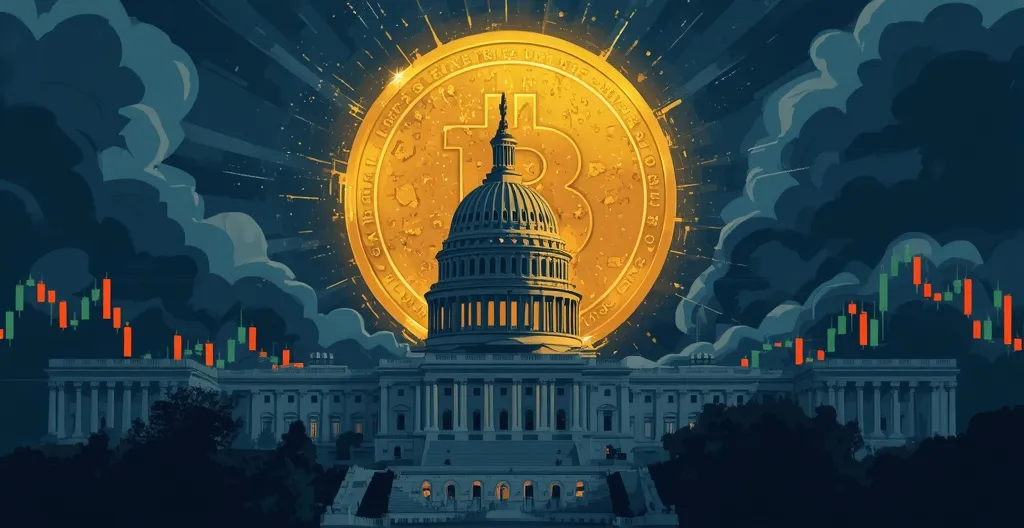
Grok AI is being cited in a Bitcoin forecast that puts a base case near $105, 000 by the end of 2026. The bull case leans on ETF demand, a Treasury buyback shift, and a Senate vote that could tighten Bitcoin’s regulatory footing.
- ETF buying is still the main supply squeeze
- Scott Bessent’s buyback pledge gave the market a boost
- The CLARITY Act could reduce regulatory fog
- The bear case still points to $60, 000, $65, 000
- Bitcoin Hyper is pitching a BTC Layer 2 with big claims and bigger caveats
The forecast tied to Grok AI is not magic dust. It is a basic market argument dressed up with AI branding: Bitcoin has a fixed supply, large buyers keep showing up, and policy could soon get less hostile. If those forces keep lining up, a higher price by the end of 2026 is not hard to imagine.
According to the figures cited, Bitcoin has seen eight straight sessions of buying that pulled $2.8 billion off the market, while August already topped $3 billion in ETF inflows. The piece says BlackRock’s IBIT took most of that flow. That matters because ETF inflows are one of the cleanest ways to measure persistent demand: money comes in, issuers buy BTC to back shares, and available supply gets tighter.
That is the part the hype merchants often flatten into a slogan. It is not just “number go up.” It is a steady bid hitting an asset with known scarcity. Bitcoin cannot be printed, copied, or inflated by a committee when things get uncomfortable. That gives every serious buyer more influence than they would have in a market with elastic supply.
The macro backdrop got another push on August 20, when Treasury Secretary Scott Bessent pledged to at least double long-bond buybacks. The source says that pledge sparked a 23% week that reclaimed $80, 000 and revived the “debasement bid”, the market habit of buying hard assets when people fear currencies or debt markets are getting quietly trashed.
That does not mean Treasury buybacks are some secret Bitcoin cheat code. They are not. But when policymakers are actively managing the debt market, risk assets can reprice fast, and Bitcoin tends to benefit when the market starts sniffing out easier financial conditions or a weaker fiat narrative. Sometimes the market is subtle. Sometimes it is basically a raccoon with a Bloomberg terminal.
The regulatory piece may matter even more. The U.S. Senate has a CLARITY Act cloture vote on September 15. A cloture vote is the procedural step that ends debate and lets a bill move forward. The source argues that passage would lock Bitcoin’s commodity status into statute, though that is a stronger phrase than the legal reality usually allows. A more careful read: it could strengthen Bitcoin’s treatment as a commodity under U.S. law and reduce some of the ambiguity that has dogged exchanges, funds, and custodians.
That ambiguity is not a small nuisance. It is a tax on builders and a headache for institutions. If firms cannot tell how regulators will classify an asset, they spend more on lawyers, compliance, and workarounds than they do on actual product development. Clarity would not solve everything, but it would make life less stupid. That alone would be an upgrade.
The bullish setup is not guaranteed, though. The downside scenario described here requires a hawkish Kevin Warsh signal from Jackson Hole combined with a failed vote. In that case, Bitcoin could fall back toward $60, 000 to $65, 000. That range is not pulled from thin air; it lines up with a zone traders often watch for stronger support after a sharp pullback. In plain English: if policy turns sour and regulation stalls, the market could give back a lot of the recent strength.
So what does Grok AI actually see? The forecast says Bitcoin’s most likely path into year-end 2026 is $95, 000 to $120, 000, with a base-case close near $105, 000. The bullish version is even cleaner: clear the hurdles and $105, 000 becomes the working target.
That sounds bold, but it is not ridiculous. Bitcoin has already shown it can move violently when the right flows arrive. The figures provided show Bitcoin closed at $80, 279, up $1, 256 or 1.59%, after trading between $78, 573 and $80, 820. The listed resistance levels are $80, 820, $84, 000, and $88, 000. Support sits at $78, 573, $72, 000, and $64, 000.
The technical picture is hot. Maybe too hot. The RSI, or Relative Strength Index, is listed at 82.09, with the signal line at 68.82. RSI is a momentum gauge that can suggest when an asset is overbought. The source notes that the gap has narrowed by 13 points, calling that “the constructive combination, ” and says “the signal line is catching up rather than the price rolling over.” In plain terms: momentum is still strong, but the market is stretched.
That cuts both ways. High RSI can mean buyers are in control. It can also mean latecomers are piling into a move that is getting tired. Traders love this kind of setup right until they are the ones holding the bag. Funny how that works.
The path that supposedly got Bitcoin here is also worth keeping in view. The source says Bitcoin peaked near $126, 000 last October, then lost half its value by February 2026. It says that month broke $60, 000 outright, March through May rebuilt toward $83, 000, June erased the recovery and dragged price back to $57, 500, and July and August delivered a long, flat shelf near $64, 000. That is not a smooth line of progress. It is a reminder that even Bitcoin’s strongest narratives come with bruises.
That matters because it keeps the bullish case honest. Bitcoin is still a volatile asset, even when the long-term thesis is intact. ETF demand and better regulation can support price, but they do not cancel drawdowns. Anyone pretending otherwise is selling incense and calling it analysis.
The piece also pivots to Bitcoin Hyper, a Bitcoin Layer 2 project that aims to extend what BTC can do. A Layer 2 is a secondary network built around a base chain to improve speed, lower costs, or add functionality. Bitcoin Hyper says it uses the Solana Virtual Machine, and its Canonical Bridge is designed to move BTC into that ecosystem.
That is the basic pitch: keep Bitcoin scarce and conservative at the base layer, then use additional infrastructure for more active financial applications. In theory, that could let BTC participate in DeFi and programmable applications without forcing Bitcoin itself to become some bloated, overengineered mess. Bitcoin does not need to be everything. It just needs to be money that does not suck.
The project says its token, HYPER, powers gas fees, staking, and governance, that the presale has raised more than $33 million, and that buyers can stake HYPER for yields of up to 35% APY, with launch planned in 2026. Those are promotional claims, and they deserve the usual skepticism. High APY is not free money. It usually means token emissions, dilution, incentives, or some mix of all three.
Bitcoin Layer 2s can be useful, but they also introduce bridge risk, trust assumptions, and extra complexity. The Canonical Bridge sounds neat until something goes wrong, which is exactly when people discover that “decentralized” sometimes comes with fine print thicker than a tax code. That does not make the idea worthless. It just means the risk has to be priced in rather than waved away.
There is still a real market argument here. If Bitcoin keeps attracting institutional capital, there will be demand for systems that let holders do more with BTC than simply sit on it. That is the second-order trade: not just betting on Bitcoin becoming scarcer, but on infrastructure that can put that capital to work across DeFi and programmable applications. Whether Bitcoin Hyper is one of the projects that survives the shakeout is a separate question.
What to watch next
The next leg for Bitcoin likely depends on three things: sustained ETF inflows, the Senate’s handling of the CLARITY Act, and whether macro policy stays supportive or turns more hostile. If those line up, the upper end of the forecast range starts to look plausible. If they do not, the market can just as easily stall or retrace.
And the market has already shown how ugly that can get. The price path cited here is a full-on roller coaster, not a straight march upward. That is exactly why the bullish case is interesting: if Bitcoin can keep attracting capital through that kind of volatility, the asset is gaining more than price. It is gaining structural legitimacy.
Crypto is a high-risk asset class. This material is provided for informational purposes and does not constitute investment advice. You could lose all of your capital.
Key questions and takeaways
-
What is driving Bitcoin’s bullish case?
ETF inflows, a more supportive Treasury policy backdrop, and possible regulatory clarity are the three main catalysts being cited. Together, they can tighten supply and improve market confidence. -
What price does Grok AI reportedly see as the base case?
The forecast points to a base-case close near $105, 000 by the end of 2026, with a broader range of $95, 000 to $120, 000. -
What could break the bullish setup?
A hawkish signal from Jackson Hole paired with a failed Senate vote on the CLARITY Act could push Bitcoin back toward $60, 000 to $65, 000. -
Why does the CLARITY Act matter?
If it advances, it could strengthen Bitcoin’s treatment as a commodity under U.S. law and reduce the regulatory fog that makes institutions slow and cautious. -
Is Bitcoin Hyper a straightforward Bitcoin upgrade?
Not exactly. It is a Layer 2 project with real ambition, but also bridge risk, token incentives, and marketing claims, including high APY numbers, that should be treated with caution.
If the inflows keep coming and policymakers stop throwing sand in the gears, $105, 000 stops sounding like fantasy and starts looking like a plausible target. Not a promise. Just a scenario with actual legs.
Further reading
One more angle worth keeping on the radar as Bitcoin politics and Bitcoin utility keep colliding.


