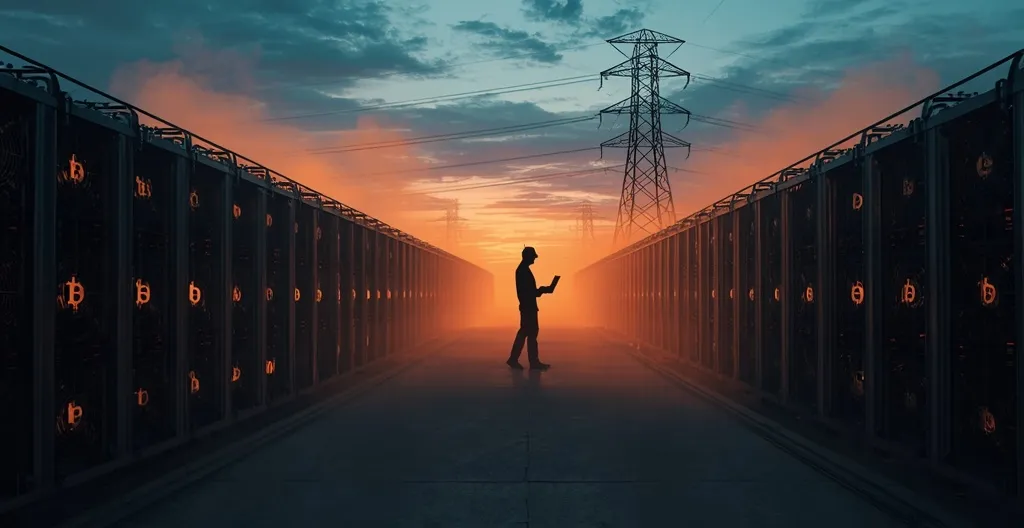
Bitcoin miners are under pressure, and that pressure may be adding real sell-side weight to the market. The catch: the headline numbers floating around need more precision than a blunt “miners dumped Bitcoin” claim.
- Mining margins are squeezed: CoinShares says publicly listed miners faced a weighted average cash cost of US$79, 995 per bitcoin in Q4 2025.
- Forced selling is plausible: When operating costs outrun revenue, miners often sell reserves or shut down inefficient rigs.
- The exact BTC outflow is unverified: A Coin Bureau post cited by CaptainAltcoin claimed 28, 000 BTC, but that figure is not independently confirmed in the materials here.
The basic setup is simple. Bitcoin mining is a brutal, energy-heavy business. If revenue weakens while power, hardware, debt service, and network difficulty stay high, miners do not get to run a vibes-based operation. They sell coins, cut costs, or both.
A post from Coin Bureau on X, cited by CaptainAltcoin, claimed miners “dumped 28, 000 BTC worth $1.78 BILLION this year” and described that as an overlooked force behind Bitcoin’s weakness. The same post said it now costs around $74, 000 to mine one Bitcoin, while BTC was trading near $63, 000.
That may point in the right direction, but it is not clean enough to treat as settled fact. The figure could refer to miner balance declines, exchange deposits, or estimated net sales, and those are not the same thing. Calling it “dumped” sounds dramatic, but it can also be misleading if the underlying data only shows coins moving, not necessarily hitting the market in one neat flush of panic.
The stronger evidence is that mining economics have been tight. In a Q1 2026 Bitcoin mining report, CoinShares said the weighted average cash cost to produce one bitcoin among publicly listed miners rose to about US$79, 995 in Q4 2025. That is a big number, and it matters because it shows real margin stress among listed operators.
One important distinction: this is a cash cost estimate for publicly listed miners, not a universal, network-wide “true cost” for every miner on Earth. Some miners have cheap power and efficient hardware. Others are running older rigs, paying up for electricity, or carrying debt that turns a rough quarter into a mess. Same industry, wildly different pain thresholds.
CoinShares also said mining profitability came under pressure, with hash price falling to around $36-38 per PH/s per day and later to $29 per PH/s per day in Q1, near breakeven for many operators. Hash price is just the revenue miners earn for each unit of computing power, so when it falls, miners feel it fast.
CoinShares added that there were three consecutive negative difficulty adjustments, the first such streak since July 2022, which it described as evidence of miner capitulation. Difficulty is Bitcoin’s automatic adjustment for how hard it is to mine new blocks. When miners leave the network because conditions are bad, difficulty eventually adjusts lower, helping the survivors. Painful? Yes. Broken? No.
That is where the market debate gets interesting. Miner selling can act like a supply overhang, adding steady pressure to a weak spot market. If miners are forced to liquidate holdings to keep the lights on, that is not the same as a long-term holder taking profits after a good run. It is closer to a business selling inventory to survive a rough quarter.
At the same time, miner capitulation is not automatically bearish forever. In past cycles, it has sometimes shown up near local bottoms. Weak operators get flushed out, inefficient machines go offline, difficulty resets lower, and the remaining network becomes leaner. That does not guarantee a reversal. It just means the system is doing what it was built to do under stress.
There is also a bigger structural shift underway. CoinShares said miners are increasingly moving into AI and high-performance computing (HPC), with more than $70 billion in cumulative AI/HPC contracts announced across the public mining sector. It pointed to companies such as IREN, WULF, CIFR, HUT, and CORZ as examples of miners becoming more like data-center operators that also mine Bitcoin.
That pivot matters. Some miners are clearly distressed sellers. Others are not just trying to survive; they are reallocating capital into a different business model. Those two things can overlap. A miner can be under pressure and chasing AI/HPC revenue at the same time. Corporate strategy and survival instinct often hold hands in ugly markets.
The broader market backdrop still matters too. The source notes that ETF inflows are slowing and macro uncertainty is lingering. That is the part the “miners did it” crowd often skips. Bitcoin price is never just one thing. It reacts to liquidity, rate expectations, leverage, institutional flows, and broader risk appetite. Miner selling can add supply pressure, but it is only one piece of the puzzle.
So what should readers actually take from this? Mining stress is real. Some miners are almost certainly selling more aggressively than usual. But the exact scale of that selling is not firmly established by the materials here, and it would be sloppy to pretend otherwise. The cleanest reading is that miner economics are tight enough to create ongoing sell-side pressure, while Bitcoin’s price is also being shaped by other forces that are harder to pin to a single headline.
The idea that Bitcoin needs to recover to the $70, 000, $75, 000 range to ease miner pressure may be only partial relief. If CoinShares’ Q4 2025 estimate of US$79, 995 in weighted average cash cost for publicly listed miners is anywhere near the mark, then many operators would still be under strain even after a bounce into that zone. A price band barely above the stated threshold is not a cure. It is a short exhale.
Key questions and takeaways
-
Are miners under real financial pressure?
Yes. CoinShares says publicly listed miners faced a weighted average cash cost of US$79, 995 per bitcoin in Q4 2025, while hash price hovered near breakeven for many operators. -
Did miners definitely sell 28, 000 BTC?
Not independently confirmed here. That figure comes from a Coin Bureau post cited by CaptainAltcoin, but the materials do not verify whether it reflects actual sales, balance declines, or another measure. -
Does miner selling always mean Bitcoin is bearish?
No. It can pressure price in the short term, but it can also be part of a capitulation phase that clears out weaker miners and improves network economics later. -
Why does mining difficulty matter?
Difficulty is Bitcoin’s built-in adjustment mechanism. If miners leave, the network eventually becomes easier to mine, which helps the remaining operators and keeps blocks flowing. -
Are miners becoming something else besides BTC producers?
Yes, for some of them. CoinShares says many public miners are shifting into AI and high-performance computing, which could reduce reliance on Bitcoin revenue but also brings new capex and execution risk.
Bitcoin mining was never supposed to be easy. If it were, the network would be weaker, not stronger. The hard part now is separating real sell pressure from lazy narrative trading. Miners may be stressed, some may be liquidating, and the market may still be absorbing it. But without better sourcing on the exact outflow numbers, the smart move is to treat the 28, 000 BTC claim as a signal, not gospel.
Coin Bureau (@coinbureau), August 14, 2026:
“DATA: Bitcoin miners dumped 28, 000 BTC worth $1.78 BILLION this year, an overlooked force behind the 27% crash. It now costs around $74, 000 to mine one Bitcoin, well above the $63, 000 price, squeezing miners into selling.”
Bitcoin Network Power Consumption Analysis
Earnings Tests Loom for Crypto Miners
Bitcoin Miners Crushed by Hashprice Collapse, AI Pivot
Bitcoin Miners Face Squeezed Margins as AI Pivot Hype Cools