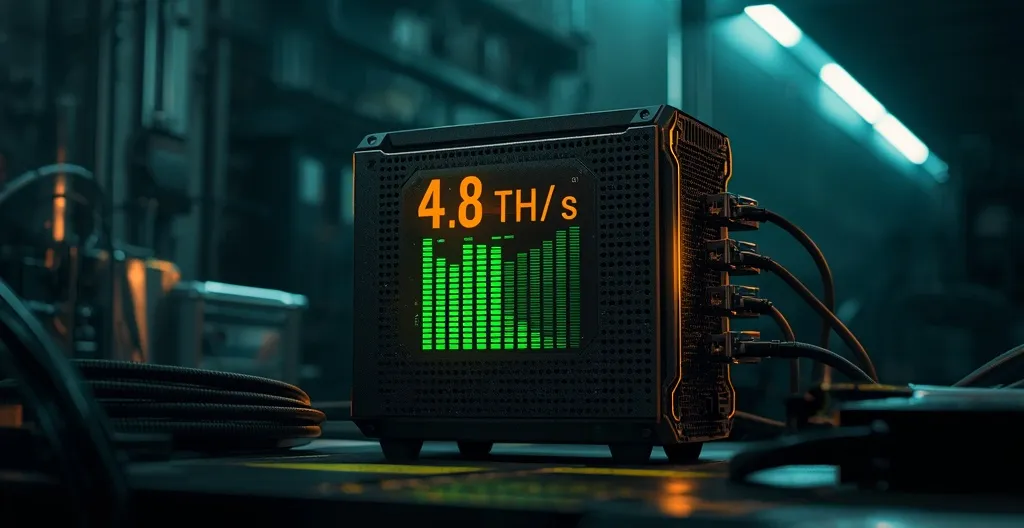
A title circulating around Braiins points to a “stackable” Forge Miner rated at 4.8 TH/s, but the supplied material does not verify whether this is a shipping product, a prototype, or just marketing copy with a nice haircut.
- Braiins is the named company.
- The device is called the Forge Miner.
- It is described as stackable and rated at 4.8 TH/s.
- No specs, pricing, launch date, or proof of shipment are provided.
That missing context matters. Braiins is a real Bitcoin mining ecosystem company, and its marketplace pages show it sells ASIC hardware, hashpower-related services, and mining infrastructure. But nothing in the supplied material independently confirms a Forge Miner listing, a product announcement, or even what “stackable” means in this case.
4.8 TH/s is the headline number here, and it needs a reality check. Hashrate means terahashes per second, trillions of hash attempts per second, and it’s the standard way Bitcoin miners measure raw computational power. Higher hash rate means more chances to compete for block rewards, but hash rate alone does not tell you if a miner is actually worth buying. Power draw, efficiency, price, cooling, and uptime do the real sorting.
And in plain English: 4.8 TH/s is tiny by modern Bitcoin ASIC standards. Braiins’ marketplace listings include machines in the 100+ TH/s range, with some models far above that. So if the 4.8 TH/s figure is accurate, this is not a warehouse beast. It would be a niche machine at best, possibly for hobbyists, experimentation, education, or some modular setup where form factor matters more than brute force.
The word stackable is the other hook, but it’s also the vaguest part of the claim. It could mean the units are designed to be physically layered, or that they’re modular in a way that simplifies deployment. It could also be plain old marketing fluff. Without a spec sheet, “stackable” is more suggestion than definition.
Braiins’ own marketplace materials are useful for context, even if they don’t solve the Forge Miner mystery. The company says pricing and availability are updated daily, the minimum order quantity is 5 units, and performance figures are based on Braiins’ testing at the default power limit, with individual results possibly varying. It also notes that Braiins OS can be installed on select models after delivery.
That caveat on performance is worth repeating because mining hardware is often sold like a flawless science project when it’s really a mess of variables. A miner’s efficiency is usually measured in joules per terahash, lower is better, and that’s the number that separates useful hardware from expensive space heaters. A shiny hash-rate figure without watts is only half the story, and half the story is how vendors end up with their eyebrows raised.
If the Forge Miner really does exist as described, the obvious question is not whether 4.8 TH/s sounds big or small. It’s whether the device has a legitimate niche. Small miners can make sense if they’re quiet, compact, cheap, or designed for a very specific use case. But they do not make sense if they’re being sold as serious industrial mining gear. That would be nonsense, and Bitcoin mining has enough nonsense already.
The broader takeaway is simple: this claim is unverified, and the lack of detail is the real story. Braiins is tied to the name, Forge Miner is the product label given, and 4.8 TH/s is the reported output, but without power data, pricing, availability, or a formal product page, there’s no solid way to judge whether this is a meaningful release or just a demo with a catchy name.
What should readers watch for next? The boring stuff. Wattage, price, release status, and whether the device is actually SHA-256 Bitcoin mining hardware. In mining, the flashy reveal is cheap; the useful machine has to survive contact with the electricity bill.
Key questions and takeaways
-
Is Forge Miner confirmed as a shipping Braiins product?
No. The provided material does not confirm a product page, launch announcement, or shipping details. -
What does 4.8 TH/s mean?
It means 4.8 terahashes per second, a measure of mining power. In Bitcoin mining, that is very small compared with mainstream ASIC miners. -
Does “stackable” tell us much?
Not really. It suggests some kind of modular or physically layered design, but the term is not defined in the available material. -
Why isn’t hash rate enough to judge a miner?
Because profitability also depends on power efficiency, electricity cost, hardware price, cooling, and uptime. A miner can look fine on paper and still be a waste of silicon. -
How does 4.8 TH/s compare with modern Bitcoin miners?
It is far below common industrial ASICs, which are often in the 100+ TH/s range. That puts this device, if real, in a very niche category. -
What is the biggest unanswered question?
Whether the Forge Miner is a real product, a prototype, or just promotional language. Until that’s clear, the claim should be treated cautiously.
For now, this is a clean example of why crypto hardware claims deserve a hard stare, not blind excitement. Bitcoin mining rewards honest engineering, not buzzword confetti.
For readers tracking the bigger backdrop, Bitcoin Mining Difficulty Drops 10% in Rare Downward was a reminder that the mining game is brutally competitive, and even a seemingly positive network adjustment doesn’t magically make every machine profitable.
That’s especially true when a miner’s reported output is this modest. In a sector where Bitcoin Mining Difficulty Plunges 10.09% as Miners Face pressure from price swings and AI competition, hardware buyers need numbers, not vibes and corporate poetry.
And because miners keep getting squeezed when weaker operations can’t keep up, the market tends to reward the survivors. That’s why our coverage of Bitcoin Mining Difficulty Drops 10% as Weak Miners Get matters: the network self-corrects, and the losers are often the ones shopping for shiny gear without doing the math.
If you are comparing products across regions, Braiins’ own marketplace options are also worth a look, including Bitcoin Mining Hardware and Hashpower Solutions by Braiins and its Spanish counterpart at Bitcoin Mining Hardware and Hashpower Solutions by Braiins, because availability, pricing, and support can vary depending on where you’re sourcing hardware.
For setup guidance, Braiins also publishes an I'm sorry, but there isn't enough information in the section for Bitcoin mining configuration, which is handy when you’re trying to keep a rig from turning into an expensive lesson in cable management.
One more note for hardware watchers: if a product page does eventually surface, it should be checked against any related coverage such as Braiins showcases stackable Forge Miner achieving 4.8 TH/s, because marketing headlines and actual product specs are often cousins that barely speak to each other.