
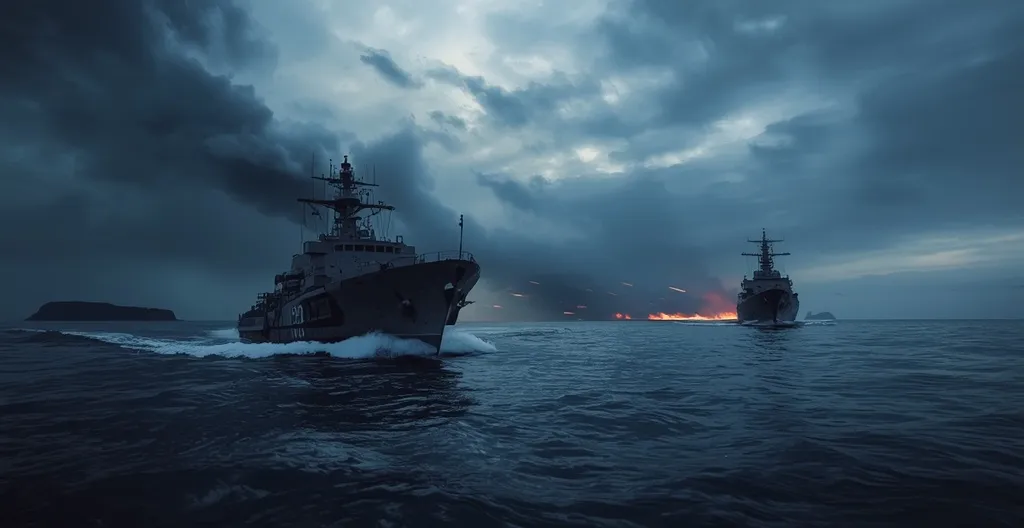
China is pushing east of Taiwan, and that changes the pressure map
China’s maritime pressure around Taiwan is no longer confined to the familiar Taiwan Strait. ACLED reports that Beijing has been running China Coast Guard patrols, inspection operations, and even a live-fire exercise east of Taiwan, putting the island’s Pacific-facing side firmly in the coercion zone.
- Eastward pressure is becoming more visible.
- China Coast Guard patrols have been reported east of Taiwan since early June.
- A live-fire exercise was reported east of Taiwan on 19 July.
- Taiwan is responding with larger anti-blockade and disruption drills.
This is gray-zone pressure: coercive moves below open-war thresholds, including patrols, inspections, drills, and harassment. It is not a formal blockade or invasion rehearsal, but it is also not harmless bureaucracy with better branding.
ACLED reports that the China Coast Guard established routine law enforcement operations and inspection patrols east of Taiwan beginning in early June. Beijing reportedly said the activity involved checking foreign vessels and enforcing against “maritime violations, ” while also linking the moves to Japan-Philippines discussions on maritime boundary delimitation that began in late May.
That matters because the eastern side of Taiwan is not the usual center of cross-strait pressure. Most attention goes to the Taiwan Strait on the western side, where China can lean harder and faster on geography. Taiwan’s Pacific coast faces a different direction, so sustained activity there sends a broader message: Beijing is willing to press beyond the usual lane and make the eastern waters part of the problem.
Why China's “Gray Zone” Campaign Has Extended to the east is pretty obvious once you look past the propaganda fog: pressure works better when it keeps changing shape and location. Beijing is not exactly hiding the playbook.
ACLED also reports a live-fire exercise east of Taiwan on 19 July, near Japan’s southernmost island, Okinotori. Live-fire drills use real weapons and real rounds, which makes them more than symbolic posturing. Their location matters too. The closer they are to regional flashpoints, the clearer the signal to Taiwan, Japan, and anyone else watching the map.
The safest reading here is not that China has fully and permanently reoriented its maritime strategy, but that it is expanding and normalizing pressure east of Taiwan. Repetition is the point. If patrols, inspections, and drills keep showing up in the same waters, they start to feel less like exceptions and more like a new baseline. That is how coercion gets baked into routine.
There is a blockade angle in the background, and that is where the stakes get ugly fast. A blockade means restricting sea and/or air access to an island. Taiwan depends heavily on imports, energy flows, and shipping access, so even a partial blockade would create serious economic and military pressure without a single soldier stepping ashore.
Taiwan clearly takes that risk seriously. Its 2026 Han Kuang Exercise, held from 5 to 14 August, reportedly included the first joint navy-coast guard anti-blockade exercise, the first simulated internet disruption, a presidential evacuation scenario, and enhanced counter-drone capabilities. That is not theater for the tourist brochures. It is preparation for pressure that comes in layers, not just missiles.
The internet-disruption piece is especially revealing. Modern coercion is not only about ships and aircraft; it also targets communications, infrastructure, and the ability to keep a society functioning under stress. Gray-zone tactics work best when they make aggression look administrative. That is the whole trick: push hard enough to intimidate, but soft enough to keep the lawyers busy.
China & Taiwan Update, August 14, 2026 points to how closely these drills and patrols are being watched by analysts tracking the pattern, not just the headlines. And yes, the pattern is the part that actually matters.
ACLED also notes that China’s maritime signaling stretched beyond Taiwan in the same period. China’s Maritime Safety Administration issued traffic control instructions for vessels entering the Strait between 6 and 9 August, citing Typhoon Dolphin. Chinese Coast Guard ships tailed a Japanese Coast Guard vessel seeking shelter from the storm. A Chinese navy frigate also conducted a passing exercise with an Indonesian navy frigate in the Philippine Sea.
That mix matters because it shows how China uses multiple tools to project authority: coast guard, maritime administration, and navy. Each serves a different purpose, but together they blur the line between civilian enforcement and military signaling. If that sounds like classic gray-zone behavior, it is. Not a clean declaration of war, just a steady attempt to make pressure feel normal.
Chinese state media reportedly framed some of these actions as evidence of Beijing’s asserted maritime rights east of Taiwan, while Indonesia described its encounter with the Chinese navy as a routine passing exercise. Those competing descriptions are worth keeping separate. Beijing’s version is messaging, not neutral fact. When a state starts presenting patrols like paperwork, it is usually trying to turn a power play into a legal narrative.
What makes the eastern push more serious is the normalization effect. A one-off patrol can be dismissed. Repeated patrols, inspection regimes, and live-fire drills begin to reshape expectations and test how much pushback regional actors are willing to tolerate. Over time, that can narrow Taiwan’s room to maneuver and make the status quo a little less stable each month.
None of this proves China is preparing an imminent blockade or a permanent new campaign east of Taiwan. The reporting does not go that far, and pretending otherwise would be sloppy. What it does show is a widening pattern of pressure, one that reaches into waters that were historically less central to routine coercion. Beijing appears to be probing, normalizing, and seeing how far it can push before anyone makes it expensive.
Does International Trade Actually Breed Conflict? In this case, the answer looks annoyingly familiar: trade and shipping routes can also become leverage points when a bigger power decides to act like the sea is its private driveway.
Taiwan Lawmaker Proposes Adding Bitcoin to $602B Forex reserves as part of the broader conversation about resilience, and that idea is not as far-fetched as the suits pretending it is. If a country’s financial system can be pressured, alternatives suddenly stop sounding like nerd fantasy.
Key questions and takeaways
-
Has China increased activity east of Taiwan?
Yes. ACLED reports routine China Coast Guard patrols and inspection operations east of Taiwan, along with a live-fire exercise on 19 July. -
Is this definitely a long-term strategic shift?
Not proven. The reporting supports an increase and possible normalization effort, but not a confirmed permanent reorientation. -
What kind of pressure is this?
Mostly gray-zone pressure. That means coercive activity below the threshold of open war, such as patrols, inspections, drills, and signaling. -
Why does eastern Taiwan matter?
Because it extends pressure beyond the Taiwan Strait and shows China can operate on Taiwan’s Pacific side, where attention has historically been lower. -
How is Taiwan responding?
Taiwan’s 2026 Han Kuang exercises from 5 to 14 August included anti-blockade drills, drone defense, evacuation scenarios, and simulated internet disruption. -
Is a blockade part of the concern?
Yes. A blockade would mean restricting access to Taiwan by sea or air, and even a partial blockade could create major economic and military pressure. -
Are other countries involved?
Indirectly, yes. The reporting links some Chinese activity to Japan-Philippines maritime boundary talks and mentions an encounter involving an Indonesian navy frigate. -
What should be watched next?
More patrols east of Taiwan, additional coast guard “law enforcement” operations, larger drills, and whether Beijing keeps trying to turn eastern waters into a normal operating zone.
Taiwan Weighs Bitcoin Reserve Strategy to Cut Dollar dependence for a reason: strategic pressure is not just about ships and missiles, but about financial and operational resilience too. The smartest states prepare before the squeeze gets worse.
Taiwan’s Bitcoin Gambit: A Digital Shield Against Chinese threats fits the same logic. Call it contingency planning, call it geopolitical hedge-hunting, call it common sense in a world where coercion doesn’t always arrive wearing a uniform.
The bigger picture is simple: China is not only pressuring Taiwan where everyone expects it. It is moving into the Pacific side too, where the message is harder to ignore and the strategic implications are wider. That deserves attention, because coercion gets more dangerous the longer it gets treated as routine.
Further reading
For more on the maritime pressure angle and what it could mean for Taiwan’s defenses, this CSIS analysis is worth a look:


