
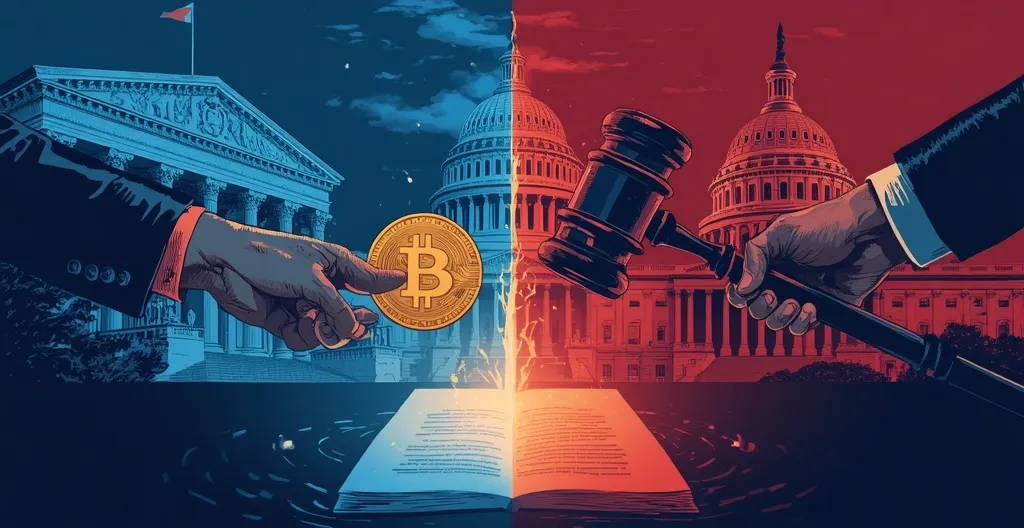
The CLARITY Act is running into the oldest problem in Washington: everyone loves “ethics” until the question becomes who gets to enforce it.
- Enforcement is the choke point.
- Democrats want state attorneys general involved.
- The White House and Republicans want the DOJ in charge.
- Senate timing is tight, and recess is closing in.
CoinDesk reported Tuesday that negotiations over the Senate’s Crypto Clarity Act still at mercy of ethics section as have stalled over an ethics provision meant to keep senior officials from holding significant cryptocurrency interests. The fight is not some tiny procedural footnote. It is about whether crypto conflict-of-interest rules can be enforced by anyone outside the same political orbit as the people being policed.
The disagreement is simple enough. Democrats want state attorneys general to have enforcement power. The White House and Republican negotiators want the U.S. attorney general to keep that role. That sounds like a bureaucratic turf fight, but it has real consequences. Enforcement authority decides who can investigate, how much pressure gets applied, and whether the rule feels credible or like a handshake deal dressed up as law.
In plain English: state attorneys general can bring more independent pressure from outside Washington, while DOJ enforcement keeps everything centralized at the federal level. Centralized may sound cleaner. It also means the same political machine that may be under scrutiny still holds the keys. Not exactly confidence-inspiring.
The reported ethics language would bar senior officials from holding “material” cryptocurrency financial interests. If adopted, it could apply across the executive and legislative branches, including the president, the vice president, and members of both chambers of Congress. That scope explains why the issue is loaded. Once lawmakers start talking about conflicts of interest at the top, every word turns into a landmine.
Democrats argue the United States Department of Justice cannot be trusted to enforce restrictions on the president and other senior officials without political influence. Republicans and the White House say enforcement should remain centralized at the federal level. Administration officials have reportedly said they have offered “every concession” possible to meet Democratic demands, and a White House official described the package to industry participants as “the most comprehensive and wide-ranging ethics provision in history.”
That is a big claim. Washington does love a grand label. The harder question is whether the language is meant to strengthen accountability or just act as a bargaining chip in a larger fight over crypto policy and political power.
The politics around the clause are hotter than usual because of President Trump’s family’s reported ties to crypto ventures, including World Liberty Financial. CoinDesk also reported that a White House official told industry participants Trump had agreed to the ethics language, although that specific text was not shared with Senate Democrats at the time. That kind of detail does not build trust. It burns it.
Adding another layer of skepticism, Attorney General Todd Blanche previously served as Trump’s personal attorney, according to the reporting. Whether that matters legally is one question. Whether it matters politically is another. In a fight about who should enforce ethics rules on powerful officials, appearances matter. A lot.
The calendar is making things uglier. Lawmakers and industry participants are looking at Aug. 7 as a practical deadline because that is when the Senate heads into summer recess. Senate Majority Leader John Thune had previously laid out a timeline that could put the bill on the Senate floor as early as next week. But Congress is where “next week” often means “whenever someone stops objecting.”
Negotiators reportedly think resolving the ethics section could let the bill move forward even if other issues, including anti-illicit finance provisions, remain unresolved. That says a lot about how central this dispute has become. One clause may be enough to unlock the rest of the package. Or it may be enough to jam the whole thing like a brick in a printer tray.
The CLARITY Act itself is not a side quest. It is a broad market-structure bill meant to define how digital assets are regulated in the U.S. The framework, as reflected in the House text and summarized by Galaxy Research, covers digital commodities, SEC and CFTC jurisdiction, issuer disclosures, intermediary obligations, and illicit finance rules. In other words, it tries to answer a very old question with very new technology: who regulates what, and under which standard?
That matters because crypto policy in Washington is not just about whether a token goes up or down. It is about which agency gets the first shot at classification, what disclosures issuers must make, how exchanges and intermediaries register, and how the government handles money laundering risks without crushing software developers or legitimate market activity in the process.
The House approved the bill on July 17 by a vote of 294-134, according to Galaxy Research. That included 216 Republicans and 78 Democrats. So yes, there is bipartisan support. But Senate negotiations are a different beast. A bill can clear the House with a healthy margin and still get stuck in the Senate because one unresolved issue becomes the legislative equivalent of a parking brake.
That is why the ethics fight matters beyond the headline. Once lawmakers start arguing over whether DOJ can be trusted, or whether state attorneys general should get a bigger role, the debate shifts from market structure to institutional credibility. And once that happens, every other unresolved issue gets dragged into the mud with it.
Some Democrats have also discussed adding language related to prediction markets, which could trigger a new round of drama. Prediction markets are platforms where people trade on the outcome of future events, such as elections or policy decisions. They sit in a gray area between finance, gambling, and commodities law, which makes them exactly the sort of subject that can hijack a crypto bill and slow it to a crawl.
The White House’s broader stance on digital assets also helps explain the current posture. On January 23, 2025, it issued an executive order that revoked Executive Order 14067, created a President’s Working Group on Digital Asset Markets, emphasized regulatory clarity and certainty, and opposed a central bank digital currency, or CBDC. So this is not an administration that is anti-crypto in broad strokes. It is pro-crypto on its own terms, with the federal government firmly in the driver’s seat.
That distinction matters. There is a big difference between supporting digital asset innovation and being willing to let independent enforcers, especially state-level ones, police the people making the rules. The administration’s message is basically: crypto is welcome, but the leash stays attached to Washington.
Even if the Senate clears the ethics issue, the bill is not home free. House approval would still be required, and that may not happen until the chamber returns for its September session. Recent internal Republican friction has already slowed House scheduling for major bills, which means the timetable is still vulnerable to the usual congressional chaos. The calendar, as always, remains a deeply unserious institution.
Key questions and takeaways
-
What is holding up the CLARITY Act?
A dispute over who should enforce the ethics restriction on senior officials’ crypto holdings. Democrats want state attorneys general involved; the White House and Republicans want the U.S. attorney general to keep control. -
Why does enforcement authority matter?
Because the choice of enforcer affects how independently the rule is applied. If the DOJ handles it alone, critics worry politics can soften enforcement; if state AGs are involved, the pressure is less centralized. -
What does the CLARITY Act cover?
It is a market-structure bill for digital assets, covering digital commodities, SEC/CFTC jurisdiction, disclosures, intermediary obligations, and anti-illicit finance rules. -
Is the bill dead?
No. But the recess clock makes delay dangerous, and a late-stage enforcement fight can easily push the timetable off the rails. -
Why should crypto users care?
Because the bill could shape how exchanges, issuers, developers, and token projects are regulated in the U.S. That affects compliance burdens, legal uncertainty, and which projects can actually build without tripping over regulators. -
Could prediction markets become the next fight?
Yes. Some Democrats are discussing added language on prediction markets, and that could create a fresh controversy right when the bill needs fewer distractions, not more.
The blunt reality is that crypto legislation in Washington rarely dies from one clean disagreement. More often, it gets strangled by jurisdiction fights, timing pressure, political distrust, and the fine art of making progress impossible. The CLARITY Act is catching all of that at once.
That does not mean reform is impossible. It means the people writing the rules are still arguing over whether the rules should apply to themselves in any meaningful way. Until that gets settled, the market-structure fight stays stuck in neutral and crypto users, developers, and companies are left waiting for Washington to stop improvising.
Further reading
A few related pieces for anyone tracking the CLARITY fight, the ethics mess, and the broader crypto policy brawl in Washington:
- TokenPost on CLARITY Act talks stalling over crypto ethics
- House Bill 3633 text on Congress.gov
- White House order on digital financial technology and CBDC restrictions
- Galaxy Research: CLARITY Act update and final push
- Arnold & Porter’s breakdown of the CLARITY Act
- Adbytes: Senate CLARITY Act faces Trump ethics fight and DeFi pushback
- Adbytes: CLARITY Act faces Senate resistance over crypto rules
- Adbytes: CFTC crypto oversight faces heat over Polymarket


