Crypto media’s traffic collapse isn’t one simple AI story. Some of it looks a lot more like de-indexing.
Crypto publishing is getting hit from more than one direction. Some sites seem to have fallen out of Google’s index, while others are being squeezed by AI-powered zero-click search.
- Four domains drove most of the damage: Cointelegraph, U.Today, DL News, and Unchained.
- Some drops are cliff-shaped, not gradual: that points to an indexing or enforcement problem, not just AI search erosion.
- The rest of the category is still under pressure: AI Overviews and AI Mode are draining clicks across publishers.
- Getting the diagnosis right matters: de-indexing and zero-click search need very different fixes.
The neat little “AI killed media traffic” explanation is satisfying. It is also too lazy to be useful.
ICODA’s two-year analysis of 40 crypto news and editorial domains suggests a messier reality. Using Ahrefs organic-traffic estimates from June 2024 through July 2026, plus AI citation counts across six platforms, the study found aggregate organic traffic across the sample fell 37.2% year over year from Q2 2025 to Q2 2026. The snapshot date for the analysis was 10 August 2026.
That headline number hides two very different patterns. One is a broad decline that looks like AI-era search compression. The other is a sudden collapse in a handful of domains that looks much more like de-indexing, a manual action, or another indexing problem.
Cliffs and slopes are not the same thing
Zero-click search usually shows up as a slope. Google answers more of the query on the results page, fewer people click through, and publisher traffic bleeds down over time. It is frustrating, predictable, and increasingly common.
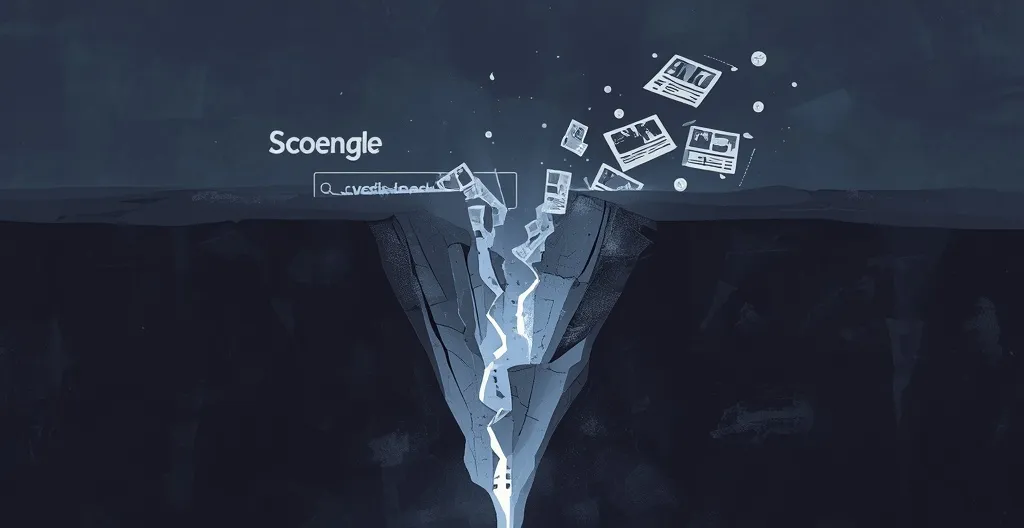
De-indexing is different. If a site, or large parts of it, fall out of Google’s index, the traffic drop is not gentle. It is a cliff. That does not prove a penalty by itself, but it does strongly suggest something beyond ordinary search churn.
That distinction is the heart of this mess. The ICODA analysis argues that the sharpest declines in crypto media are concentrated in four domains: Cointelegraph, U.Today, DL News, and Unchained. Together, those four account for 76.8% of the category’s total traffic loss, even though they started with under 30% of the category’s traffic share.
In plain English: the category-wide number is real, but it is doing a lot of hiding. A few sites got hammered so hard they distort the whole picture.
The numbers behind the collapse
The most dramatic example is Cointelegraph. The traffic sequence cited in the analysis shows 2.04 million monthly visits in October 2025, then 79, 347 in November, 2, 310 in December, and 18 at the time of the 10 August 2026 snapshot. Whatever label you want to put on that, “normal decline” is not one of them.
U.Today is said to have fallen from 651, 022 monthly visits in June 2025 to 6, 476 in August. DL News reportedly dropped from 374, 651 monthly visits to 4, 091, a 99% loss of organic traffic over the same window. Unchained is included among the four domains driving most of the category’s loss, though the cleanest numeric examples in the cited material are Cointelegraph, U.Today, and DL News.
The report says that if those four domains are removed from the sample, the remaining 36 domains were down a combined 12.2%. That is still ugly, but it is a very different story from a sector-wide implosion.
This is where the “AI did it” crowd runs into a wall. A broad, steady slide points to one problem. A sudden, near-vertical drop points to another. Mix them together and the analysis turns into vibes.
AI search is real pain, but it is not the whole pain
The 33 domains in the study’s cleaner cohort, meaning the ones without a collapse event or a relaunch artifact, showed a different pattern. Traffic stayed around 14 million to 21.5 million monthly visits through most of 2025, then dropped starting in March 2026 to 13.41 million, 10.25 million, 10.56 million, 7.94 million, and 7.46 million. The median domain lost 47.7% between March and July 2026, and 28 of 33 declined.
That is much more consistent with zero-click compression. The timing also lines up with Google’s consolidation of AI Overviews and AI Mode into a single surface, though that should be treated as correlation, not proof of causation. Traffic estimates alone can tell you that something changed. They cannot tell you with certainty whether the cause was Google product design, ranking shifts, audience behavior, technical issues, or all three at once.
Similar pressure is showing up well beyond crypto. The Wall Street Journal, as cited in the research notes, reported Semrush figures showing roughly -50% for USA Today, roughly -25% for CNN, roughly -23% for Politico, and more than -85% for Business Insider. This is not a crypto-only problem. It is a publisher problem.
And that is the part platforms would rather everyone hand-wave away. AI answers are convenient for users and brutal for publishers. A search box that fully answers the question is great for the person asking. For the site that reported the news, it can mean less traffic, less revenue, and less leverage. A very efficient way to squeeze the people who actually did the work. Lovely system.
Why the distinction matters for publishers
Conflating de-indexing with AI-search erosion is how publishers waste time. If a site has been de-indexed or heavily suppressed, the fix is usually technical, editorial, or compliance-related. That means checking crawlability, noindex tags, manual actions report, content quality, site migrations, and other indexation problems. You fix the plumbing.
If a site is still indexed but losing clicks to AI summaries, the response is different. That means building stronger direct audience relationships, email lists, subscriptions, and brand demand. It can also mean pushing back against platform behavior that strips value from publishers while calling it “helpful.” Visibility without traffic is not a business model; it is a consolation prize.
“Rising zero-click behavior produces a slope. It does not produce a cliff.”
That line captures the key idea here. A cliff-like drop and a long, grinding decline are not interchangeable. Treat them like they are, and you end up solving the wrong problem.
What AI citations tell us, and what they don’t
The analysis also looks at citation counts across AI surfaces including Google’s AI Overviews, AI Mode, Gemini, ChatGPT, Perplexity, and Grok. A citation is simply a reference to a domain inside an AI-generated answer. That is useful as a visibility signal, but it is not the same thing as traffic.
A site can be cited and still receive very few clicks. A site can also be absent from one AI surface and still perform normally in search overall. Citation counts are helpful context, not a verdict.
One striking claim in the analysis is that Cointelegraph has zero citations across Google’s AI Overviews, AI Mode, and Gemini in the sampled set, while DL News retains citations in those surfaces. If that snapshot holds up, it suggests Cointelegraph is not just less visible in AI search, it may be severely underrepresented there. That is a very different problem from “people are clicking less.”
Still, caution matters. Citation counts can shift depending on query set, geography, timing, and prompt wording. A snapshot taken on 10 August 2026 is informative, but it is not a permanent truth stamped in granite.
The bigger fight is not just about crypto media
Crypto publishing is getting squeezed, but it is not alone. General-news publishers are also dealing with the same structural problem: search is becoming more answer-like, and answer engines do not exist to hand everyone else traffic out of charity.
The broader publisher response is becoming harder-edged too. Some outlets are considering blocking crawlers, limiting access, or using registration walls to reduce dependence on Google. That is not paranoia. It is a business model trying to survive being disintermediated by the very platform that once fed it.
There is a darker side to this that deserves to be said plainly. Google gets to look more useful while quietly siphoning off the clicks that sustained the sites producing the information. Efficient? Sure. Benevolent? Spare us.
At the same time, crypto media has some self-inflicted wounds. This sector is notoriously volatile, tightly tied to market cycles, and addicted to traffic spikes. When search referrals soften, outlets are tempted to chase junk headlines, recycled takes, and SEO sludge. That is how weak businesses start devouring their own credibility.
But there is also a constructive takeaway. If this pressure forces publishers to build direct relationships with readers and stop pretending Google will love them forever, that is not the end of the world. It is a correction. Depending on a centralized discovery layer for your survival was always a fragile plan.
Key questions and takeaways
-
Is this mainly an AI-search problem?
Not entirely. AI-driven zero-click search is clearly hurting publisher traffic, but the sharpest crypto-media collapses look more like de-indexing or another indexing disruption than ordinary AI compression. -
What is the difference between de-indexing and zero-click search?
Zero-click search slowly reduces clicks because users get answers directly in Google. De-indexing is more abrupt and usually means a site has been removed from, or badly disrupted inside, the index itself. -
Which crypto sites appear to have been hit hardest?
ICODA identifies Cointelegraph, U.Today, DL News, and Unchained as the four domains driving most of the category’s traffic loss. -
Does being cited by AI tools mean a site is safe?
No. Citations are a visibility signal, not a guarantee of clicks, revenue, or durable search performance. -
What should publishers do if they suspect de-indexing?
They need to check technical setup, indexation status, policy issues, and any site changes or migrations. AI-search tactics alone will not fix an indexing problem.
The useful takeaway is simple: not every traffic drop has the same cause, and not every fix addresses the same damage. Some publishers are losing clicks. Others may have been kicked out of the room entirely. If you confuse the two, you will waste time, money, and probably a fair amount of dignity.
Further reading
A few related pieces and references that help frame the search-and-indexing mess facing crypto media.
- Claude's Shared Chats and Artifacts Exposed in Google Search
- Publishers Consider Opting Out of Google as Search Traffic
- Zero-click result
- Cointelegraph & CoinMarketCap Hacked: Ad Network Scams Hit
- Cointelegraph and CoinMarketCap Hacked: Crypto Giants
- Asia’s Crypto Media in 2025: Top 18 Publishers Control 82%