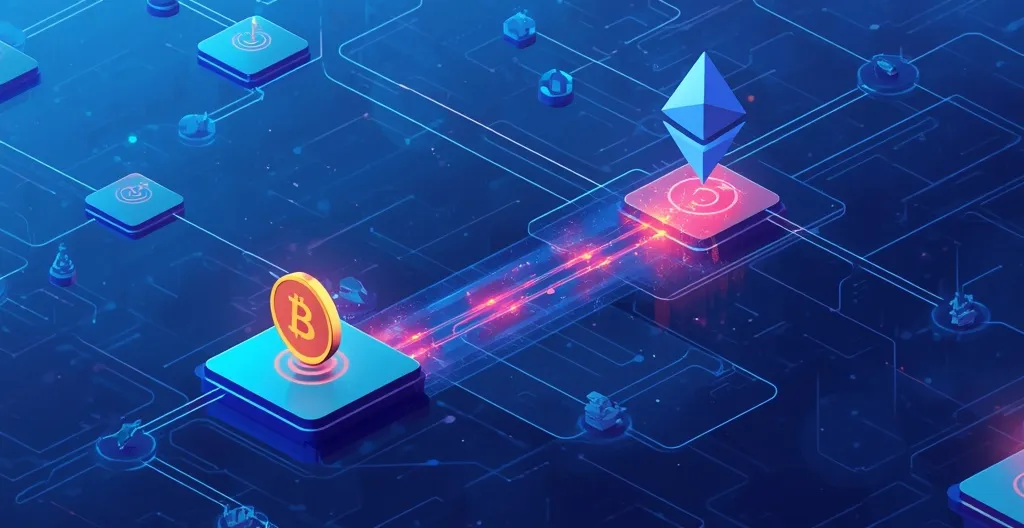
The Ethereum Economic Zone (EEZ) aims to give users access to applications and liquidity across Ethereum-connected networks without requiring them to initiate a separate bridge transfer. At Devcon on November 4, 2026, the team presented a CoW Swap demo showing how this could work. Gnosis and ZisK introduced the project at EthCC, with support from the Ethereum Foundation, according to crypto.news.
- Trade demo: A signed order on Rollup X used Ethereum mainnet liquidity.
- Other tests: Demos explored Safe permissions and Falcon signature verification.
- Open test: Production costs, failure handling and settlement guarantees remain to be established.
One Order, Multiple Networks
In the reported trade demonstration, a user signed an order on Rollup X, a development network. A CoW Swap solver found a route that used liquidity on Ethereum mainnet, the base layer of Ethereum, and returned the purchased tokens to Rollup X. The team said the flow required one order signature, with no separate bridge transaction for the user.
That does not mean the operation involved no cross-network activity. The goal is to coordinate the steps behind the scenes, so users do not have to transfer funds to mainnet themselves, wait for them to arrive, and then place a trade. The report does not say whether production use would require other approvals or fees.
A solver finds and executes a route for a signed order. Here, it connected the order on Rollup X to mainnet liquidity. The EEZ team calls the model atomic execution, meaning the connected steps are intended to succeed or fail together. The reported demo does not explain how the system enforces that outcome or exactly when the result is settled.
Those distinctions matter. Coordinated execution is not the same as instant finality. The available details do not spell out every guarantee users would have if a network is delayed or an operation fails.
More Than Trading
A Safe demonstration tested whether a rollup could read and verify an ownership change made on Ethereum mainnet. Safe is a wallet and treasury system for managing assets and permissions. Coordinating ownership across networks could save organizations from updating permissions separately on each one.
But the demo, as described by crypto.news, leaves basic operational questions unanswered. How do revocations, signer changes, recovery and pending operations work across networks? The report also does not explain exactly what “within the same transaction” means when separate networks are involved.
Another demonstration used Falcon, a post-quantum signature scheme. The team said it verified a Falcon signature on Rollup X and used the result to authorize a mainnet transfer. It reported that verification used 91% less gas than direct verification on mainnet, which the report estimated would take about 5.5 million gas.
That figure compares signature verification, based on the team’s report. It does not measure savings on the trade or across all EEZ operations. Gas measures computation on Ethereum, but gas units alone do not show the full cost in dollars. The comparison also leaves out costs that may come from rollup execution, proof generation, relaying or settlement. Using Falcon in a demo does not make the entire EEZ system quantum-resistant.
Better Liquidity Does Not Guarantee a Better Trade
Access to a deeper market can help when a local pool has little liquidity. But the best route depends on what the user gets after costs. Trade size, price impact, fees, execution costs and the solver’s pricing all matter.
For illustration, not as a live quote, imagine a local pool would deliver $9, 900 on an order with a $10, 000 reference value. A cross-network route might deliver $9, 980 before execution costs. With $30 in added costs, it would return $9, 950. If those costs reached $100, the local pool would be the better choice. A more connected route is useful only when its final output justifies the costs.
The Production Questions
The demonstrations show how cross-network coordination might work. They do not show how reliably the system will perform under heavy demand, how it will handle late proofs or failed operations, or what users will see while an outcome awaits settlement.
These are not minor details. Wallets and applications will need to explain delays and failures clearly. Solvers will need to account for route and execution costs. Users will need to know whether an operation has merely been included, is fully settled under the relevant networks’ rules, or could still change.
Gnosis Chain offers a larger test than a development-network demo. GnosisDAO approved a proposal, GIP 153, in August to move the chain from its standalone design to an EEZ rollup, according to crypto.news. Gnosis has described preserving applications, balances, contract addresses and the chain identifier as migration goals. These are objectives, not guarantees that every dependency will carry over without disruption.
The reported target for an initial deployment is late 2026 or early 2027, depending on technical readiness. That is not a confirmed date for making EEZ the default across Gnosis Chain or completing every part of the migration.
crypto.news also reported that Consensys announced an institutional interoperability platform with planned support for the EEZ standard. The available details do not name the platform or explain what that support will involve.
Key Questions and Answers
-
Does the demo mean users no longer need to bridge?
It was designed to avoid a separate, user-initiated bridge step before trading. It does not show that every asset, route or network will work this way in production.
-
Does atomic execution mean instant settlement?
No. It describes connected steps intended to succeed or fail together. The demo does not establish when the outcome is finally settled.
-
What does the reported 91% gas reduction measure?
It applies to the Falcon verification example, compared with direct verification on mainnet. It does not mean the total cost of an EEZ operation is 91% lower.
-
When could Gnosis Chain make the transition?
The reported target for an initial deployment is late 2026 or early 2027, subject to technical readiness. The available reporting does not establish a date for making EEZ the chain’s default.
Rollups can expand Ethereum’s capacity, but their separate environments can split liquidity and applications. EEZ aims to make those boundaries less visible to users. The demos point in a useful direction. The harder test is whether the system can coordinate operations reliably, explain failures honestly and deliver better net results than simpler alternatives.
The Ethereum community discussion offers another place to follow conversations about the network.
For DeFi users weighing opportunity against risk, the Mono Protocol presale debate is a reminder to scrutinize claims and incentives.