
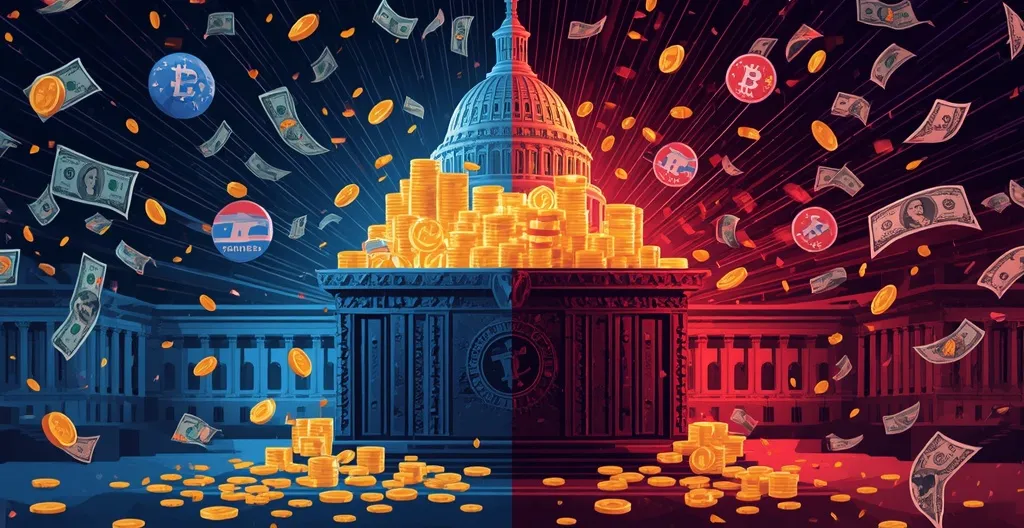
Fairshake is heading into the general election with $122 million in the tank, a pile of primary wins, and one very expensive reminder that money does not buy political gravity on demand.
- Nearly 50 primary wins, but a bruising loss in Illinois
- $122 million left for the fall campaign push
- Crypto’s real target: committee control and market structure
The crypto industry-backed super PAC helped push a long list of candidates through primary season, then hit a wall in Illinois after spending more than $10 million trying to stop Juliana Stratton. That split screen says a lot about where crypto political spending stands right now: powerful, disciplined, and very well financed, but still not omnipotent. Voters remain annoyingly difficult to buy in bulk.
Fairshake and its network backed nearly 50 candidates who won party nominations in the 2026 primaries, according to the reporting cited in the group’s latest spending update. The political machine is split between Protect Progress, which supports Democrats, and Defend American Jobs, which backs Republicans. That is not ideological purity. It is strategy. Win seats, build leverage, shape the rules.
Among the Republican Senate nominees supported by Fairshake were Barry Moore in Alabama, Andy Barr in Kentucky, Kevin Hern in Oklahoma, and Harriet Hageman in Wyoming. The reporting also noted that Hageman is running for the seat held by retiring Senator Cynthia Lummis.
Prediction markets gave those candidates strong odds at the time cited: Barry Moore at 99% on Polymarket, Kevin Hern at 97%, Harriet Hageman at 96%, and Andy Barr near 94% on Kalshi. Those numbers are useful as a sentiment check, not as prophecy. A market price is not a ballot box, no matter how much some traders like to cosplay as election shamans.
The bigger prize is not just who gets elected. It is who controls the committees that decide what happens next. If crypto-friendly lawmakers land in the right places, they can affect leadership in the House Financial Services, House Agriculture, Senate Banking, and Senate Agriculture committees. Those panels matter because they are where digital asset rules are shaped, fought over, and sometimes mangled into something that barely works.
That is especially important because Congress is still wrestling with the Digital Asset Market Clarity Act, which would divide oversight of parts of the U.S. digital asset market between the Securities and Exchange Commission and the Commodity Futures Trading Commission. In plain English, the SEC generally argues many tokens look like securities, while the CFTC oversees commodities and derivatives. Crypto has spent years trapped in that jurisdictional mud fight, and Washington still has not fully cleaned it up.
Fairshake spokesperson Geoff Vetter put the group’s posture bluntly:
“With dozens of wins in House and Senate races across the country, and $122 million ready for the fall, we’re not slowing down.”
That confidence is backed by real numbers. It is also a reminder that political spending can be highly effective without being magical.
Illinois is the cleanest example. Fairshake spent more than $10 million trying to defeat Juliana Stratton, who went on to beat Raja Krishnamoorthi and Robin Kelly in the Democratic Senate nomination fight. The state has consistently elected Democrats in statewide federal races, and the Democratic nominee is considered advantaged over Republican nominee Don Tracy. In other words, Fairshake ran into a political wall that money alone could not bulldoze.
That is the part a lot of crypto cheerleaders ignore. Outside spending can flood the airwaves, shape narratives, and reward loyal lawmakers. It cannot erase local political reality. Sometimes voters hear the mailers, roll their eyes, and vote the other way anyway. Democracy remains a rude little inconvenience for special interests.
Fairshake’s spending on both sides of the aisle also shows this is not a simple red-versus-blue operation. Protect Progress spent $189, 527.60 on four mailers supporting Jake Auchincloss in Massachusetts, even though he received a C grade from Stand With Crypto and did not support the GENIUS Act stablecoin legislation last year. On the Republican side, Defend American Jobs spent nearly $512, 000 supporting Bill Huizenga in Michigan.
Protect Progress also backed Suzan DelBene, Kim Schrier, and Marilyn Strickland. Fairshake and its affiliates also spent money defending seven members of Congress who support digital asset legislation. In August, the network added victories in Michigan and Washington. These are not vanity buys. They are targeted bets on lawmakers who can help move crypto policy when it matters.
The broader picture is even bigger than Fairshake alone. According to Public Citizen, crypto companies had contributed a record $189 million to the 2026 election cycle by the end of June. That was about 37% of corporate political contributions in the group’s analysis. Public Citizen also said Fairshake had spent more than $82 million by that point, which helps explain why the network entered the cycle with roughly $193 million in cash.
Fairshake’s main financial backers are Coinbase, Ripple, and Andreessen Horowitz. That alone tells you this is not just a bitcoin-native political fight. It is a broad industry effort to influence the rules before those rules harden against it.
Other crypto-linked PACs are trying to muscle in too. Fellowship PAC, backed by Cantor Fitzgerald and Anchorage Digital, had indicated it could spend $100 million. It received about $11 million, most of it from Cantor Fitzgerald, and supported a mix that was mostly Republican plus three Democrats, including Virginia Senator Mark Warner. Almost all of its spending went to a political firm co-founded by Bo Hines, a former crypto adviser to President Donald Trump who later took charge of Tether’s U.S. operation.
That detail is worth watching because campaign finance gets ugly fast when stablecoin businesses, political consultants, and foreign-funds concerns start circling each other. U.S. political committees cannot accept foreign money. If the structure looks sloppy, or the donor trail looks questionable, the whole thing can become a compliance headache very quickly. No one wants a “freedom” campaign turning into a paperwork fire drill.
Another new vehicle, the Digital Freedom Fund, has been backed by Tyler Winklevoss and Cameron Winklevoss through a $21 million contribution from Winklevoss Capital. Kraken parent Payward added another $1 million. At the time cited, the fund had not started supporting individual candidates yet.
The bottom line is simple: crypto is no longer a side character in American politics. It is a serious donor bloc with a clear agenda, real money, and a direct stake in how Congress handles market structure, stablecoins, and agency turf. If you care about decentralization, privacy, and getting regulators off the industry’s neck when they overreach, some political muscle is necessary.
But the industry should also keep its own house in order. Huge spending can distort races, inflate weak candidates, and drown local politics in a blizzard of polished messaging. The space spends a lot of time talking about freedom and truth. It should be just as ruthless about calling out nonsense, especially when that nonsense comes wearing a crypto lapel pin.
Fairshake is entering the final stage of the 2026 US elections with a huge war chest, and the campaign-finance breadcrumbs are not subtle. The Campaign Finance Statistics and Data Access database is where the paper trail lives, and Congress is still trying to cram the Failed to extract title into something resembling coherent law. Meanwhile, industry watchers are tracking the CLARITY Act Campaign Finance fight while the PAC itself keeps flexing through its Fairshake political machine.
And the reach is not limited to the usual battlegrounds. A Deep-pocketed crypto super PAC eyes New York House races is exactly the kind of line that should make both insiders and skeptics sit up. Crypto spending has already shown up in local wins and losses, including Crypto PAC Spending Helps Christian Menefee Oust Al Green, and the industry’s own biggest players have been busy, with Coinbase and Brian Armstrong Pour $25.5M Into Fairshake ahead of the next round of midterms.
One more wrinkle: policy is not just about market structure and committee chairs. The U.S. Stablecoin Yield Ban Advances in Digital Asset Market debate shows how quickly Washington can turn a technical issue into a blunt-force instrument. That is why political spending matters so much here, and why it also needs to be scrutinized hard instead of worshipped like some sacred blockchain talisman.
Key questions and takeaways
-
Why does Fairshake matter so much?
Because it is one of the main political machines trying to shape how Congress writes crypto rules, especially on market structure and agency oversight. -
Did Fairshake’s money decide the primaries?
No. It helped a lot of candidates win, but the more than $10 million push against Juliana Stratton in Illinois still failed. -
Why are committees such a big deal?
Committees decide hearings, markups, and much of the legislative grind. In crypto, that can mean the difference between workable rules and bureaucratic sludge. -
Is Fairshake backing only Republicans?
No. It splits spending between Republican-focused Defend American Jobs and Democratic-focused Protect Progress to build influence on both sides. -
Should prediction-market odds be treated as fact?
No. Polymarket and Kalshi are useful signals, but they are still just market snapshots. Elections are decided by voters, not ticker tape.
With primary contests still underway in New Hampshire, Rhode Island, Delaware, and Louisiana, Fairshake is not done spending. The group has made its point: crypto money is here, it is organized, and it wants a seat at the table, and it is willing to pay for it.


