Fiserv says its digital asset platform is live, and Roughrider Coin is the first use case to go public on Solana. The catch: this is not some retail crypto toy with a state seal stamped on it. It is a permissioned, institution-only payment rail with a bank issuer, a state-bank sponsor, and a lot of fine print doing the heavy lifting.
- Live on Solana: Roughrider Coin is now running on Fiserv’s digital asset platform.
- Institution-only: It is restricted to financial institutions, not retail users.
- Split responsibilities: VersaBank USA issues and manages reserves; Bank of North Dakota oversees; Fiserv runs the platform; Fireblocks provides wallet infrastructure.
- Onchain is not the whole truth: A token transfer on Solana does not, by itself, prove reserves or legal redemption rights.
Fiserv announced on October 1 that its digital asset platform was live with financial institution clients, and said Roughrider Coin was the first use case to go public. That may sound simple enough, but the actual structure is layered.
The token runs on Solana, but the dollars behind it live in bank accounts and banking controls. That distinction is the whole story. Crypto headlines love to flatten that kind of arrangement into one neat phrase, “state bank coin on Solana, ” when the reality is closer to bank plumbing with a blockchain bolted on. Not sexy, but often more useful than the nonsense parade of speculative tokens and fake-deep “price discovery” sermons.
Bank of North Dakota describes Roughrider Coin as a “token deposit for financial institutions”. Fiserv and related materials call it a dollar-backed stablecoin. Those are not the same thing, and treating them as if they are interchangeable is how people end up confused about what is actually being offered. A stablecoin is usually understood as a token designed to track the U.S. dollar. A token deposit sounds more like a bank-native mechanism with specific operational and legal rules attached.
The roles are split in a way that matters:
VersaBank USA is the issuer. It handles minting, burning, custody, and reserve management. Bank of North Dakota provides governance oversight and sponsors the North Dakota use case. Fiserv supplies the platform and the Commercial Center interface. Fireblocks provides wallet and tokenization infrastructure. Solana records the token transfers onchain.
That split tells you what this is, and what it is not. This is not a permissionless DeFi experiment. It is a controlled institutional system built for bank-to-bank use. Only approved financial institutions can hold or move the token. Bank of North Dakota’s Roughrider Coin says participation is voluntary and limited to financial institutions only. No retail treasure hunt, no “buy the dip” circus, no memecoin cosplay.
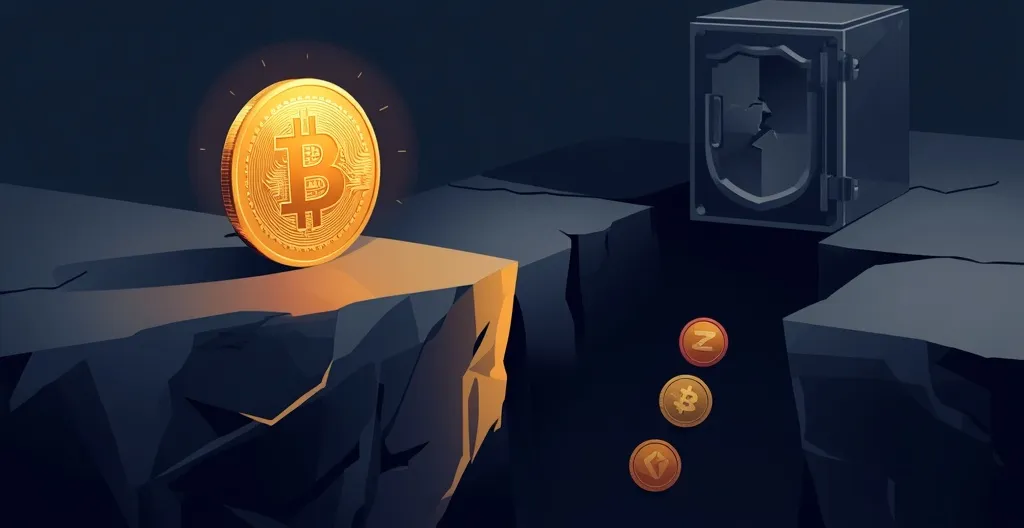
The public blockchain does have a role here, but it is not the magic trick some people will pretend it is. Solana can record a token transfer. It cannot, on its own, verify the reserve balance, confirm the legal right to redeem at par, or tell you how the offchain bank-side settlement is handled. Those things live in account structures, disclosures, contracts, and supervision. In other words: the truth is still in the boring paperwork.
The source materials describe a structure in which funding must be confirmed before minting occurs, and the token is tied to an FBO arrangement, “for the benefit of, ” held through participating bank accounts. That is a standard payments structure, but it is also the part that makes one-to-one backing an assertion that has to be reconciled, not something the blockchain itself magically proves. For a plain-English primer on what backing actually means, the dictionary version is still a useful sanity check.
There is also an autoburn-style flow described in the materials: when the receiving wallet gets the token, that receipt triggers a burn instruction and starts the offchain settlement leg. In plain English, the token transfer and the dollar movement are linked, but they are not the same event. The chain shows token state changing. The bank system handles the money movement and the daily settlement mechanics.
That difference matters because public-chain visibility is useful, but it is not legal finality. A blockchain can show that an authorized transfer happened. It does not, by itself, prove that every reserve dollar is where it should be, that every redemption right is ironclad, or that a failed transfer will be unwound cleanly without a lot of institutional back-and-forth. Finance loves to dress this up as elegant automation until something breaks and everybody suddenly remembers what a reconciliation team does.
The public materials also leave real gaps. Fiserv did not publish active-user counts, completed transaction totals, daily settlement volume, or time saved. No public benchmark shows how much faster or cheaper this is than ACH, RTP, FedNow, or ordinary bank transfers once all the offchain steps are included. That does not make the system useless. It just means the launch is a launch, not proof of scale.
Fiserv says more than 90 banks and credit unions can access the system. The North Dakota banking ecosystem, meanwhile, includes 61 FDIC-insured institutions with $64.9 billion in assets as of the first quarter of 2026, according to the figures cited in the materials. Those numbers are not the same thing. Access is not adoption. A door being unlocked is not the same as people actually walking through it.
That distinction matters because the real argument for a setup like this is not ideology. It is utility. Fiserv says its platform can support tokenized deposits, global currency accounts, cross-border payments, card issuance, and treasury automation. If that stack actually works in practice, then Roughrider Coin may be less a one-off launch and more a proof point for a broader bank-owned digital asset rail.
And honestly, that is where the opportunity is. Not in pretending this is some permissionless revolution, but in seeing whether regulated bank money can move with less friction, fewer delays, and fewer headaches than the legacy systems everyone keeps paying for because they are already there. That is a low-glamour, high-value target. Financial plumbing rarely gets applause, but it is where a lot of the economic heavy lifting happens.
Still, the legal and operational details are the part that decides whether this is genuinely useful or just well-marketed. The public materials reviewed here do not fully spell out redemption rights, insolvency treatment, pass-through coverage, reserve attestation details, or the exact handling of exceptions, retries, freezes, and clawbacks. Without that information, claims like “one-to-one backing” remain claims to be reconciled, not truths stamped into existence by a public blockchain.
That skepticism is not anti-innovation. It is basic hygiene. Plenty of crypto projects hide behind grand language and vague promises; this one at least looks like it is trying to build something concrete inside the real banking system. Good. But concrete systems should be judged on concrete facts, not on vibes and a logo on Solana.
Here is the cleanest way to think about it: Solana is the transfer layer, not the promise layer. Fiserv is the interface. VersaBank is the issuer and reserve operator. Bank of North Dakota is the sponsor and overseer. The dollars still live in bank accounts, and the legal reality still lives in contracts and supervision. The blockchain is important, but it is not a cheat code for trust.
Key questions and answers
-
Can retail users buy Roughrider Coin?
No. Bank of North Dakota says it is a permissioned asset for financial institutions only, not retail consumers or investors. -
Who actually issues the token?
VersaBank USA is identified as the issuer responsible for minting, burning, custody, and reserve management. Bank of North Dakota sponsors and oversees the use case, but it is not the issuer. -
Does Solana prove the coin is fully backed?
No. Solana records token transfers, but reserve backing has to be verified through bank records, account structures, and disclosures. Onchain visibility is useful, not magical. -
How many institutions can use it?
Fiserv says more than 90 banks and credit unions have access, but that does not prove active usage. No public transaction totals were disclosed. -
Why does this matter if it is not retail-facing?
Because institutional payment rails are where a lot of financial infrastructure gets rebuilt. If this works, it could reduce friction for bank-to-bank transfers and support broader tokenized banking products. -
What is still missing?
The big gaps are public usage data, reserve details, redemption terms, failure handling, and proof of real-world settlement performance versus legacy rails.
Roughrider Coin is not a moonshot, and that is exactly why it deserves attention. It is a controlled institutional payment tool running on a public blockchain, with all the promise and all the paperwork that implies. The future of money may include systems like this, but it will not be built on hand-waving, and it will not be proven by a blockchain logo alone.
Further reading
A few related pieces that help round out the bank-backed stablecoin angle:
- North Dakota’s bank coin runs on Solana, following the dollar
- VersaBank partners with Fiserv to launch Roughrider Coin
- Bank of North Dakota and Fiserv launch the state’s first stablecoin
- FIS and Circle on USDC, plus Fiserv’s FIUSD launch on Solana
- bitFlyer to list Solana in Japan’s regulated market
- BlockDAG, Solana, Bittensor and Chainlink among top crypto gainers