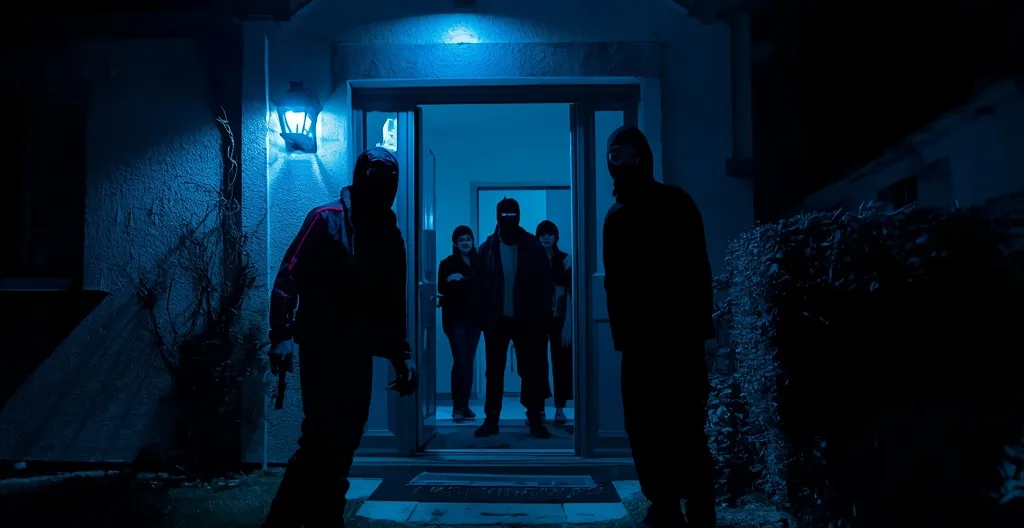
A family in northern France was held inside their home for more than three hours while masked attackers forced the father to hand over about €40, 000 in crypto. It is another ugly reminder that in crypto, the attack surface is not just software, it is the person at the door.
- Four masked men entered a home in Vendin-le-Vieil at about 4 a.m.
- A father was forced to transfer roughly €40, 000 in crypto-related value.
- France is seeing a surge in violent “wrench attacks” tied to crypto.
- Different trackers agree on the trend, even if their counts and methods differ.
According to BFMTV, the attackers held a family of four captive in Vendin-le-Vieil, a town in northern France, for more than three hours after breaking in around 4 a.m. Sunday. The family included a father, a mother, and two children aged eight and twelve.
France Télévisions, citing a police source, said the family was bound with black tape and that the father was forced to “communicate his identification information and codes.” In plain English, the attackers were trying to get whatever would let them access his crypto holdings, whether that meant account credentials, recovery details, or other access codes.
The father, a 40-year-old salaried IT specialist in the digital currency sector, was then forced to transfer about €40, 000 in crypto. BFMTV reported that the 12-year-old daughter was struck in the face with car keys. After the attackers left, the family freed itself, and firefighters arrived around 7 a.m.
The Béthune prosecutor’s office opened an investigation into unlawful detention and extortion. Prosecutors are treating it as kidnapping and extortion by an organized gang, and the case has been handed to regional judicial police and France’s anti-cybercrime office. All four suspects remain at large.
The local case fits a much broader pattern.
France has become one of the clearest hotspots for violent crypto extortion, with criminals using home invasions, impersonation, kidnapping, and physical intimidation to bypass technical security. The slang term for this is a wrench attack: instead of hacking a wallet, criminals threaten or assault the person who controls it. Brutal, crude, and effective enough to keep showing up. Chainalysis says France leads the surge in violent crypto attacks, and the numbers back up the ugly trend.
Interior Minister Laurent Nuñez said in late June 2026 that France had recorded 77 cases involving kidnappings, unlawful detention, extortion, or attempted offenses connected to cryptocurrency. The National Anti-Organized Crime Prosecutor’s Office later said it had recorded more than 70 crypto-linked kidnappings and unlawful detentions during the first eight months of 2026.
Those figures are related, but they are not identical. One counts a broader set of crypto-related offenses, including attempts. The other focuses on kidnappings and unlawful detentions. That kind of difference matters, because sloppy number-mashing is how reporting turns into confetti.
Chainalysis adds another layer to the picture. The blockchain analytics firm estimated that physical attacks against crypto holders extracted more than $30 million worldwide in the first half of 2026. It documented 46 attacks in that period, and only 12 resulted in payment, a 26% success rate.
That success rate is the part that should make criminals nervous, not just victims. Chainalysis says the share of successful attacks was 49% in 2025 and 67% in 2024. So while the number of incidents is rising, the payoff rate is falling. More violence, less efficiency. Not exactly a masterclass in criminal innovation.
Chainalysis also said France accounted for 30 publicly documented incidents in its methodology, making it the leading hotspot in its dataset. Home invasions made up 37% of the incidents it tracked in the first half of 2026, up from 14% in 2025. Family members or acquaintances were involved in roughly 25% to 30% of documented cases.
That last point is especially grim. It suggests attackers are not only hunting obvious high-net-worth targets. They are going after spouses, children, relatives, roommates, and people who merely look close to crypto wealth. In other words, the weak spot is often the social circle, not the wallet itself.
CertiK’s data points in the same direction, even though it uses a different method. The security firm recorded 52 wrench attacks worldwide in the first six months of 2026, up 33.3% from 39 in the same period in 2025. It estimated financial exposure at $124.1 million, compared with about $10.5 million a year earlier. That lines up with France’s alarming rise in violent wrench attacks on crypto holders, and it is the kind of metric that should make everyone stop pretending this is some fringe nuisance.
CertiK’s figure is not the same as confirmed stolen proceeds. It includes stolen funds, ransom demands, frozen assets, and other values tied to the incidents it tracked. That makes it useful for understanding scale, but not for pretending every dollar was actually extracted by attackers.
France accounted for 33 of CertiK’s 52 incidents. In its dataset, home invasions rose from one documented case in the first half of 2025 to 20 in the same period of 2026, while kidnappings rose from 12 to 16. CertiK’s France data for H1 2026 shows just how quickly physical crime is swallowing the digital-asset conversation.
The overlap between Chainalysis and CertiK is hard to ignore. Both show more physical coercion, more home invasions, and a heavy concentration in France. The exact numbers differ because the firms are not tracking the same universe of events. One is not “wrong” and the other “right”, they are simply looking at the same mess from different angles.
Why France? Part of the answer is visibility. High-profile cases attract copycats. Publicized crypto wealth attracts opportunists. And once organized criminals see a tactic working, even sporadically, they tend to keep trying until the returns dry up or law enforcement starts slamming doors.
Another part is the nature of crypto itself. Self-custody gives users control, but it also puts responsibility, and risk, on the individual. A blockchain will process a transfer whether the person making it is a willing trader or someone under a kitchen knife at 4 a.m. That is the dark side of financial sovereignty: the system does not know, and usually does not care, how the signature was obtained. The trend has been stark enough that some now describe France as the crypto kidnapping capital, which is a bleak title no country should want.
French authorities appear to be treating the problem as more than isolated robbery. Nuñez has said protections for people in the crypto sector need to be strengthened, including a rapid identification and alert system for those at risk. The current probe in Vendin-le-Vieil also involves regional judicial police and the anti-cybercrime office, which shows how these cases are being pulled into both organized-crime and cybercrime lanes.
The broader lesson is not subtle. Crypto security is not just about hardware wallets, multisig, or cold storage. It is also about privacy, personal security, and not advertising your exposure to the world. If attackers can map your home, your family, and your routines, the best technical setup in the world can still be forced open by a masked man and bad timing.
That is not a reason to abandon self-custody or retreat into centralized cages. It is a reason to get serious about the whole stack: technical defenses, operational discipline, and physical security. The industry has spent years bragging about trustless money. Fine. But trustless money still sits in human hands, and those hands can be threatened.
Key questions and takeaways
-
What is a wrench attack?
It is physical coercion used to force someone to give up crypto access, usually through threats, violence, kidnapping, or a home invasion instead of an online hack. -
Why are attackers targeting crypto holders this way?
Because crypto transfers can be irreversible, and many wallets are protected by access codes, recovery phrases, or private keys that can be surrendered under pressure. -
Why is France getting so much attention?
French police, prosecutors, and security firms are all reporting a sharp rise in crypto-linked violence there, and a large share of the publicly documented incidents in 2026 have been in France. -
Are the police, Chainalysis, and CertiK numbers the same thing?
No. They use different methods, time windows, and definitions, so the figures should be read as separate indicators of the same trend, not interchangeable totals. -
Are these attacks always succeeding?
No. Chainalysis says only 12 of 46 attacks in the first half of 2026 led to payment, which suggests more victims are resisting, more attacks are being interrupted, or more criminals are failing than before. -
What does this mean for crypto holders?
Treat personal security as part of crypto security. Avoid broadcasting holdings, tighten privacy, reduce doxxing risk, and separate access layers so no single compromise gives attackers a clean path to funds.
The Vendin-le-Vieil case is not an isolated freak event. It is the kind of ugly, practical crime that shows what happens when digital wealth meets real-world violence. The code may be decentralized. The threat, unfortunately, is very local.
Further reading
For more on the human cost behind crypto security, these pieces add useful context.