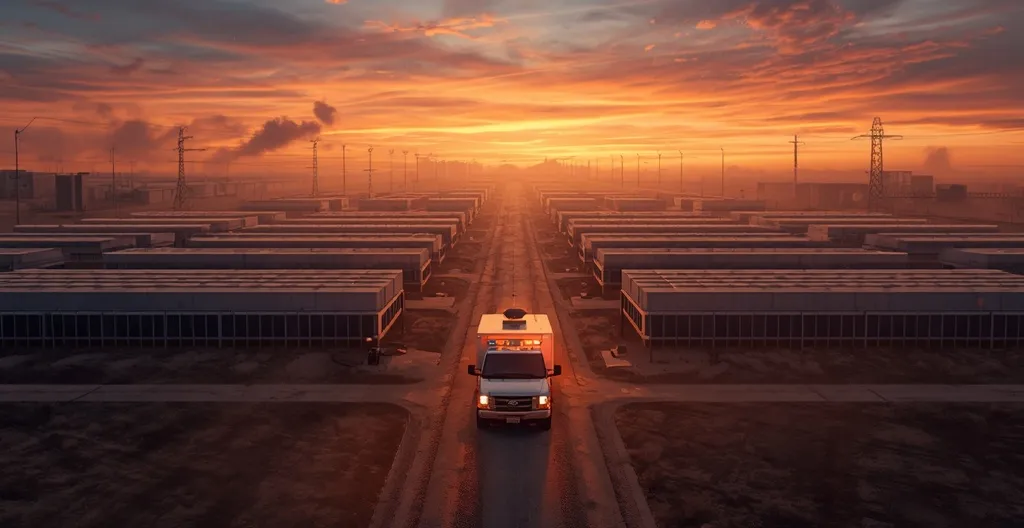
Galaxy adds 24/7 emergency coverage at Helios as the Texas buildout gets more industrial
Galaxy has teamed up with industrial safety provider Total Safety to put 24-hour fire, rescue, paramedic, and EMT coverage in place at its Helios Data Center Campus in Dickens County, Texas. The point is to take some pressure off local volunteer responders as the old Bitcoin mining site grows into a major AI and high-performance computing campus.
- 24/7 emergency coverage added at Helios
- Designed to support Dickens County volunteers during major incidents
- Helios is already live with 133 megawatts of critical IT load to CoreWeave
- More phases are coming as Galaxy pushes toward multi-gigawatt scale
This is what large-scale compute infrastructure looks like when the glossy slides hit the Texas dirt. Servers are only part of it. Fire response, technical rescue, medical stabilization, and the awkward fact that the nearest trauma center is about 60 miles away in Lubbock, according to Galaxy, are part of the package too.
That distance matters. Remote industrial campuses do not get to treat emergency planning like a box-ticking exercise. If something goes wrong, minutes matter, and hoping a volunteer department can handle a sprawling power-heavy site is not much of a strategy.
Why Helios needs its own emergency muscle
Galaxy says the dedicated service is meant to reduce pressure on Dickens County’s volunteer emergency responders. That is not just corporate polish. Rural counties often depend on volunteer fire and EMS teams that do important work with limited manpower and limited specialized equipment.
Total Safety will handle fire response, technical rescue, paramedic care, and EMT support. “Technical rescue” is the kind of phrase that sounds harmless until you remember it can mean specialized extraction from dangerous equipment, confined spaces, or other industrial messes nobody wants to deal with after the fact.
Austrin Storms, Galaxy’s co-head of data centers, described the arrangement as creating a “professional response capability” on the company’s property. That is a fair way to put it. A giant AI campus is an industrial site, not a cloud-shaped fantasy. It needs people on hand who can respond when something catches fire, someone gets hurt, or the weather decides to go feral.
Galaxy has not disclosed the contract value, staffing numbers, equipment inventory, response targets, or activation date. So while the direction makes sense, the operational detail is still thin. The broad idea is clear. The plumbing is still behind the curtain.
Helios is no longer just a Bitcoin relic
Helios started as a Bitcoin mining operation. Now Galaxy is turning it into a revenue-generating AI and high-performance computing campus under a 15-year lease with CoreWeave. That shift says a lot about where serious capital is flowing, from energy-hungry crypto infrastructure toward contracted compute demand with longer revenue visibility.
According to Galaxy’s newsroom release, Phase I is complete and the campus is already delivering 200 megawatts of gross power and 133 megawatts of critical IT load to CoreWeave. In plain English, gross power is the total site power available, while critical IT load is the power actually feeding the servers and core computing gear. Those are not the same thing, and mixing them up is how infrastructure numbers turn into marketing soup.
Galaxy also said rent commencement began in the second quarter as capacity was delivered. That matters because this is not just about theoretical capacity on a slide deck. It is about a campus actually producing revenue.
Phase II is expected to add 260 megawatts of critical IT load, with initial data hall deliveries in the first half of 2027. Across Phases I through III, CoreWeave has committed to 526 megawatts of critical IT load.
Galaxy says those leases could generate more than $1 billion in average annual revenue if the campus is fully utilized. That is a huge number, and it should be treated as a projection, not a prophecy. Power access, construction, customer demand, and grid studies all have to line up before any of this becomes real in the way spreadsheets like to pretend it already is.
The power story is the real story
Helios currently has 800 megawatts of approved and contracted gross power, according to Galaxy. In one release, the company said the campus could eventually scale to as much as 3.6 gigawatts. In an earlier financing release, Galaxy put the figure at up to 3.5 gigawatts. That small mismatch is worth noting, because infrastructure claims have a habit of getting larger the farther they move from the utility interconnect.
Still, the scale is real. Galaxy financed the first phase with a $1.4 billion secured facility and $350 million of its own equity. It later pursued another $3.5 billion financing for the Texas expansion. This is not speculative land banking dressed up as “future optionality.” It is heavyweight capital tied to a heavyweight buildout.
Galaxy has also said it has 2.7 gigawatts of additional power capacity under various stages of load study. That suggests Helios is part of a broader Texas infrastructure push, not a one-off campus story.
And that is the part that often gets lost in the crypto-to-AI conversion narrative. Bitcoin mining sites are not just being abandoned when the economics change. Some are being repurposed into industrial compute assets with long leases, real tenants, and actual operating requirements. The old “hashing boxes in a shed” era was always going to give way to something more serious. This is what that looks like.
Why the safety move matters beyond Helios
The emergency-response partnership is practical, but it also shows that AI infrastructure is an industrial business. These campuses need power, cooling, security, construction crews, heavy electrical gear, and a plan for when things go wrong. The bigger the campus gets, the more it starts to look like a private utility-and-manufacturing operation with servers inside.
There is also a fair devil’s-advocate view here. On-site emergency response can improve readiness and ease pressure on local volunteers. But it can also exist mainly to protect a company’s own assets. Whether Dickens County benefits in a meaningful way will depend on how the mutual-aid arrangement works in practice, how training is handled, and whether the campus team can actually support local incidents when needed.
Galaxy has not yet given the details that would answer those questions. The next useful disclosures would be simple: how many responders are on shift, what equipment is staged on site, and how coordination with local departments will work during major events.
Key takeaways
-
Why is Galaxy adding emergency services at Helios?
The campus is remote, large, and getting more complex. On-site fire, rescue, and medical coverage is meant to reduce reliance on outside response and support local volunteer departments. -
What is Helios now?
It is no longer just a Bitcoin mining facility. Galaxy is turning it into a long-term AI and high-performance computing campus with contracted power and customer demand. -
How much compute is already live?
Galaxy says Phase I delivered 200 megawatts of gross power and 133 megawatts of critical IT load to CoreWeave under a 15-year lease. -
How big could Helios get?
Galaxy says the campus has 800 megawatts of approved and contracted gross power and could eventually scale into multi-gigawatt territory, depending on grid studies, construction, and customer demand. -
What details are still missing?
Galaxy has not disclosed staffing numbers, equipment, response targets, contract value, or the exact go-live date for the 24/7 emergency coverage.
The big picture is pretty simple: this is what the post-mining phase of crypto infrastructure looks like when it grows up and starts paying actual bills. The romance is gone, the power bills are real, and the fire trucks are part of the plan. That is not flashy, but it is how industrial-scale compute survives the real world.
Further reading
A few related pieces that add more context around Helios, the power buildout, and the shifting economics behind it:
- Galaxy adds 24/7 emergency services at Helios
- Texas Medical Facilities and Expiration Dates
- Galaxy Announces On-Campus Emergency Services
- Galaxy Completes Phase I of Its Helios Data Center
- CoreWeave Joins Nasdaq 100 as AI Infrastructure Beats
- CoreWeave Stock Plummets 61%: AI Bubble Fears Hit Crypto
- Galaxy Slashes Bitcoin 2025 Price Target to $120K: Bullish