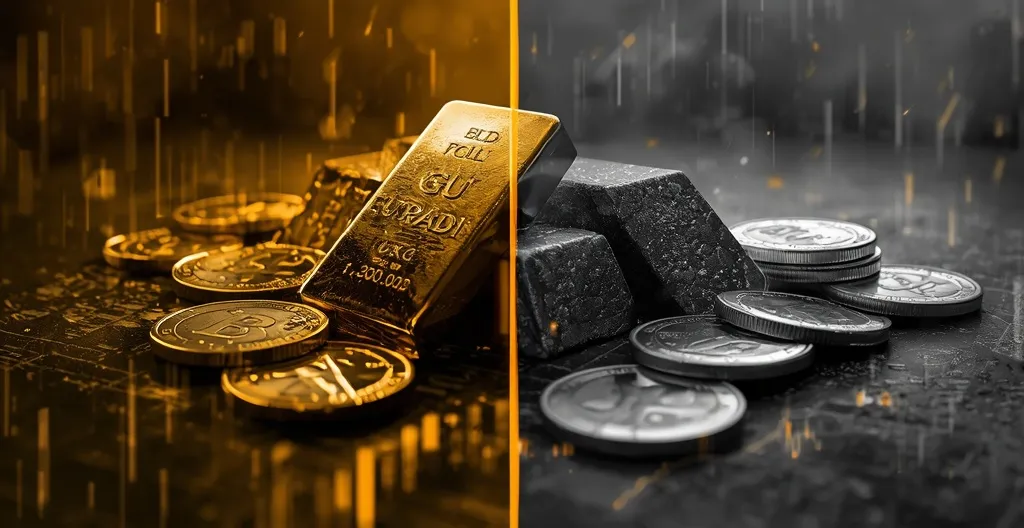
Gold and silver had a violent 2026, and the real question now is whether the pullback is just a reset or the start of a much deeper unwind. Institutional research and AI-generated scenario ranges still point to more upside, but neither one suggests a straight-line moonshot is the base case.
- Gold surged above US$5, 500 in late January, then fell toward US$4, 000 in June
- Silver hit extreme highs, then suffered a brutal correction
- Gold is the cleaner macro hedge; silver is the bigger swing trade
- Fed policy, the dollar, inflation, and industrial demand still run the show
The World Gold Council said gold set 12 all-time highs in 2026, topping US$5, 500 per ounce intraday in late January before briefly dipping below US$4, 000 in late June. Silver also saw wild price action, with the broader case for the metal supported by persistent supply tightness and strong industrial demand, even if the ride has been anything but smooth.
That’s the setup. Both metals have already made huge moves, both have given back a chunk of those gains, and both now depend on whether macro conditions keep favoring hard assets or turn into a headwind. Precious metals may be “real money, ” but they still have moods. Annoying, yes. Also true.
Gold: the stronger macro hedge, but not a one-way bet
Gold’s 2026 path was violent even by precious-metals standards. According to the World Gold Council, the metal surged above US$5, 500 per ounce intraday in late January, then fell toward and briefly below US$4, 000 in late June. The Council also said gold was down 7% year to date at its June 26 snapshot, despite still being one of the best-performing assets over the prior 12 months.
That matters because gold is not just a shiny panic button. It is a macro asset. When inflation, policy risk, currency weakness, or geopolitical stress rise, gold usually finds buyers. When real yields rise or the U.S. dollar strengthens, it tends to catch flak.
The World Gold Council’s framework is useful because it explains the move without the usual crystal-ball nonsense. Its drivers are economic expansion, risk and uncertainty, opportunity cost, and momentum. In plain English: if investors can earn more in interest-paying assets like Treasury bonds, gold becomes less attractive; if fear rises or policy gets looser, gold can get a bid.
Central bank buying also remains an important support factor. Official-sector buyers are not chasing chart candles or Reddit narratives. They are usually focused on reserve diversification, portfolio stability, and reducing overreliance on the dollar. That does not mean they buy blindly, but it does mean there is real institutional demand under the market.
The source used a ChatGPT-style scenario exercise for year-end 2026 and came up with three gold ranges:
Base case: US$4, 600 to US$5, 000
Bullish scenario: US$5, 200 to US$5, 500
Bearish scenario: US$3, 900 to US$4, 300
Those are scenario bands, not forecasts carved in stone. The bullish case would put gold back near its January record territory, but the broader evidence does not support treating that as the default outcome. The World Gold Council’s own second-half framework was more restrained, saying gold may trade roughly 5% above or below US$4, 100 per ounce if conditions do not materially change.
That is a useful reality check. Gold can still grind higher, especially if the Fed turns less restrictive, inflation fears reheat, or the dollar weakens. But a straight return to the top of the chart would need a lot more than hopeful talk and a few green daily candles.
Silver: tighter supply, bigger swings, and a nastier personality
Silver is the more explosive metal, and in 2026 it showed exactly why traders either love it or get chewed up by it. The broader source material says silver reached an extreme record around US$121.64 on January 29, then dropped more than 52% from that peak and traded around US$57.60 in June before recovering into the mid-US$60s by August. Another price reference in the material places silver around US$63 to US$64 after a further pullback.
One way or another, the message is the same: silver has been wild. It can outpace gold on the way up and then punish anyone who assumes the trend is invincible. That is not a bug. That is silver being silver.
What keeps the bull case alive is the supply-demand backdrop. The Silver Institute expects the global silver market to post a sixth consecutive annual deficit in 2026, with a shortfall of 67 million ounces. It also forecasts total global supply to rise only 1.5% to 1.05 billion ounces, with mine production up just 1% and recycling up 7%.
That is not trivial. A persistent deficit means the market depends more heavily on above-ground inventories, which can be a problem when demand spikes. If those inventories tighten further, price moves can get sharp fast. Silver does not need a perfect backdrop to rise, but it does need the market to keep believing supply is not catching up anytime soon.
Silver also has a second demand engine that gold largely lacks: industrial use. It is used in solar energy, electronics, electric vehicles, and data centers. That gives silver a different profile from gold. Gold is mostly a monetary and reserve asset. Silver is both a precious metal and an industrial input, which is why it can rally like a hedge and trade like a commodity.
The same dual identity creates the downside risk. If growth slows, manufacturing weakens, or the dollar firms up, silver can get hit harder than gold. It is the metal version of a talented rider who refuses to wear a helmet. Impressive upside, ugly crash potential.
The scenario ranges in the source were also more aggressive for silver than for gold:
Base case: US$72 to US$85
Bullish scenario: US$90 to US$100
Bearish scenario: US$50 to US$60
Even the bullish range leaves silver well below the extreme January peak referenced in the source. That is the key point. A return to those highs would need an enormous move, and silver would need both strong investment flows and a very supportive industrial backdrop to get there.
What actually decides the next move?
For both metals, the next big stretch likely comes down to the same core variables: Federal Reserve policy, the U.S. dollar, inflation, and geopolitical risk. Silver adds one more ingredient: industrial demand.
If the Fed stays restrictive or markets think rates will stay higher for longer, non-yielding assets like gold and silver usually struggle. If policy expectations soften, those metals typically get a tailwind. A stronger dollar also tends to weigh on them because they are priced in dollars, making them more expensive for buyers using other currencies.
Inflation and energy prices matter too. The source notes that rising oil prices and renewed U.S.-Iran tensions can stoke inflation worries, which is exactly the kind of backdrop that often benefits gold. When people fear purchasing power is being eroded, they often turn toward hard assets. That is not mystical. It is just the market looking for something that cannot be printed into oblivion.
Geopolitical stress usually helps gold first because it is the classic safe haven. Silver can join the move, but it often does so with more volatility and less consistency. Gold tends to attract fear-driven capital; silver needs that, plus healthy industrial demand, to really shine.
The institutional backdrop also matters. The World Gold Council’s mid-year view was notably less exuberant than the AI scenario ranges, which is exactly why readers should not confuse a forecast exercise with a hard market call. ChatGPT can sketch scenarios, but the market still answers to rates, yields, currency flows, and real demand. Machines can dream. Price charts collect the receipts.
That framework also fits a broader macro debate echoed in In Our Time, where the Fed’s stance, credibility, and inflation-fighting posture continue to loom over hard assets.
On the gold side, the bigger structural backdrop is not just rate policy but reserve management and geopolitics, which is why the ECB’s discussion of gold demand: the role of the official sector and geopolitics matters more than the usual gold-bug fan fiction.
For readers tracking the broader setup, the World Gold Council’s Gold Outlook 2026: Push ahead or pull back and Gold's Volatile Journey: Mid-Year Outlook 2026 provide the kind of sober framing that beats the average social-media gold guru by a country mile.
Silver’s case is just as grounded in fundamentals, and the metal’s status as both a monetary and industrial input is why Silver as an investment still matters as a basic primer before anyone starts aping into a leveraged long position like it is a personality trait.
Key questions
-
Can gold retest its 2026 highs by the end of the year?
Yes, but that is not the base case. The institutional backdrop is more cautious, and gold would likely need a friendlier Fed, a softer dollar, or a stronger risk-off bid to push back toward record territory. -
Is silver fundamentally tight?
Yes. The Silver Institute expects a sixth straight annual deficit in 2026, with a projected shortfall of 67 million ounces. That gives silver a real supply story, not just a trader narrative. -
Why is silver so much more volatile than gold?
Because silver has two identities: it is a monetary metal and an industrial metal. That mix can amplify gains, but it also makes the downside nastier when macro conditions tighten. -
Which metal looks cleaner as a defensive asset?
Gold. It is simpler, more established as a reserve asset, and less tied to industrial cycles. Silver may offer more upside, but it also brings more chaos. -
What matters most from here?
The Fed, the dollar, inflation, and geopolitical risk will steer both metals. Silver’s industrial demand and supply deficit add another layer, but macro policy still sets the tone.
Gold remains the cleaner hedge. Silver has the more interesting supply picture, but also the nastier temperament and the higher bar to reclaim its old highs. If macro conditions turn supportive, both can extend higher. If rates stay sticky and the dollar keeps flexing, both can get knocked back hard.
That is the blunt truth with precious metals: they are hedges, yes, but they are also trading vehicles. And when the market gets twitchy, even the “safe” assets can remind everyone that volatility is the rent paid for conviction.
For a sharper comparison with crypto’s own volatility, see Gold and Silver Hit 2026 Records: Bitcoin Faces Wake-Up, Bitcoin Crashes 30% as Gold, Silver Soar: Is This the Calm, and Silver Soars to $57.86 with 100% Gain, Could Bitcoin Rebound.
And yes, the AI price-parlor game gets its own spotlight too: ChatGPT Predicts Silver and Gold Prices by the End of 2026. Forecasts are fun. Reality, as usual, is less cooperative.
Further reading
For a closer look at the supply side and why silver still has room to surprise, this one is worth keeping on hand.