
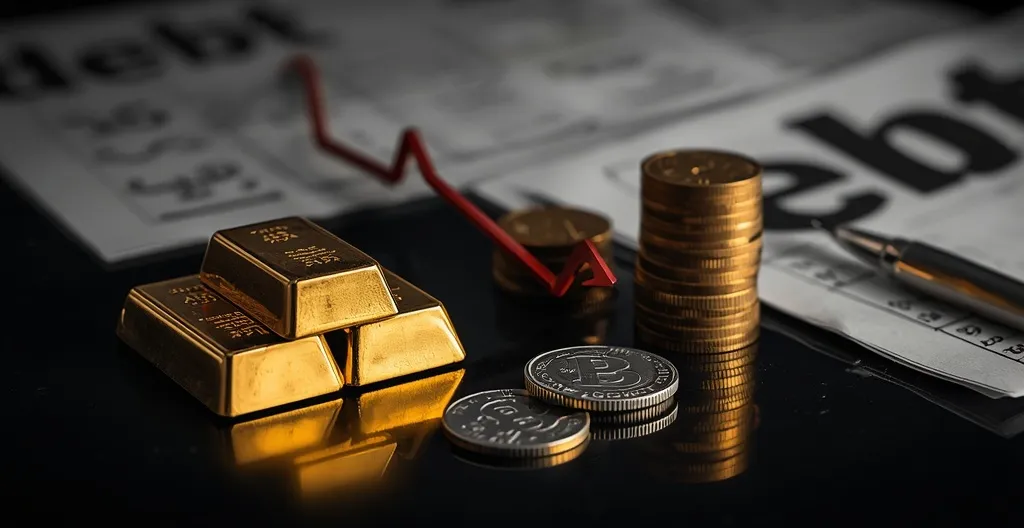
Robert Kiyosaki is back on his favorite drum kit: gold, silver, debt, inflation, and a healthy distrust of central banks. His latest message is simple enough, he’s buying the dip and still thinks precious metals are headed much higher.
- Dip-buying stance: Kiyosaki says he bought more gold and silver after a sharp pullback.
- Macro warning: He blames debt, inflation, and policymakers for the mess.
- Big targets, big skepticism: His eye-popping price calls are attention-grabbers, not valuation models.
- Long-term case still stands: Gold and silver remain credible hard assets, even if the timing is another matter.
The Rich Dad Poor Dad author posted on X after the latest metals volatility, quoting Jim Rogers as saying, “Gold and silver going to the moon.” Kiyosaki added that he bought more during the recent “retracement” or “crash.” In plain English, he treated the pullback as a buying opportunity, not a warning sign.
He also leaned into his standard anti-establishment message:
“The world economy is in great trouble, and I do not trust our leaders or central banks to solve the problem. In fact they are the problem and things like debt and inflation will only go up”
Then came the sort of line Kiyosaki has built a career on:
“What are you going to do? Buy high sell low. Or: Buy low and get rich? Gold and silver are going to the moon!!!!”
That’s classic Kiyosaki: punchy, provocative, and made to sound like the monetary system is one bad headline away from a full breakdown. Sometimes he’s tapping into a real macro concern. Sometimes he’s just cranking the volume to eleven.
What happened to gold as an investment and silver?
The immediate backdrop was geopolitical tension in the Middle East, which has a way of making traders nervous and safe-haven assets move around like they’ve had too much coffee. The source says the metals were hit by a sharp reversal after strong gains, but the bigger point is the volatility itself. When fear gets crowded, profit-taking can hit just as hard as the original bid.
For readers new to the term, a retracement is simply a pullback after a price rises. A crash is the uglier version, a fast drop that leaves late buyers staring at the chart like it owes them money.
According to the figures provided, gold had climbed to around $4, 000 before slipping back to about $4, 006, while silver traded near $56. The notes also refer to a broader spike and reversal in which gold was said to have reached $5, 405 and silver $118 before pulling back sharply, though those numbers should be treated cautiously unless independently verified.
The key point is not whether every quoted level is perfect down to the penny. It’s that the metals have been volatile enough to invite both panic and chest-thumping predictions.
Why Kiyosaki keeps making this call
Kiyosaki’s view is built on a familiar macro thesis: debt keeps rising, inflation does not disappear because officials say nice things on television, and central banks are not the magical problem-solvers people hope they are.
That argument isn’t crazy. Gold is widely seen as a hedge against inflation, currency weakness, and geopolitical stress. Silver plays a similar role, but it’s even more volatile because it has both monetary demand and industrial demand. That dual identity can be a blessing in a bull market and a faceplant in a correction.
There’s also a boring but important market reality behind precious metals. When interest rates are high, cash and bonds become more attractive because they actually pay you something. Gold doesn’t yield anything. It just sits there looking shiny and morally superior.
A stronger U.S. dollar can also pressure gold and silver. So even if the long-term thesis remains intact, the path higher is not supposed to be smooth. Anyone selling “easy money” in metals is usually selling fairy dust with a ticker symbol.
The huge targets are the part that needs a cold shower
The source revisits Kiyosaki’s earlier price calls, including $27, 000 gold, $100 silver, and $250, 000 Bitcoin by 2026. It also cites later forecasts attributed to him for $35, 000 gold, $200 silver, $750, 000 Bitcoin, and even Ethereum at $95, 000.
Those are not valuation targets in any traditional sense. They’re thesis bombs.
To be fair, the source says his $100 silver call in 2025 “was actually right” because silver did reach that level. But the bigger numbers remain exactly what they look like: huge calls that would require a serious breakdown in confidence, a major monetary shock, or both.
The same source argues that gold at $27, 000 or $35, 000 would represent roughly a 7x to 9x move from current levels. That kind of move is not impossible over a long enough horizon. Gold did stage a major run from 2000 to 2011. But expecting that scale of move in the next year or two is a very different claim.
That’s the gap Kiyosaki often skips over. A long-term bull case can be reasonable while the near-term target is still wildly overstated.
He has also reportedly acknowledged that his silver call could be wrong, which is more humility than many market prophets bother with. Credit where it’s due: at least he leaves the door open a crack. Most online forecasters act like every chart was handed down from Mount Olympus in a leather jacket.
What readers should actually take from this
The useful takeaway is not that gold and silver are guaranteed to explode tomorrow. It’s that Kiyosaki is using a volatile pullback to reinforce a broader belief: when debt, inflation, and geopolitical risk are all flashing red, hard assets deserve a place on the radar.
The less useful takeaway is that anyone should build a portfolio around giant social-media price targets. Extreme calls can be directionally right and still useless for timing. A good macro thesis can produce terrible short-term guidance.
So the balanced view is this: the long-term case for gold and silver remains real, but the exact numbers being thrown around should be handled with a very large grain of salt. Preferably a salt mine.
Key takeaways
-
Why is Kiyosaki bullish on gold and silver?
He says debt, inflation, and weak leadership make hard assets more attractive, especially when markets are rattled. -
Did he buy the recent dip?
Yes. He said he bought more gold and silver during the recent “retracement” or “crash.” -
Are his huge price targets realistic near term?
Probably not. A move to $27, 000 or $35, 000 gold would be enormous and would likely require a major macro shock, not just a routine rally. -
Why can silver move so violently?
Silver has both investment and industrial demand, which makes it more volatile than gold in both directions. -
Should investors ignore hard assets because the targets sound wild?
No. The long-term case for holding some gold or silver as monetary insurance is still coherent, even if the timing calls are questionable.
Kiyosaki’s latest message is vintage Kiyosaki: bold, defiant, and built to make headlines. The core warning, distrust easy promises, own scarce assets, and stay alert to inflation and monetary games, is not irrational. The exact price targets, though, deserve a heavy dose of skepticism.
Gold and silver may still have more upside ahead. Just don’t confuse a real macro thesis with a fortune cookie wearing a gold chain.
Further reading
A few related reads on gold, silver, Bitcoin, and the macro mess driving all of it:
- Robert Kiyosaki’s latest gold and silver price call
- Understanding the impact of climate change on global markets
- Reuters: gold hits record highs as safe-haven demand lifts silver
- Yahoo Finance: Kiyosaki’s Ethereum and crypto outlook
- ECB: gold demand, the official sector, and geopolitics
- Reuters: gold edges higher on a weaker dollar and Fed outlook
- Bitcoin vs. silver and oil as inflation hedges
- Gold and silver hit 2026 records as Bitcoin faces a wake-up call
- Bitcoin crashes 30% as gold and silver soar


