
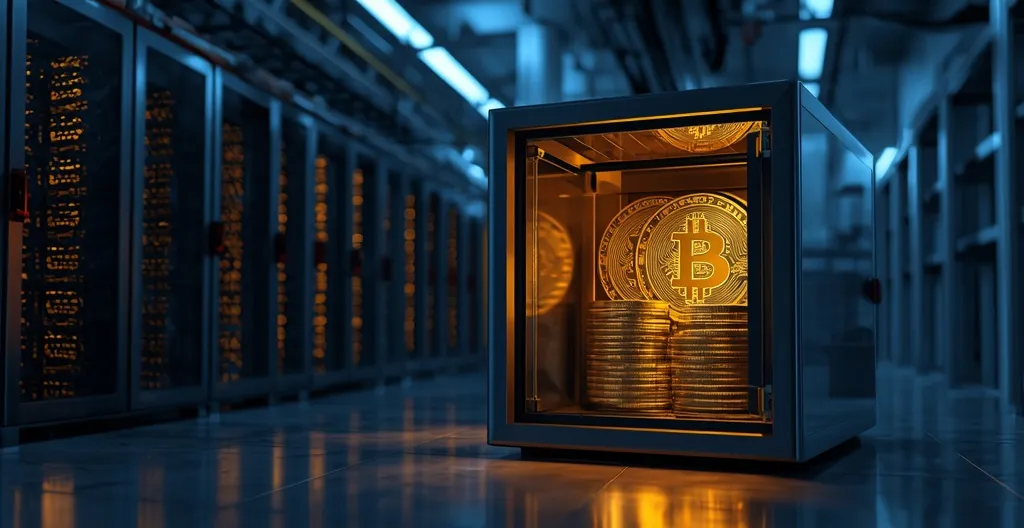
MARA pledges 18, 750 BTC for $600 million in new loans
MARA Holdings has turned a big slice of its Bitcoin treasury into borrowing power, pledging 18, 750 BTC as collateral for $600 million in new loans. That gives it cash now, but it also ties more of the company’s future to Bitcoin staying well above trouble.
- $600 million in new borrowing secured on Aug. 4
- 18, 750 BTC pledged as initial collateral, worth about $1.2 billion at disclosure time
- Financing from Coinbase Credit and Two Prime Lending
- Fresh capital supports MARA’s energy and infrastructure push, but adds volatility and collateral risk
The collateral pledge was disclosed in MARA’s Aug. 6 quarterly filing with the U.S. Securities and Exchange Commission. At the end of June, the company reported holding 35, 577 BTC, so the pledged coins amount to roughly 53% of its quarter-end Bitcoin stash. More than half the reported treasury is now tied up as loan support. Not exactly the old-fashioned “stack sats and chill” playbook.
To be clear, pledged BTC is not sold BTC. The coins are locked up as security for a loan, which lets MARA access cash without dumping more Bitcoin into the market. That is the upside. The catch is just as obvious. If BTC falls sharply, the company may need to post more collateral, and the lenders have contractual remedies if MARA fails to keep up.
The structure is split between two lenders. Coinbase Credit provided a $450 million facility, made up of $300 million in fresh funding and refinancing of MARA’s existing $150 million credit line. Two Prime Lending provided a separate $300 million term loan. The combined principal across the two facilities is $750 million, but only $600 million is new borrowing.
Coinbase’s debt floats at the midpoint of the federal funds target range plus 3.875%. With the Federal Reserve keeping its target range at 3.50% to 3.75% on July 29, that puts the current rate at about 7.5%. The Two Prime loan carries a fixed annual interest rate of 7.65%. Both mature in August 2028.
That is not cheap money. If both facilities were fully outstanding for a year, they would generate about $56.7 million in annual interest expense. That kind of bill looks manageable when Bitcoin is ripping and a lot less charming when the market turns into a meat grinder.
MARA’s latest financing sits inside a broader balance-sheet shuffle. At June 30, the company already had 4, 528 BTC pledged as collateral and another 4, 742 BTC loaned to third parties. During the first six months of 2026, MARA sold about 23, 093 BTC for $1.6 billion. In the first quarter, it sold 20, 880 BTC and used part of the proceeds to repurchase convertible debt.
By June 30, MARA said total debt had fallen to about $2.4 billion from $3.6 billion at the end of 2025. That is a real reduction, but it does not mean the company has gone conservative. It has simply been moving pieces around, selling BTC, paying down some debt, and then borrowing again against BTC to fund expansion.
That strategy makes sense if you think MARA is becoming more than a Bitcoin miner. The company is pushing into energy infrastructure, Bitcoin mining, AI, and high-performance computing. In April, it announced a planned acquisition of Long Ridge Energy & Power in Hannibal, Ohio, at an enterprise value of about $1.5 billion, including assumed debt. Long Ridge includes a power generation business and more than 1, 600 acres.
In July, MARA also agreed to acquire a powered site in Matagorda County, Texas, covering more than 1, 200 acres. The purchase price can reach $600 million through milestone-based payments, and MARA says the site could eventually support up to 2 GW of capacity.
That is the real thesis here: power, land, and compute are becoming the core assets, with Bitcoin acting as both treasury reserve and financing collateral. If the company can turn cheap energy and industrial sites into durable contracts for mining, AI, or high-performance computing, the pivot could look smart. If not, it becomes an expensive pile of acreage and ambition.
MARA said it “expects to use the proceeds” for general corporate purposes, including financing part of the cash consideration for its planned Long Ridge Energy & Power acquisition.
That wording is worth reading carefully. It suggests a connection to the Long Ridge deal, but not a neat, one-loan-for-one-acquisition setup. Money is fungible. Corporate finance loves to dress that up, but the point is simple: the cash can support the Ohio transaction and broader operations, depending on what MARA needs at the time.
There is also a Barclays-backed bridge facility in the background. MARA has a commitment for a 364-day senior secured bridge facility of up to $785 million as backstop financing for Long Ridge. The acquisition could also trigger a $75 million termination fee if it is not completed by Nov. 30, 2026, though that deadline can extend to June 30, 2027 if certain regulatory issues remain unresolved.
MARA says Long Ridge generated approximately $144 million of annualized adjusted EBITDA based on second-half 2025 performance. Adjusted EBITDA strips out interest, taxes, depreciation, and amortization, which makes it a useful operating gauge, and also a favorite metric of companies that want to make a capital-heavy business look cleaner than it may feel in real life. On its own, it is not proof that the economics are bulletproof.
The company also says it has seen inbound interest from potential investment-grade AI and critical IT tenants. That may be encouraging, but “inbound interest” is management-speak that can range from serious pipeline activity to a few polite emails and a lot of PowerPoint oxygen. No completed tenant contracts were cited in the disclosed material, so investors should keep their feet on the ground.
The bigger picture is that MARA is no longer behaving like a pure Bitcoin treasury story. It is using BTC as a financing tool, a liquidity buffer, and a balance-sheet weapon. That can be effective. It can also get messy fast if Bitcoin weakens, borrowing costs stay elevated, or the infrastructure buildout takes longer than the pitch deck suggests.
Bitcoin-backed lending is attractive for obvious reasons. It lets a holder access cash without selling coins and without immediately giving up the upside if BTC rallies. But the trade-off is just as obvious: the borrower is now exposed to price swings, collateral thresholds, and the ugly possibility of forced remedies if the market moves the wrong way.
MARA’s move is a clean example of both sides of that trade. On one hand, the company is reducing debt and raising capital without issuing more equity. On the other, it is piling more obligations onto a treasury that is already heavily encumbered. That is not reckless by default, but it is definitely not free money either.
Bitcoin, when used as pristine collateral, can be powerful. Bitcoin, when used to fund a capital-intensive expansion during a volatile cycle, can also turn into a very sharp edge. MARA is betting it can keep both hands on the wheel.
Key takeaways
-
Why did MARA borrow against Bitcoin instead of selling more BTC?
Borrowing gives MARA cash while preserving upside exposure to Bitcoin. The downside is that the coins are locked up as collateral, which brings collateral maintenance and liquidation risk. -
How much Bitcoin did MARA pledge?
It pledged 18, 750 BTC as initial collateral, worth about $1.2 billion at the time of disclosure. -
Is the full $750 million all new money?
No. The combined facilities total $750 million of principal, but only $600 million is fresh borrowing. The other $150 million refinances an existing line. -
What are the loan rates?
Coinbase Credit’s loan floats at the midpoint of the federal funds target range plus 3.875%, which works out to about 7.5% at current Fed levels. Two Prime’s loan is fixed at 7.65%. -
What happens if Bitcoin weakens sharply?
MARA may need to post more collateral. If it does not, the lenders could exercise contractual remedies under the loan agreements. -
Is Long Ridge already producing AI revenue?
Not based on the disclosed information. MARA says it has received interest from potential tenants, but no completed AI tenant contracts were cited. -
Is MARA in better financial shape than before?
Mixed. Total debt fell to about $2.4 billion by June 30 from $3.6 billion at the end of 2025, but the company is still highly exposed to Bitcoin volatility and expensive infrastructure bets.
The cleanest read is this: MARA is trying to turn Bitcoin into productive capital while building out power and compute infrastructure. That can work. It can also go sideways fast if BTC weakens, financing stays pricey, or the AI-hosting dream proves harder to monetize than the slide deck promised.
Further reading
- MARA Pledges 18, 750 BTC for $600M in New Loans
- MARA Holdings Q2 update on Yahoo Finance
- MARA Expands Energy Capacity with $1.5 Billion Acquisition
- The Bitcoin lending renaissance
- Bitcoin-backed lending: opportunities and considerations
- MARA Pledges 18750 BTC for $600 Million New Bitcoin-Backed Loans
- MARA Holdings Spends $46M on 400 BTC, Boosts Treasury to $6.12B
- MARA Holdings to Raise $2 Billion in Stocks for Bitcoin and Mining Expansion
- MARA Holdings Raises $2B to Buy Bitcoin, Shifts Strategy Post-Halving


