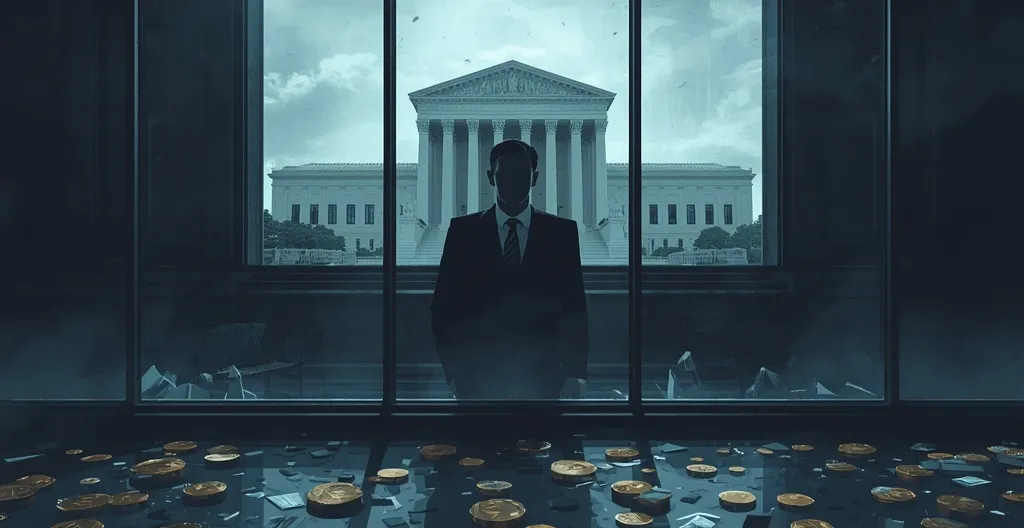
Sam Bankman-Fried Asks the Supreme Court to Overturn His Conviction and $11 Billion Forfeiture
Sam Bankman-Fried has filed a petition asking the U.S. Supreme Court to review and overturn his fraud conviction and a roughly $11 billion forfeiture order tied to the collapse of FTX and Alameda Research.
- It’s a request for review, not a guaranteed hearing.
- His legal team is challenging both the conviction and the forfeiture order.
- The key arguments center on trial evidence and whether the financial penalty is excessive.
The filing is the latest and likely final high-profile swing from the former FTX chief executive, who is serving a 25-year prison sentence after his November 2023 conviction on seven fraud and conspiracy counts. The Supreme Court has not agreed to take the case. This is a petition for a writ of certiorari, which is a formal request for the justices to review what happened in the lower courts.
For readers who do not spend their weekends reading appellate filings, a petition for certiorari is not the same thing as an appeal of right. The Supreme Court picks only a small fraction of the cases it is asked to hear. Most petitions are denied without much fanfare. No gold star, no express lane, no miracle button.
The number getting attention here is the roughly $11 billion forfeiture order. That figure refers to the amount Bankman-Fried was ordered to give up as part of the criminal case, separate from the bankruptcy process that is handling creditor claims and customer recoveries. That distinction matters. Forfeiture is a criminal remedy aimed at assets tied to wrongdoing. Bankruptcy is the civil process that deals with who gets paid, how, and from what remains of the estate.
His lawyers are reportedly arguing that the trial court unfairly limited evidence about FTX’s assets and whether customers could have been repaid, and that the prosecution’s presentation of losses distorted the picture for jurors. They are also challenging the forfeiture as an excessive financial penalty under the Eighth Amendment, which prohibits excessive fines. In plain English: they are saying the punishment went too far.
That is a serious legal argument, even if the odds are still long. Courts do sometimes step in when a trial or sentence crosses a constitutional line. But appellate courts also give trial judges a lot of room on evidence rulings, and financial penalties tied to large-scale fraud can get very large very quickly when the underlying conduct was huge. FTX was not a roadside shakedown. It was a catastrophe with a balance sheet attached.
The broader crypto angle is hard to ignore. The FTX collapse remains one of the ugliest failures in the industry’s history, and not because of Bitcoin, open networks, or the logic of decentralization. The damage came from centralized custody, sloppy controls, opaque accounting, and a culture that treated basic governance like an optional extra. That is the part of crypto that deserves ridicule, not the protocol layer that was supposed to make this whole mess less trust-dependent in the first place.
Still, criminal process is supposed to be fair even when the defendant is deeply unpopular. If the defense is right that the jury was kept from hearing relevant evidence, that is not a trivial issue. And if the forfeiture truly stretches into excessive-fine territory, courts should at least look at it with clear eyes instead of turning the case into a moral theater performance. Justice is not supposed to run on vibes and headlines, no matter how richly earned the outrage is.
What happens next is procedural, not dramatic: the Supreme Court can deny the petition outright, ask the government to respond, or decide later whether the case is worth hearing. The most likely outcome in cases like this is simple denial. The Court is selective by design, and high-profile names do not change that math.
What Bankman-Fried is trying to do
Bankman-Fried is trying to persuade the justices that the lower courts made legal errors serious enough to warrant review. In practical terms, that means arguing the jury did not hear enough about FTX’s financial condition and that the forfeiture order was unconstitutionally steep.
The government will almost certainly argue the opposite: that the conviction was sound, the sentence was lawful, and the forfeiture reflects the scale of the fraud. With FTX, the scale was enormous. The legal system tends to get less sentimental when the alleged misconduct reaches the “destroyed billions and vaporized trust” tier.
For crypto investors and builders, the case is another reminder of an old lesson dressed up in new branding: centralized exchanges can fail spectacularly when there is no real transparency, no real segregation of customer assets, and no real accountability until the house burns down. That is not a failure of decentralized systems. That is a failure of human beings with too much power and too little restraint.
Key questions and takeaways
-
Is Sam Bankman-Fried asking the Supreme Court to hear his case?
Yes. He has filed a petition asking the Court to review his conviction and forfeiture order, but the justices have not agreed to take it. -
What is he trying to overturn?
He is seeking to overturn his fraud conviction and the roughly $11 billion forfeiture order tied to the FTX collapse. -
What does forfeiture mean here?
It is a criminal penalty that requires a defendant to surrender assets connected to the offense. It is separate from the bankruptcy process that handles creditor claims. -
What is the Eighth Amendment argument?
His lawyers say the forfeiture is an excessive fine and therefore unconstitutional under the Eighth Amendment. -
Does this change FTX creditor recoveries?
Not directly. Bankruptcy payouts are handled through a separate civil process, not by the Supreme Court petition. -
How likely is Supreme Court review?
Not very likely. The Court accepts only a small fraction of petitions, and most are denied without explanation.
Sam Bankman-Fried appeals FTX fraud conviction to ...
Sam Bankman-Fried Appeals FTX Fraud Conviction to Supreme
SBF Appeals to Supreme Court to Overturn $11 Billion FTX
Please provide the HTML content for me to extract or
17-1091 Timbs v. Indiana (02/20/2019)
Sam Bankman-Fried’s latest legal move may keep the FTX saga in the headlines, but it does not rewrite the underlying story. Centralized custody without real controls is a disaster waiting to happen. The industry learned that the hard way. Anyone pretending otherwise is selling fairy dust in a spreadsheet.