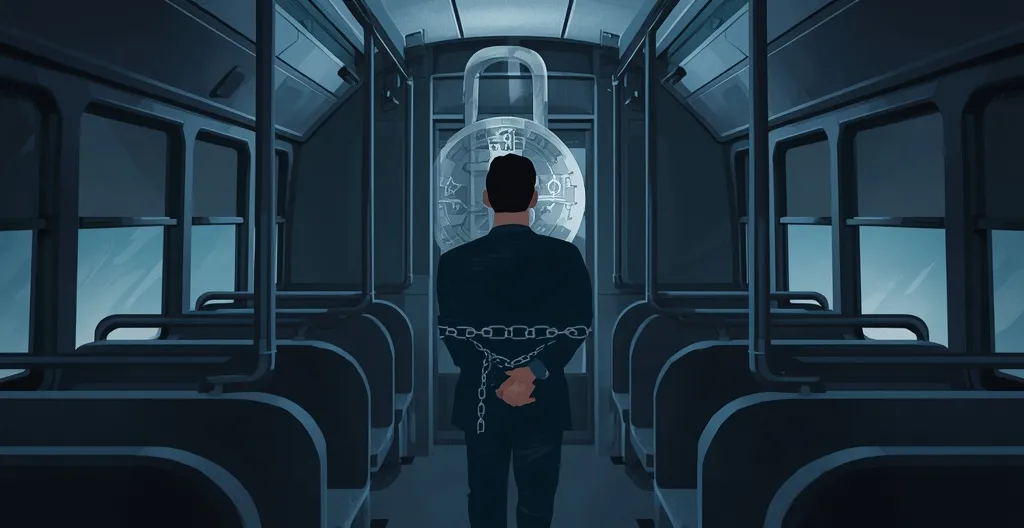
Samourai co-founder says another prison transfer is coming after a brutal 30-day move
Keonne Rodriguez, the Samourai Wallet co-founder who received a five-year prison sentence, says he may be headed for yet another transfer after the drug-treatment program at FCI McKean was shut down. On paper, that sounds like routine prison bureaucracy. In practice, it can mean another round of buses, restraints, waiting rooms, and lost time, the federal system’s favorite hobby.
- Rodriguez says FCI McKean ended its drug-treatment program
- He says roughly 70 inmates may be transferred
- His last move took 30 days for a trip that should have taken hours
- The Samourai case still sits at the center of the crypto privacy debate
Rodriguez posted about the situation on X on September 24, saying the prison’s Residential Drug Abuse Program, or RDAP, had been shut down and that he could be moved again if he wants to keep participating. RDAP is a federal drug-treatment program for eligible inmates that can lead to a sentence reduction if the program is completed and Bureau of Prisons rules are satisfied. The Small Business Administration says inmates in qualifying cases may receive an early-release reduction, with the amount depending on sentence length and program requirements. Nothing about it is automatic, despite the way prison lore sometimes makes it sound like a magical coupon for time off.
For Rodriguez, the stakes are not abstract. A transfer can disrupt treatment, add months of uncertainty, and complicate any chance at getting the maximum benefit from the program. If the treatment spot disappears, the inmate goes where the system tells him to go. Choice is not exactly the brand here.
Rodriguez says this is not his first ugly federal move. He described his previous transfer from FPC Morgantown in West Virginia to FCI McKean in Pennsylvania as the “absolute worst 30 days, ” even though the facilities are only about a four-hour drive apart. According to his account, the transfer began on June 10 after officials denied his request for a transfer furlough on June 8. He said the journey involved buses, two flights, and a stop at the Federal Transfer Center in Oklahoma City. He also said he was placed in ankle restraints and handcuffs secured to a waist chain, and that he shared a cell with a man serving a murder sentence.
The Bureau of Prisons had not published a separate notice confirming the McKean program shutdown at the time of reporting, so Rodriguez’s account remains just that, his account. But if the program did end, the result is simple enough. Inmates trying to remain in RDAP may have to move, and the prison system gets to add another layer of pointless misery to a process that already has plenty.
That immediate headache sits on top of a much larger and messier story.
Rodriguez and co-founder William Lonergan Hill pleaded guilty in July to conspiracy to operate an unlicensed money-transmitting business. Rodriguez received a five-year sentence, and prosecutors in the U.S. Attorney’s Office for the Southern District of New York said Samourai transmitted more than $237 million in traceable criminal proceeds through its services. Those funds were linked to darknet markets, fraud, cybercrime, sanctioned jurisdictions and other offenses.
That “traceable” part matters. In this context, prosecutors were not claiming every dollar that passed through Samourai was criminal; they were saying they could identify a large pool of funds tied to illegal activity that moved through the platform. Samourai’s privacy tools, Whirlpool and Ricochet, were at the center of that case. Whirlpool was a coin-join style mixing protocol, designed to combine transactions and make on-chain tracing harder. Ricochet added extra transaction hops between sender and receiver to obscure links further.
That is the tension in one sentence: privacy tools can protect ordinary users on Bitcoin’s transparent ledger, and the same tools can also be attractive to criminals who do not want a clean paper trail. Same software, wildly different use cases. Welcome to crypto, where the tech is often neutral and the human beings are the problem.
Prosecutors said more than 80, 000 BTC, then valued above $2 billion, moved through Samourai’s services after launch. According to the Justice Department, Rodriguez and Hill also paid roughly $6.37 million in forfeiture representing Samourai fees. Judge Denise Cote imposed a prison sentence, a $250, 000 fine, and three years of supervised release for Rodriguez.
The defense has argued that Samourai was built to preserve financial privacy, not to run a laundering shop. That argument is not insane. Bitcoin’s base layer is public by design, which means people who do not want every payment exposed to the world often need privacy tools. The real legal fight is not whether privacy software exists. It is whether developers crossed the line by knowingly catering to criminal users instead of building general-purpose tools and letting the market sort out the rest.
That distinction is where the case becomes bigger than one wallet app. The broader policy fight is over whether non-custodial crypto developers, meaning developers who do not hold or control user funds, should be treated like money transmitters. If lawmakers and regulators blur that line too far, software builders can get dragged into the same bucket as actual intermediaries, even when they never touch customer assets. That is a fantastic way to kill innovation with a compliance crowbar.
Privacy groups and crypto policy advocates have been pushing back hard on that risk. Coin Center has urged lawmakers to preserve protections for non-custodial blockchain developers. The final Senate CLARITY Act Showdown: Why Tomorrow's Senate Vote text released September 14 included language derived from the Blockchain Regulatory Certainty Act, and Senator Cynthia Lummis’s office said that language would “shield qualifying developers from money-transmission registration requirements and create a civil safe harbor.”
That sounds like a reasonable line to draw: protect software developers who never take custody of funds, while still letting prosecutors go after people who actually run illicit financial operations. The problem is that Washington loves to turn clean distinctions into mush the moment lobbyists, politics, and fear get involved.
The Senate did not advance H.R. 3633 on September 15, after the cloture motion failed 49-50. Republican Senator Susan Collins said the bill needed more study, including questions over community-bank deposits. Democratic senators including Catherine Cortez Masto and Angela Alsobrooks raised concerns over ethics, illicit-finance enforcement, and other provisions. So the developer-protection debate remains unresolved, and the paperwork battlefield marches on.
That matters well beyond Samourai. The same argument is going to keep showing up in cases involving wallets, mixers, infrastructure software, and any tool that helps users keep their financial activity out of public view. If the law treats every privacy-preserving tool like a laundering engine because criminals also use it, then developers will respond the obvious way: stop building useful things. That would be a ridiculous self-own for a sector that claims to care about freedom, decentralization, and censorship resistance.
But the opposite overreaction is just as dumb. If operators knowingly solicit and serve criminal demand, they should not be shocked when prosecutors stop pretending this is just a harmless privacy experiment. Privacy is a right. Helping criminals hide is not a founding principle.
Rodriguez has also said he is still seeking presidential clemency while dealing with the realities of prison transfers and treatment eligibility. Whether that goes anywhere is another matter. Clemency is not a strategy; it is a long shot with a filing cabinet.
Key questions and takeaways
-
Why does RDAP matter to Rodriguez?
RDAP can offer eligible federal inmates a sentence reduction if they complete the program and meet Bureau of Prisons requirements. For someone serving five years, that possibility is worth fighting for. -
Why is the McKean program shutdown such a big deal?
If the treatment program really ended, inmates in RDAP may have to be transferred to another facility. That can interrupt treatment, delay progress, and turn a sentence-reduction path into a bureaucratic slog. -
What did Samourai Wallet do?
Samourai offered Bitcoin privacy tools, including Whirlpool and Ricochet, to make transactions harder to trace. Supporters see that as legitimate privacy tech; prosecutors said it was used to move criminal proceeds. -
Why is this case important beyond one developer?
It sits at the center of the fight over whether non-custodial crypto developers should be treated like money transmitters. The outcome affects wallet builders, privacy tools, and the broader future of financial software. -
Is the legal and policy fight settled?
No. The Senate setback shows federal policy remains unsettled, and the deeper question of how to draw the line between software development and money transmission is still wide open.
Bitcoin needs privacy tools if it is going to function as more than a chain-wide surveillance layer with a mascot. But developers who knowingly cater to criminals are not freedom fighters; they are lighting a fuse and acting surprised when the blast radius arrives. The hard part is telling the difference without turning every privacy tool into contraband. Washington, naturally, has made that harder than it should be.
Further reading
A few related pieces and tools for anyone tracking the Samourai fallout and the privacy debate around Bitcoin.
- Samourai co-founder faces new move after 30-day ordeal
- Samourai Wallet dev gets max sentence in case watched by privacy advocates
- Random password and multiword generator
- Samourai Wallet founders plead guilty, face 5 years in Bitcoin privacy crackdown
- Samourai Wallet founders plead guilty: Bitcoin privacy tools face DOJ crackdown