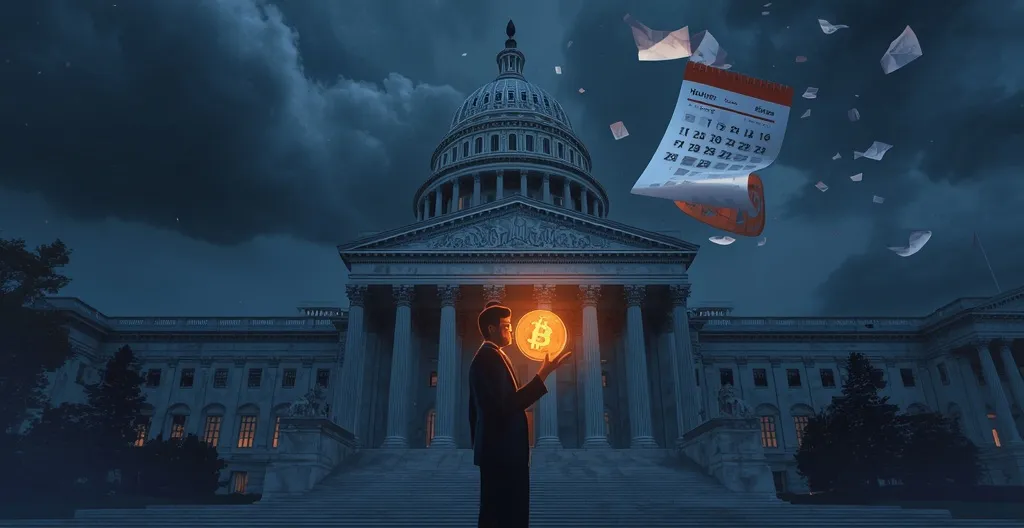
The SEC has pushed back a vote on crypto fundraising exemptions, adding more uncertainty to a market that already spends too much time guessing what Washington will do next.
- August 14 SEC meeting canceled
- Crypto fundraising exemptions left on ice
- Atkins is steering the SEC toward a looser approach
- CLARITY Act still has a rocky path in Congress
The U.S. Securities and Exchange Commission canceled its August 14 open meeting, which had been expected to consider crypto-related rule proposals. An SEC spokesperson said the meeting would be moved because of an “unforeseen scheduling issue”. No replacement date was announced.
That sounds mundane. It is not. In crypto regulation, a delay is often a sign that the gears are still grinding, and not always in a good way.
The postponed vote would have covered proposed exemptions that could make it easier for crypto startups to raise capital without following the full set of traditional securities offering rules. In plain English, the SEC was weighing whether some crypto businesses should get a lighter path when raising money from investors.
That matters because startup fundraising under the usual securities framework can be slow, expensive, and paperwork-heavy. For legitimate founders, that can mean years of legal drag before a real product even gets off the ground. For scammers, it can also mean fewer easy excuses. The trick is finding a middle ground that does not choke innovation or hand grifters a fresh costume.
Separate from the SEC delay, the broader legislative push around crypto also hit a wall. The Senate left for a five-week recess without voting on the CLARITY Act, the industry’s top federal policy priority. Reuters reported that the missed vote suggested the bill’s chances had dimmed. The bill would create new federal rules tailored to cryptocurrencies and put companies on firmer legal footing, according to lobbyists cited by Reuters.
Congress.gov identifies the legislation as the Digital Asset Market Clarity Act of 2025. It passed the House on July 17, 2025, by a vote of 294 to 134, and was later received in the Senate. So this is not vaporware or a press-release fantasy. It is a real bill with a real legislative trail, even if Washington has a habit of dragging its feet when crypto is involved.
Those two developments are related only in the broad sense that both affect crypto policy. They are not the same process. One is SEC rulemaking. The other is congressional legislation. Mixing them together only muddies the waters, and crypto already has enough murk to make a swamp jealous.
Under SEC Chair Paul Atkins, the agency has been moving in a more crypto-friendly direction, at least by the standards of the agency’s recent history. Reuters reported that the SEC has rescinded stringent crypto accounting guidance and dismissed lawsuits against Coinbase, Binance, and other companies. Reuters also reported that Atkins has backed the view that most tokens more closely resemble commodities than securities.
That distinction is the whole fight.
If a token is treated as a security, issuers generally face registration, disclosure, and compliance requirements built for traditional capital markets. If it is treated more like a commodity, the regulatory load can be lighter and the oversight can shift. But this is not a magic switch. Legal treatment can depend on how a token is issued, sold, and promoted, not just what the asset is called. The law cares about substance, not just the marketing department’s imagination.
In March, Atkins said the SEC was considering a safe harbor, a fit-for-purpose startup exemption, and an innovation exemption. A safe harbor is basically a temporary or conditional legal cushion. In this context, it could give companies breathing room to launch and raise funds without immediately being crushed by the full weight of securities law.
The startup exemption would be aimed at crypto entrepreneurs raising a certain amount of money or operating for a finite period while exempt from SEC rules. The innovation exemption, meanwhile, would let companies test new digital-asset business models without complying with every standard disclosure and investor-safeguard requirement.
That last part deserves a hard look. “Innovation exemption” sounds polished, but if the carve-out is too broad, it can become a convenience store for bad actors. Registration rules, periodic reporting, and basic disclosure exist for a reason. If those protections get stripped away too far, the result will not be bold innovation. It will be the same old hustle wearing a better jacket.
Reuters’ reporting on the proposal included the idea that the innovation exemption could cover experiments with blockchain-based stocks. That is not a trivial test case. Tokenized or blockchain-based equity raises hard questions about custody, transfer restrictions, settlement, market structure, and disclosure. Real capital markets are not a sandbox where regulators can wave a hand and hope the plumbing works itself out.
The bullish case for this shift is straightforward: if the SEC creates clearer exemptions, more crypto startups could raise money in the U.S. instead of fleeing to friendlier jurisdictions. That could help legitimate builders, improve capital formation, and stop the country from acting like it wants the upside of innovation without tolerating any of the actual innovation.
The skeptical case is just as valid. Looser fundraising rules can also invite thinner disclosure, weaker oversight, and a fresh crop of overpromising projects. Crypto does not suffer from a shortage of ideas. It suffers from too many people who think a token launch is a substitute for accountability.
The bigger picture is that U.S. crypto policy is still split between two tracks. The SEC is considering whether to soften the rules around fundraising and experimentation. Congress is still trying to settle the broader legal framework through the CLARITY Act. Until both pieces move with some consistency, companies are left operating in a regulatory fog that wastes time, burns cash, and forces serious builders to spend too much energy decoding bureaucratic mood swings.
What happens next will matter a lot. The SEC has not set a new date for the canceled meeting. The fate of the proposed exemptions remains unclear. And while the CLARITY Act has already made it through the House and into the Senate, that does not mean final passage is anywhere close to guaranteed.
For now, the most honest takeaway is simple: the SEC is signaling more flexibility, but the rules are still unwritten. In crypto, that is usually where the promise of progress meets the hard reality of paperwork.
Key questions and takeaways
-
Why does the canceled SEC meeting matter?
It delayed a possible vote on crypto fundraising exemptions that could have made it easier for startups to raise money under lighter SEC rules. -
What is a safe harbor in crypto regulation?
It is a temporary or conditional legal protection that gives companies more room to operate while reducing immediate regulatory risk. -
Why is the commodity-versus-security debate so important?
Because that classification helps determine which rules apply, how much disclosure is required, and which regulator has the upper hand. -
Is the CLARITY Act dead?
No. It has faced delays and political friction, but Congress.gov shows it passed the House and reached the Senate. -
What is the main risk of an innovation exemption?
If it is written too broadly, it could weaken investor protections and create room for sloppy projects or outright scams.
Further reading
A few useful reference points on the SEC’s crypto posture and the broader regulatory mess.