
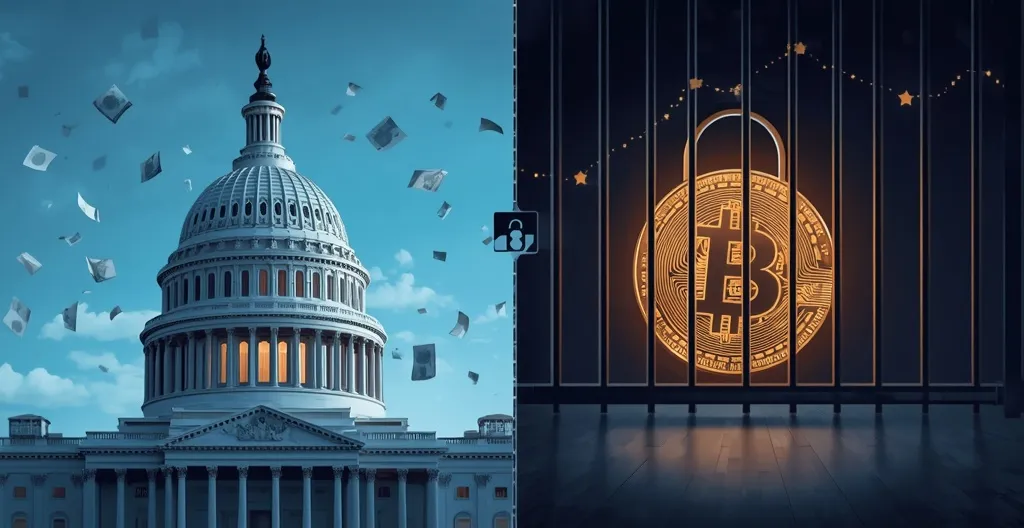
A Senate housing package could temporarily block the Federal Reserve from issuing a U.S. central bank digital currency, or CBDC, until December 31, 2030. That is not a tidy little four-year pause. It is a much firmer political barricade.
- CBDC ban, not just a delay
- Housing bill used as the vehicle
- Fed has not committed to a digital dollar
- Private digital dollar systems are not the target
The distinction matters. A CBDC is government money in digital form, issued by the central bank. Supporters sell it as a payments upgrade. Critics hear something else: more surveillance, more control, and a shiny new way for the state to keep score. For a basic definition of central bank digital currency, that is the gist in plain English.
According to a March 2026 analysis from Mayer Brown, the Senate’s housing package includes Section 1001, which would temporarily prohibit the Federal Reserve or a Federal Reserve Bank from issuing or creating a CBDC, or anything substantially similar. The restriction would run through December 31, 2030. The 21st Century ROAD to Housing Act: Key Provisions and analysis lays out that structure in more detail.
That is the key point getting flattened by the “four-year brake” framing. It is more accurate to call this a temporary prohibition with a specific end date, not a vague pause. Congressional language loves precision when it wants to be slippery.
The broader vehicle is the What's in the 21st Century ROAD to Housing Act? The CBDC language is only one part of a much larger housing and mortgage bill that also covers issues such as regulatory streamlining under NEPA, institutional investors and single-family homes, CFPB studies on mortgage loan originator compensation and points and fees, and efforts to expand the pool of appraisers.
That’s how Washington often moves controversial policy, tuck it into a bigger bill and hope the noise gets lost in the furniture. A standalone anti-CBDC bill would invite a direct fight over privacy, banking power, monetary control, and whether the Fed should be anywhere near retail digital money. In a housing package, the issue becomes harder to isolate and easier to move. That is exactly the sort of legislative sleight of hand that keeps people looking for the New Senate housing bill may put a four-year brake on a U.S while missing the fine print.
The Federal Reserve, for its part, has not decided to issue a CBDC. It says it has made no decisions on whether to pursue or implement one and has been studying the potential benefits and risks. So despite all the breathless “digital dollar is coming” chatter, the U.S. is still nowhere near an announced rollout. The Fed’s own overview of Central Bank Digital Currency (CBDC) makes that caution explicit.
That caution does not mean the debate is harmless. A CBDC would be a digital liability of the central bank available to the general public. In plain English: public money, but on programmable rails owned by the state. If that sounds benign, you may also enjoy being told your permissions are “user-friendly.”
The risk critics focus on is not fantasy. Depending on how it is designed, a CBDC could make transaction surveillance easier, enable restrictions on how money is used, or give policymakers a cleaner line of sight into everyday spending. That is exactly why Bitcoiners, privacy advocates, and anyone with a healthy distrust of central authority get twitchy when the phrase “digital dollar” shows up in a bill summary. The Senate’s own No CBDC Act shows that this skepticism is not exactly fringe anymore.
The Mayer Brown analysis also says the bill would not restrict a dollar-denominated currency that is open, permissionless and private, and would not alter the privacy protections of U.S. coins and physical currency. That matters because it draws a line between a state-issued CBDC and private dollar-based digital systems.
Stablecoins are the obvious comparison. They are privately issued tokens designed to track the dollar, and they are not the same thing as a CBDC. One is public money issued by the central bank. The other is private money-like infrastructure built by companies. Similar rails, very different power structure. The Fed even separates its explanations of the concept from its broader Central Bank Digital Currency (CBDC) material and its public-facing FAQs, which is a useful reminder that “digital dollar” is not one neat bucket.
If that carveout holds, the bill is not trying to ban every digital dollar-shaped instrument on earth. It is trying to keep the Fed out of the business of issuing a retail CBDC while leaving room for private-sector alternatives. Whether that is the right line depends on what you value more: financial innovation or keeping the state’s hands off the payment stack.
There is also a separate anti-CBDC effort in the Senate. S.464 - No CBDC Act was introduced by Sen. Mike Lee (R-Utah) on Feb. 6, 2025 and assigned to the Senate Banking, Housing, and Urban Affairs Committee. Congress.gov says there is no latest action for the bill, and as of 06/23/2026, text had not been received.
That tells you this is not a one-off stunt. Anti-CBDC politics keep resurfacing because the underlying fight is real: who controls money, who sees transactions, and whether digital payments should be built around public surveillance risks or private competition. Spoiler: the people selling “efficiency” rarely mention the part where efficiency can also mean easier control.
To be fair, the pro-CBDC case is not imaginary. A well-designed public digital currency could, in theory, improve payment settlement, reduce friction, and offer a public alternative to private payment monopolies. That is the best version of the pitch. The problem is that once the central bank owns the rails, every future administration inherits the temptation to use them for more than payments.
And that is why the precise legislative language matters so much. This is not just a “four-year brake” on a digital dollar. Based on the available information, it is a temporary prohibition through the end of 2030 on the Federal Reserve creating or issuing a CBDC or something substantially similar. In other words: Washington is not merely hesitating. It is writing the brakes into the bill text.
Key questions readers should be asking
-
Does the housing bill ban a U.S. CBDC?
It appears to temporarily prohibit the Federal Reserve or a Federal Reserve Bank from issuing or creating one, or anything substantially similar, until December 31, 2030. -
Is “four-year brake” accurate?
No. Based on the available information, that wording is misleading. The cited timeline runs to a specific date in 2030, not a simple four-year pause. -
Has the Federal Reserve decided to launch a digital dollar?
No. The Fed says it has made no decisions on whether to pursue or implement a CBDC and is still studying the risks and benefits. -
Why is CBDC language attached to a housing bill?
Large legislative packages are often used as vehicles for unrelated provisions. It is a familiar Washington tactic: attach the controversial rider to the bill that already has momentum. -
Does this target Bitcoin or private stablecoins?
Not directly. The described carveout is aimed at state-issued digital money, while private dollar-denominated systems are treated differently. Bitcoin’s core use case as decentralized money sits in a separate category altogether.
The Senate may still change the language, strip it out, or kick the whole mess down the road. But the direction is clear enough: the U.S. CBDC fight is no longer just a policy seminar for economists. It is becoming an actual legislative battle, and the Fed is now in the crosshairs whether it likes it or not.


