
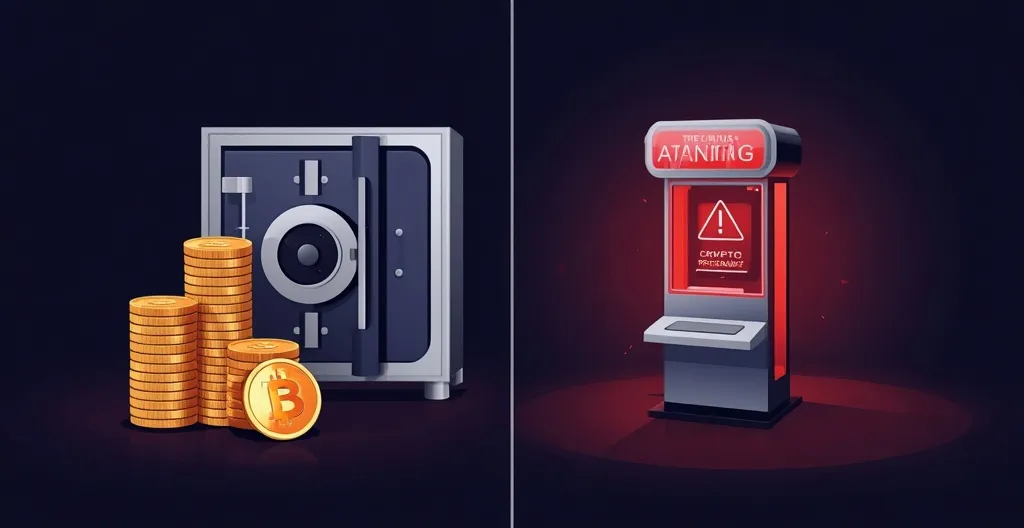
Bitcoin treasury buying is still doing what it does best: reminding markets that scarcity is not a meme. Strive has added to its BTC stack, while Pepeto is pushing a far riskier story, a presale wrapped in utility claims, big APY promises, and upside math that belongs in a casino brochure, not a sober memo.
- Strive’s BTC accumulation is real and the filing numbers matter more than the hype.
- Pepeto is a promotional presale with self-reported features that are not independently verified here.
- Solana and Cardano still matter, but their market caps limit the kind of upside a tiny presale can dangle.
- 100x-to-300x return talk is marketing, not a forecast.
Start with the part that has actual weight behind it: Strive’s Bitcoin accumulation. According to the company’s 8-K filing, Strive purchased 1, 110 bitcoin between August 17 and August 21, 2026 at an average price of about $73, 409 per bitcoin, bringing its total holdings to 21, 356 BTC.
That is a meaningful stack. It also shows why corporate Bitcoin buying keeps getting attention. When a public company converts cash into BTC, it is making a very clear statement: it would rather hold a scarce asset than sit on dollars that can be nibbled away by inflation, policy, and time. That does not make the move sacred. It does not mean every treasury buyer is a genius either. Sometimes it is conviction. Sometimes it is a capital-markets flex. Sometimes it is both.
The bigger point is simple: verified accumulation matters. A filing-backed purchase is one thing. Social media fan fiction about giant corporate stacks is another. Crypto has enough nonsense already without pretending every treasury move is a moonshot catalyst.
Strategy remains the heavyweight in the room, and large corporate holders continue to shape the market narrative around Bitcoin as a treasury asset. But nobody should confuse “companies are buying BTC” with “number goes up forever.” That is not analysis. That is hope wearing a tie.
Then there is Pepeto, which is playing a very different game. The project says it has raised more than $10.9 million and describes itself as offering a cross-chain bridge, a zero-fee exchange, and an on-chain security scanner. It also says stakers are locking in at 163% APY, with the presale token priced at $0.0000001893.
Those claims sound slick. They are also exactly the kind of claims that deserve a hard squint. In crypto, “zero-fee” usually means the costs are simply hidden, shifted, or subsidized somewhere else. Nothing is free. If someone says it is, they are either selling something or getting you to stop asking questions.
The same skepticism applies to the scanner pitch. A tool that flags risky contracts can be useful, sure. But a scanner is not a magic shield against rugs, honeypots, or bad actors who know how to dress a scam in a clean interface. It can help surface danger. It cannot turn a bad trade into a safe one.
And that 163% APY? Annual percentage yield is just the annualized return rate, and in crypto it is often driven by token emissions rather than real business revenue. That matters. A yield can look fantastic right up until the incentives run thin, the emissions hit price, or the rewards stop paying for themselves. High APY can be attractive bait. It is not the same thing as sustainability.
This is why presales are such a mixed bag. They exist because early buyers want asymmetry, the chance to get in before a token lists and, in rare cases, runs hard. But the same setup also attracts opaque tokenomics, thin liquidity, insider allocation risk, and outright scams. The upside is obvious. So is the trap door.
The “100x to 300x” chatter around Pepeto should be treated accordingly: as promotional speculation, not research. A $1, 000 buy becoming $100, 000 or $300, 000 sounds exciting because it is designed to. It is not a credible forecast. It is the kind of math that makes people forget that most tiny tokens do not become legends, they become bagholder lessons.
That does not mean every presale is worthless. It does mean buyers need to stop pretending a marketing deck is the same thing as a proven product. If the feature set is real, it still needs to be used, tested, and secured in the wild. If it is not, then the “utility” is just glitter with a token attached.
Solana and Cardano sit on the other end of the spectrum. They are established networks with real communities, real ecosystems, and far less of the pure hype-soaked chaos you get in a presale. The tradeoff is obvious: bigger market caps usually mean less explosive upside, even if the underlying chain has serious momentum.
Solana is described as trading around $103, with a market cap of roughly $60 billion. The material provided also points to a reported test with Alibaba Cloud on September 3 that allegedly reached a million transfers per second, plus $143 million in August app revenue. Those are eye-catching numbers, but they are also the sort of claims that need careful sourcing and context. Throughput tests are not the same thing as everyday network conditions, and app revenue estimates can mean different things depending on who is doing the counting.
Still, the broader point holds. Solana has been one of crypto’s most active ecosystems, with real user activity and serious technical ambition. That matters. But a large, liquid asset with a $60 billion valuation is not playing the same upside game as a tiny presale. The physics are different.
Cardano is in a similar lane, just with a slower burn and a different crowd. ADA is described as sitting near $0.2076 with a market cap around $7.6 billion. The material also mentions the Leios testnet, which is said to have shown six times the current chain speed. That is a promising headline, but readers should remember that testnet performance is not the same thing as production reality.
Cardano has long been a network with patient believers, a strong community, and a development process that often moves at a pace that frustrates traders and comforts engineers. Whether that turns into a stronger market narrative later depends on execution, adoption, and whether the market decides to care on time. Crypto markets are famously polite like that.
The key divide here is not simply BTC versus altcoins versus presales. It is verified accumulation versus marketing copy. Bitcoin treasury buying can be read as a real vote of confidence in BTC as long-term reserve property. Large-cap chains like Solana and Cardano can still offer meaningful utility and ongoing ecosystem growth. But presales are where the loudest claims usually show up, because they have to sell the dream before the product has proven anything.
That is where caution matters most. A bridge does not make a token safe. A scanner does not make a contract trustworthy. A giant APY does not make emissions sustainable. Crypto can be innovative and full of nonsense at the same time, which is part of why the sector remains both compelling and exhausting.
Key questions and takeaways
-
Why does Strive’s Bitcoin buying matter?
Because it is a filing-backed signal that a public company is still treating BTC as a treasury asset. That is real demand, even if it does not guarantee a price rally. -
What did Strive actually buy?
Strive’s filing says it bought 1, 110 bitcoin between August 17 and August 21, 2026 at about $73, 409 per coin, bringing holdings to 21, 356 BTC. -
Are Pepeto’s features independently verified?
Not here. The bridge, zero-fee exchange, and scanner are presented as Pepeto’s own claims, so they should be treated as unverified until shown to work in practice. -
Is 163% APY sustainable?
Probably not unless there is real revenue behind it. In crypto, very high yields are often powered by emissions, not durable cash flow. -
Can Pepeto really do 100x to 300x?
That is promotional speculation, not a serious forecast. Tiny tokens can move fast, but they can also collapse just as quickly. -
Do Solana and Cardano still have upside?
Yes, but their larger market caps mean the upside is more measured. They have real ecosystems, stronger liquidity, and less room for wild multiple expansion than a presale.
Right now there are two kinds of math in crypto. One is the slow grind of a large asset doubling. The other is the fast-talking circus of a presale promising the moon before lunch.
Bitcoin keeps winning the credibility battle because scarcity, liquidity, and institutional accumulation are hard to fake for long. Solana and Cardano continue to earn relevance by building networks people actually use. Pepeto, meanwhile, sits in the danger zone where big promises, thin verification, and heavy marketing tend to travel together. That is not a reason to panic. It is a reason to keep both eyes open and your wallet hand firmly on the brake.
Further reading
A few related references that help frame the BTC-treasury angle, the regulatory backdrop, and the usual presale noise.
- Pepeto passes $10.9 million as Strive draws attention
- Approval of forms; definition
- U.S. Strategic Bitcoin Reserve
- Crypto update September 2026: Strive buys $109 million
- Tether’s $147.5M Solana rescue, Cardano’s 1, 400% surge, and Pepeto hype analyzed
- CLARITY Act nears Senate vote: Solana targets $121 by 2026
- Solana eyes $120 amid ETF surge, regulatory risks, and Pepeto hype


