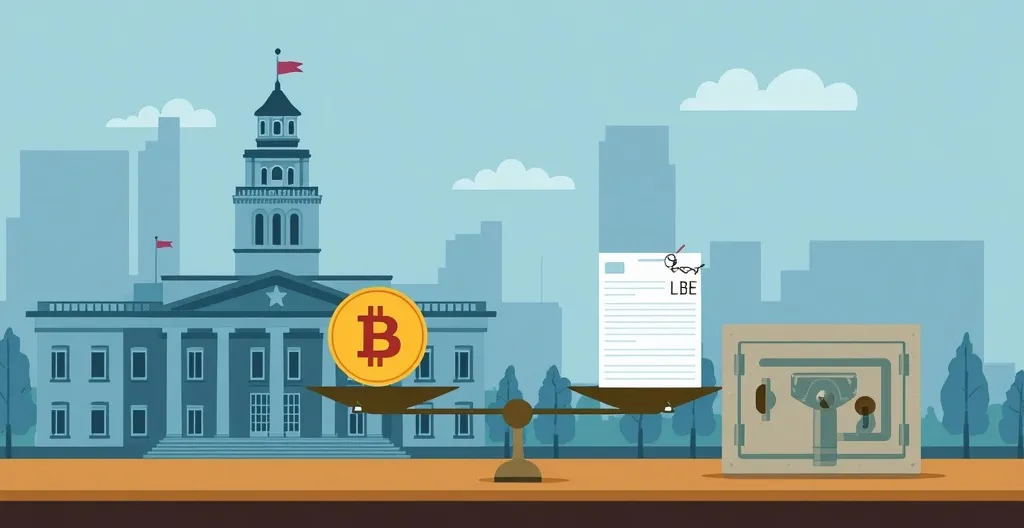
Texas House Bill 815 would let each municipality and county invest up to $10 million in cryptocurrency. The proposal is not law. Key details, including how the cap would be measured and what safeguards would apply, need close scrutiny before any public money is invested.
- Up to $10 million for each municipality or county, not a shared statewide pool.
- Optional authority, with no purchase requirement or state funding.
- The bill does not adopt the state Bitcoin reserve’s $500 billion market-capitalization test.
- If enacted, it would take effect Sept. 1, 2027.
What HB 815 would authorize
Filed by Rep. Ron Reynolds, a Democrat representing Missouri City, HB 815 would amend the Public Funds Investment Act, the Texas law governing how certain public entities invest public money. The bill names municipalities and counties as eligible investors. School districts and other public bodies are not included.
The $10 million limit would apply separately to each eligible municipality or county. It would not create a statewide pool for local governments to share. The proposal is optional: it would not require any government to buy cryptocurrency, set a minimum allocation or direct state money toward local purchases. A Texas proposal to let cities invest in Bitcoin has drawn attention to the authority it would give local governments.
The bill uses cryptocurrency definitions from Section 403.701 of the Government Code. That section covers more than Bitcoin, so the proposed authority is not limited to Bitcoin by name.
The bill’s stated cap leaves a practical question unanswered: would the $10 million limit apply to the initial investment, the value of holdings at a later date or some other measure? The answer matters if cryptocurrency prices swing sharply. A government could buy below the cap, then see the value of its holdings rise or fall.
HB 815 proposes an effective date of Sept. 1, 2027, if passed. It is still a proposal, not an authorization in force. The proposed date does not mean local governments can invest now.
The state reserve’s rules are separate
Texas established its Strategic Bitcoin Reserve under Senate Bill 21 in 2025. Its rules apply to purchases made with reserve funds, not automatically to every public investment in Texas.
Under the state reserve framework, cryptocurrency bought with reserve money must have averaged at least $500 billion in market capitalization over the previous 24 months. Market capitalization is the market value of an asset’s circulating supply. The threshold determines whether an asset qualifies for reserve purchases. It is not a $500 billion investment limit, nor does it prove an asset is stable, liquid or suitable for public funds. The Senate Bill 21 analysis describes the reserve’s proposed framework.
HB 815 does not include that market-capitalization threshold in its described terms. It uses definitions from Section 403.701, but sharing definitions with the reserve law does not, on its own, bring in the reserve’s separate investment criteria. The measures cover different pools of public money.
Permission is not a risk-management plan
The state reserve framework offers a useful comparison on custody and oversight. The Texas Legislature’s analysis of SB 21 says the comptroller may hire a qualified custodian, a firm responsible for securely holding and administering assets, and may use secure technologies such as cold storage. Cold storage keeps the private keys needed to control crypto offline. The analysis also says the comptroller may hire an independent auditor. It does not make that audit mandatory. Texas’s Bitcoin reserve law addresses protections for the state’s crypto holdings.
HB 815’s described provisions contain no comparable crypto-specific custody or audit requirements. That does not mean local governments would be exempt from other investment, fiduciary, procurement, reporting or security obligations. But it leaves a key question: what standards would officials use to choose assets, control access, disclose holdings and respond to theft or operational failure?
These are more than box-ticking exercises. Directly holding cryptocurrency means safeguarding the private keys that authorize transactions. Lose control of those keys, and the assets may be lost too. Investing through a fund or other product can provide price exposure without a government directly holding Bitcoin, but it comes with different terms and risks. HB 815’s described language does not specify which investment methods local governments could use.
Reynolds introduced a related proposal, HB 4258, in March 2025. It would have allowed the state to invest up to $250 million from the Economic Stabilization Fund, alongside a $10 million allowance for local governments. HB 815 keeps the local-government proposal but drops the state-fund investment.
Any local government considering this authority would still need to decide whether crypto belongs in public funds and, if so, how much risk taxpayers should bear. A $10 million ceiling sets a maximum. It does not answer those questions. A Texas bill that would open $10 million in crypto investments to cities would not, by itself, show officials how to manage those risks.
Key questions and answers
-
How much could each municipality or county invest?
Up to $10 million per municipality or county. The proposal’s description does not say whether the limit would be based on the purchase amount or the later market value of the holdings.
-
Would local governments have to buy cryptocurrency?
No. HB 815 would allow investment but would not require a purchase or provide state money for one.
-
Would the state reserve’s $500 billion test apply?
The test applies to cryptocurrency bought with state reserve funds. HB 815 does not adopt it in its described terms.
-
Would school districts be covered?
No. The proposal names municipalities and counties, not school districts or other public bodies.
-
Is HB 815 law?
No. It remains a proposal. If passed, it would take effect Sept. 1, 2027.