
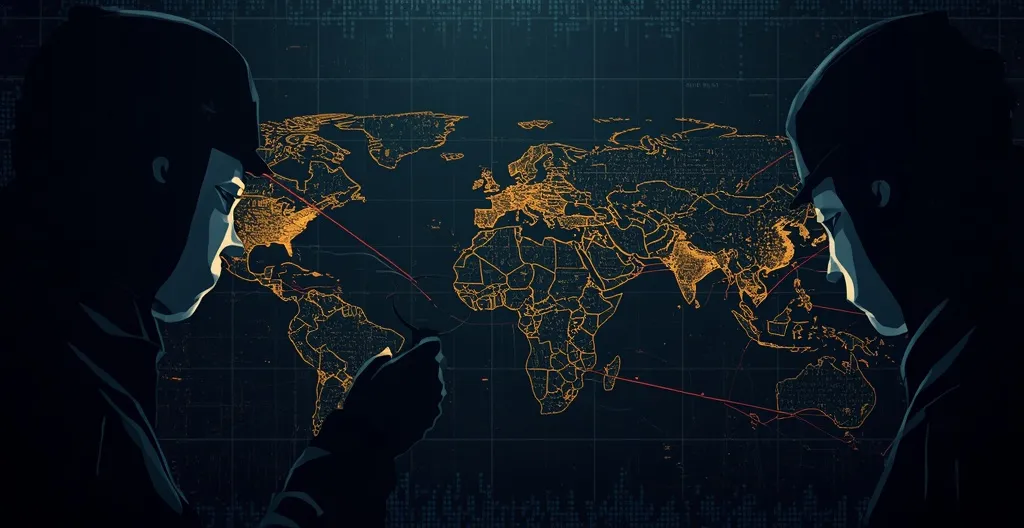
The claim that Uppsala Security has joined an INTERPOL Gateway to help trace Bitcoin crime is not verified by the material provided. That leaves us with a headline-sized claim and almost no evidence attached to it.
- Claim: Uppsala Security joined an INTERPOL-linked gateway
- Purpose: Bitcoin crime tracing
- Status: Unverified by the supplied material
- Why it matters: Crypto forensics can help track illicit BTC flows across borders
That distinction matters. In crypto, rumor often outruns reality, and headlines can turn into wishful thinking faster than funds through a bad bridge. If this is a real collaboration, it could be a meaningful step for blockchain forensics and cross-border policing. If not, it is just noise dressed up as news.
What is known, and what is broadly established, is that Bitcoin transactions are visible on a public blockchain. Investigators and compliance teams can often follow transaction flows and sometimes connect addresses to real-world entities using exchange records, wallet patterns, operational mistakes, and forensic analysis. Bitcoin is not “anonymous” in the movie sense. It is pseudonymous, meaning the ledger does not name people by default, but it does leave a trail.
That is why crypto tracing is taken seriously by law enforcement. Public blockchains can help investigators follow ransomware payments, fraud proceeds, stolen coins, and sanctions evasion. When criminals move value on-chain, they are often leaving breadcrumbs in a system that never forgets. The ledger has a long memory. Criminals, unfortunately for them, often do not.
But blockchain forensics is not magic. Attribution can be messy. Funds may move through mixers, which are services designed to obscure transaction trails, or through cross-chain bridges, which let users move assets between different blockchains. Coins can also bounce through multiple jurisdictions before an investigator gets a clean picture. The tools are useful, but they are not omniscient.
The title’s use of INTERPOL Gateway also raises a basic problem: the provided material does not explain what that gateway is. It could be a program, a technical interface, a partnership channel, or simply a headline shorthand. Without a source, that detail stays undefined and unconfirmed.
Uppsala Security is named as the entity joining the effort, but its role is not described either. The material does not say whether the company is providing software, data, training, or some other kind of support. That matters, because “joined” can mean almost anything from formal integration to loose marketing language. Crypto is already full of vapor; no need to add more fog.
There is also a bigger tension underneath all of this: stronger tracing can help victims and investigators, but it can also expand surveillance if the guardrails are weak. That is the tradeoff the industry keeps running into. Privacy matters. Due process matters. A system that helps trace stolen Bitcoin should not become an excuse to treat every user like a suspect just because they value financial privacy.
For Bitcoin maximalists, the upside is straightforward. A transparent monetary base makes certain kinds of abuse easier to expose, and that is a feature, not a bug. Bitcoin is built for secure settlement on a public ledger; it is not meant to be a privacy coin, an identity system, or a do-everything financial operating system. It does one job extremely well. That does not mean it should be forced into every other lane.
For the broader crypto world, the lesson is similar but wider. Different networks serve different purposes, and different privacy models create different tradeoffs. Some chains aim for openness and auditability. Others push harder on confidentiality. The point is not that one model wins every time. The point is that the design choice matters.
If a real INTERPOL-linked integration exists, it would likely improve cross-border coordination and help investigators move faster when blockchain evidence spans multiple countries. If it does not, then the responsible position is simple: do not confuse a claim with a confirmed development. Crypto has enough shameless fluff already.
Key takeaways
-
Is the Uppsala Security and INTERPOL Gateway claim confirmed?
No. The supplied material does not verify the partnership, the gateway, or any technical details behind it. -
Can Bitcoin transactions be traced?
Yes. Bitcoin’s public blockchain allows transaction flows to be followed, and sometimes linked to real-world entities through forensic methods. -
Does traceability make Bitcoin anonymous?
No. Bitcoin is pseudonymous, not truly anonymous. Wallet addresses are not names by default, but patterns and records can reveal identities. -
Why would INTERPOL care about crypto tracing?
Crypto crime often crosses borders. INTERPOL’s role would be to help agencies share intelligence and coordinate investigations across jurisdictions. -
What is the downside of better tracing tools?
They can help stop crime, but they also raise privacy and surveillance concerns if used without strong limits and accountability. -
What is missing from the claim?
A source, official statement, quote, or technical description of the alleged INTERPOL Gateway and Uppsala Security’s role.
For now, the sober read is cautious: Bitcoin tracing is real, important, and increasingly sophisticated. This specific Uppsala Security-INTERPOL claim, though, remains just that, a claim, until someone puts evidence on the table.
Further reading
For more on crypto tracing, cross-border enforcement, and the darker side of on-chain crime, these resources are worth a look:
- Uppsala Security joins INTERPOL Gateway to aid Bitcoin crime tracing
- Easing financial burdens for victims and their families
- UN guide for first responders on digital devices in the battlefield
- Smarter blockchain investigations: insights from INTERPOL
- Russian national arrested in $730K Seoul crypto heist as Bitcoin crime spikes
- INTERPOL recovers $97M in crypto from global cybercrime sting operation
- INTERPOL’s Serengeti 2.0: 1, 209 arrests in $97M crypto crackdown


