
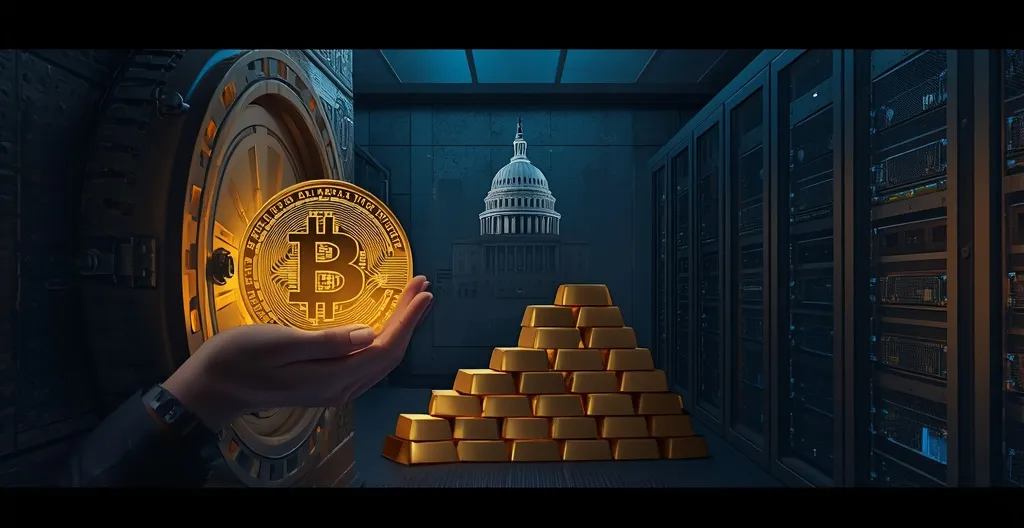
What is a Bitcoin strategic reserve? Government BTC holdings explained
A Bitcoin strategic reserve is a government-held stash of BTC treated as a national reserve asset, and the United States has now turned that idea into policy.
- Created by executive order: U.S. Strategic Bitcoin Reserve established on March 6, 2025
- Seeded with seized BTC: built from forfeitures and civil asset seizures already in government hands
- Big question: reserve-grade money or a shiny political headache?
The basic idea is simple. Governments already hold reserves in gold, foreign currencies, and other assets meant to support financial stability. A Bitcoin strategic reserve applies that same logic to BTC: hold it as a sovereign asset, don’t treat it like random inventory, and keep it off the “sell because the mood changed” conveyor belt.
In the U.S., that framework came through Executive Order 14178, signed by President Trump on March 6, 2025. The order created two separate buckets: a Strategic Bitcoin Reserve for Bitcoin, and a U.S. Digital Asset Stockpile for other forfeited digital assets. That split matters. BTC is being treated as reserve-grade property; everything else gets handled separately.
The reserve was capitalized with Bitcoin already held by federal agencies through criminal and civil forfeiture cases. In plain English: this was not a taxpayer-funded shopping spree. The government already had the coins, mostly because they were seized in enforcement actions, and decided to stop pretending they were just crypto garage sale leftovers.
The executive order says Bitcoin in the reserve shall not be sold. It also directs the Treasury and Commerce departments to develop “budget-neutral strategies” for acquiring more BTC. That means any future additions are supposed to avoid new taxes or fresh appropriations. No blank check, no fiscal clown show.
That language is careful for a reason. A strategic reserve is supposed to strengthen national balance sheets, not become a hostage to political mood swings. If policymakers think Bitcoin deserves reserve treatment, they want it framed as a long-term asset, not a trading desk stunt.
Why Bitcoin at all? Supporters argue that it is the only reserve-style asset with a fixed supply. Bitcoin’s cap is 21 million coins, and roughly 19.7 million have already been mined. Issuance also cuts in half about every four years through the halving, which slows new supply over time.
That scarcity is the whole pitch. Gold is scarce too, but it still expands through mining. Fiat currency can expand far more easily, which is exactly why Bitcoin people keep pointing at the last few years and muttering darkly about monetary debasement, debt, and policy overreach.
There’s a geopolitical angle here as well. The U.S. immobilized roughly $300 billion in Russian central bank reserves after the 2022 invasion of Ukraine. That sent a blunt message: reserve assets can be weaponized. For Bitcoin proponents, a bearer asset with self-custody potential offers a way around that problem. Whoever controls the keys controls the coins. No keys, no coins. It’s brutally simple.
That’s also why the custody model matters. The reserve is described as being held in cold storage, which means the BTC is kept offline to reduce hacking risk. Cold storage is exactly what it sounds like: a way of keeping assets out of easy reach from attackers, because leaving government BTC online would be the kind of dumb that deserves its own audit report.
Still, the skeptics have a point, and it’s not a small one. Bitcoin is volatile. It produces no yield. It can swing hard enough to make a finance ministry look like it swallowed a battery pack. A reserve asset is supposed to be steady, boring, and reliable, the financial equivalent of a chair that doesn’t collapse during a board meeting. Bitcoin is many things. Boring is not one of them.
That tension is why the debate is so fierce. Bitcoin advocates see a scarce, politically neutral asset that can sit alongside gold. Critics see a highly speculative instrument being dressed up in sovereign language. Both readings have merit, depending on what question you’re asking.
El Salvador is the clearest real-world example of a national Bitcoin policy. President Nayib Bukele started buying BTC in September 2021, and the country now holds approximately 6, 100 BTC. The International Monetary Fund’s $1.4 billion loan agreement put pressure on El Salvador to limit new Bitcoin purchases, which shows how messy this gets when crypto ideology runs into hard-nosed external financing.
That’s the part a lot of Bitcoin tourists ignore. Sovereign adoption is not just about conviction or price charts. It’s about whether a state can absorb volatility without damaging its balance sheet, spooking lenders, or turning monetary policy into a recurring political migraine.
The U.S. version is different because the reserve began with seized assets, not open-market buying. But the same core question remains: is Bitcoin a serious reserve asset, or just a very visible one? Visibility is not the same thing as usefulness, and governments know the difference even if some crypto influencers do not.
Transparency is another reason Bitcoin keeps getting attention in reserve discussions. Blockchain data can often be tracked on-chain if the relevant wallet cluster is known. Analytics firms such as Arkham Intelligence and Glassnode have built entire businesses around following those breadcrumbs. Attribution is not perfect, and custody structures can be messy, but Bitcoin is at least auditable in principle. Try doing that with a pile of gold stored behind a vault door and three layers of bureaucracy.
Research often cited by Bitcoin proponents also makes the portfolio argument. According to ARK Invest and Fidelity Digital Assets, a 1% to 5% Bitcoin allocation in a sovereign reserve portfolio would have improved risk-adjusted returns over five-year periods since 2014. That is not a divine revelation, and backtests are not prophecy. They are historical models, not guarantees. Still, the argument is straightforward: a small BTC allocation may improve portfolio convexity without forcing a government to go full maxi and start speaking in laser eyes.
But that kind of modeling has limits. Bitcoin can help in one market regime and punish in another. A reserve asset that looks clever in a bull market can look ridiculous during a drawdown. That’s exactly why reserve policy tends to be conservative: governments hate being laughed at by bond desks.
There’s also a legal durability problem in the U.S. Executive orders are easier to reverse than laws passed by Congress. That means the Strategic Bitcoin Reserve exists, but it is not bulletproof. A future administration could try to unwind or alter it, depending on the legal mechanics and political appetite.
That is why legislative efforts matter. Congress.gov includes a bill titled Establishing a Strategic Bitcoin Reserve for the United States, which would push the idea into more durable statutory territory. At the state level, New Hampshire became the first U.S. state to sign a Bitcoin reserve bill into law, authorizing allocation of up to 5% of certain public funds to Bitcoin and other digital assets with a market capitalization above $500 billion. Texas, Arizona, and Oklahoma have also advanced similar proposals.
Outside the U.S., the policy chatter is spreading. Brazil introduced a bill in November 2024 to create a Sovereign Strategic Bitcoin Reserve holding up to 5% of the country’s international reserves. Japan’s parliament debated a reserve proposal in late 2024. Hong Kong legislators have also floated adding Bitcoin to the Exchange Fund. This is no longer a fringe talking point. Governments are taking the idea seriously, whether skeptics like it or not.
That does not mean every reserve proposal is wise. Some of this is sober hedging against monetary abuse and sanctions risk. Some of it is institutional FOMO wrapped in official language. Bureaucracies are not immune to fashion; they just put their fashion in a binder and call it policy.
Even so, Bitcoin’s appeal is real. Governments can print fiat. They can confiscate reserves. They can freeze bank accounts. They cannot create more BTC. That hard cap is what makes Bitcoin fundamentally different from most other digital assets, and it’s also why the U.S. Digital Asset Stockpile exists as a separate bucket. Bitcoin is being framed as money-like reserve collateral; most other tokens are not.
That distinction is harsh, but it’s useful. Not every blockchain belongs in a sovereign reserve. Ethereum, stablecoins, and altcoins may serve real roles in payments, settlement, or application layers, but that does not automatically make them reserve assets. “Innovative” is not the same thing as “credible store of value.” A lot of token projects learned that lesson the hard way, usually right before a liquidity crisis.
Gold still matters here too. The U.S. holds roughly 8, 133 metric tons of gold, long treated as the old reliable reserve asset. Bitcoin is not replacing that overnight. Gold has history, depth, and institutional legitimacy. Bitcoin has portability, provable scarcity, and a rapidly growing policy footprint. They are competing ideas for reserve management, not identical instruments.
There are still open questions that matter a lot more than the headline hype. Will Congress codify the reserve into law? Will Treasury and Commerce actually find real budget-neutral ways to add BTC? Will more countries follow the U.S. and El Salvador, or will this stay a niche policy experiment with a few loud advocates and a stack of white papers? And if Bitcoin takes a nasty drawdown, will the political enthusiasm vanish faster than a memecoin Discord after the founder goes silent?
Those questions matter because sovereign reserve policy is not a vibe. It is statecraft. If Bitcoin is going to sit beside gold and foreign currency as a strategic asset, it needs legal durability, solid custody, and enough political logic to survive a bear market without turning into a parliamentary embarrassment.
For now, the signal is clear: governments are no longer treating Bitcoin as a joke. They are treating it as something that might belong on the balance sheet. Whether that turns into a serious strategic shift or a very expensive lesson depends on how well policymakers handle the boring parts, custody, law, transparency, and patience.
Key questions and takeaways
-
What is a Bitcoin strategic reserve?
It is a government-held stockpile of Bitcoin treated as a sovereign reserve asset, similar in concept to gold or foreign currency reserves. -
Did the U.S. create one?
Yes. Executive Order 14178, signed on March 6, 2025, established the Strategic Bitcoin Reserve and a separate Digital Asset Stockpile. -
Where did the reserve’s Bitcoin come from?
From BTC already held by federal agencies through criminal forfeitures and civil seizures. -
Can the government sell the Bitcoin?
The executive order says Bitcoin in the reserve shall not be sold and is meant to be held as a reserve asset. -
Can more Bitcoin be added?
Possibly, but Treasury and Commerce are only directed to look for “budget-neutral strategies, ” meaning additions should not create new taxpayer costs. -
Why do supporters want a Bitcoin reserve?
They argue BTC is scarce, politically neutral, and useful as a hedge against inflation, debt stress, and reserve freezes. -
What is the biggest criticism?
Bitcoin is volatile and does not produce yield, which makes skeptics question whether it belongs in a sovereign reserve at all. -
Why does El Salvador matter?
It is the leading national Bitcoin case discussed here, but it also shows how Bitcoin policy can clash with IMF financing and debt pressure. -
Is the reserve permanent?
No. Because it was created by executive order, it is easier to change or reverse than a law passed by Congress. -
Why not just hold gold?
Gold is the traditional reserve asset, but Bitcoin supporters argue BTC offers fixed supply, easier transferability, and stronger resistance to political manipulation. -
What does “budget-neutral” mean here?
It means the government is supposed to find ways to acquire more Bitcoin without new taxes or a direct spending program.
Further reading
A few useful references for the policy, custody, and geopolitical angles behind sovereign Bitcoin holdings:
- El Salvador's Bitcoin Gamble: IMF Bailout and Economic Risks
- Fact Sheet: President Donald J. Trump Establishes
- U.S. Strategic Bitcoin Reserve
- Trump signs order to establish strategic bitcoin reserve
- Trump’s Treasury Secretary Issues Ultimatum: Comply with
- El Salvador’s Bitcoin Battle: IMF Clash and Chivo Wallet
- Bitcoin at $91K: $83, 800 Support Test as ARK Invest and El


