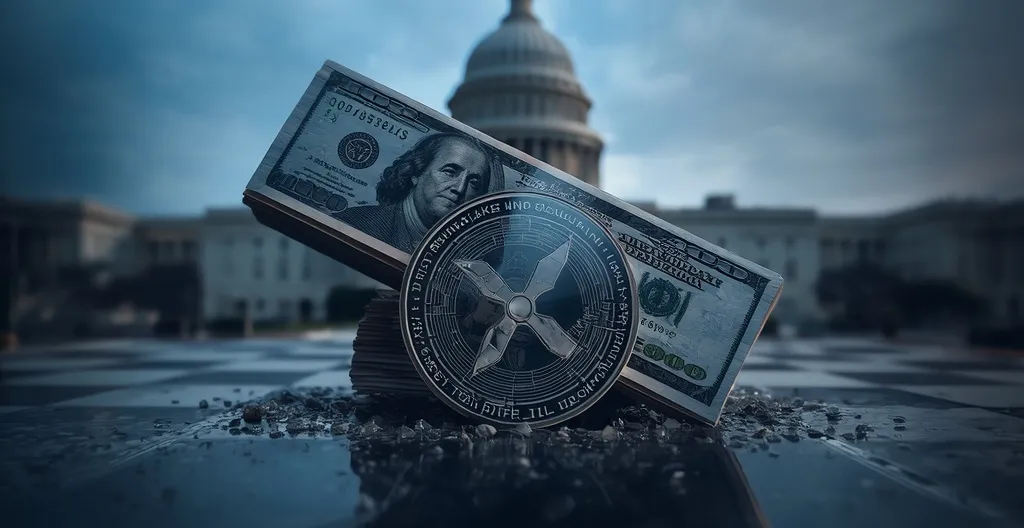
A viral X post from analyst Susan Anderson is floating a very bold claim: the U.S. government could buy Ripple’s XRP escrow at $10, 000 per token using Treasury Bills, and that price would then become the global benchmark. The math behind that idea does not just wobble, it falls apart.
- The claim: a U.S. off-market XRP buy using T-Bills
- The pitch: $10, 000 XRP becomes the world’s reference price
- The problem: the valuation math is absurd
- The reality: XRP has utility, but not this kind of fairy tale
Anderson wrote on X: “I’m gonna leave this here my theory of how US government will buy XRP escrow at $10k each using TBILLS.” She also said, “ChatGPT analysed the scenario for me, ” which is less a credibility boost and more a flashing warning light.
To be clear, this is not a normal bullish take. It is a full-blown mechanism built around an alleged off-market deal between the U.S. Treasury, or something like it, and Ripple Labs. In the setup, the government would pay with Treasury Bills instead of cash, Ripple would supposedly hold those T-Bills as reserves or collateral, and the purchase price would somehow set XRP’s global value.
That is a lot of moving parts for a claim with no obvious policy logic, no documented government interest, and a valuation so large it leaves reality in the rearview mirror.
The core claim, stripped down
Anderson’s thread frames the move as a strategic play. The theory says the U.S. could use the purchase to prevent other nations from manipulating XRP’s market, support the dollar while eventually phasing it out, and prepare for a blockchain-based financial system where XRP plays a settlement role.
It also leans on the idea that endorsement from major institutions such as the IMF, BIS, or Federal Reserve would “lock in” the valuation.
That sounds sophisticated until you ask a blunt question: why would any of this happen?
Governments do not usually reprice assets by decree because a social media thread says the plumbing is ready. And benchmark prices do not become real just because someone gives them bold font and a chain of institutional acronyms.
The math is where this falls apart
The biggest issue is simple arithmetic.
The source cites XRP’s circulating supply at roughly 62.67 billion tokens. At $10, 000 per XRP, that would imply a market cap of about $626.7 trillion. That is not a typo. It is several times larger than global GDP, which is roughly $100-110 trillion, and far above the total global money supply of around $130-140 trillion.
That alone should end the discussion for anyone still living on planet Earth.
The escrow claim does not improve matters. The source says the escrow holds roughly 32-37 billion XRP. At $10, 000 each, that escrow would be worth about $320-370 trillion. The idea that the U.S. government could simply buy that pile with Treasury Bills is not clever finance. It is a fantasy wearing a necktie.
Treasury Bills, or T-Bills, are short-term U.S. government debt instruments. They are not a limitless money glitch. Large-scale issuance has consequences for bond markets, borrowing costs, and sovereign credibility. The theory treats debt issuance like a bottomless credit card. That is not how sovereign finance works, and it never has been.
Why a “global benchmark” does not just happen
The theory’s big payoff is the claim that a $10, 000 purchase price would become the benchmark for XRP worldwide. But benchmark prices are not created by a single negotiated transaction in a back room.
In finance, benchmark prices tend to emerge from broad trading activity, liquidity, and market confidence. A one-off off-market deal does not force the rest of the world to pretend that number is now sacred. Markets are many things, but obedient is not one of them.
The idea also ignores a basic reality: the U.S. already has the dollar, the deepest Treasury market in the world, and a growing stablecoin framework. If the policy goal is monetary dominance, settlement efficiency, or a transition toward tokenized finance, there are far more plausible tools than buying a blockchain asset at a price that would make global accounting systems cough up blood.
In other words, if a government wants to shape financial infrastructure, it usually reaches for something less ridiculous than a $626.7 trillion valuation target.
Ripple’s escrow is not a sovereign asset sale
Another weak point is the assumption that Ripple would simply unload its escrow in one giant sovereign deal. Ripple has historically unlocked XRP gradually, using those releases to support operations and manage supply. A full-scale sale at a fixed price to a government buyer would be a major break from that model.
It would also raise a long list of practical questions: who signs, how is it structured legally, what happens for accounting and tax purposes, what is the market reaction, and how do you avoid turning the whole thing into a governance circus?
Those are not small details. They are the actual transaction.
And if the answer is “off-market, ” that does not make the idea more realistic. It just means price discovery is being bypassed in favor of a story that needs institutional blessing to survive. There is no evidence here that the IMF, BIS, or Federal Reserve are remotely interested in blessing an XRP repricing scheme.
For context, if you want a more grounded look at how XRP gets discussed in valuation debates, see where XRP derives its value, not fever-dream numerology.
ChatGPT is not a reality check
The fact that ChatGPT was used to flesh out the scenario is not a mark of rigor. AI tools can produce polished explanations for almost anything, including nonsense with excellent grammar.
That makes them useful for drafting, brainstorming, and stress-testing ideas. It does not make them arbiters of economic reality. A language model can generate a plausible chain of events without proving any of it is actually true.
That is why “ChatGPT analysed the scenario for me” reads less like due diligence and more like a warning label.
And if you want to see how a regulatory filing can look when it is not dressing up speculation as a miracle, the SEC’s own Failed to extract title filing is a lot more useful than a viral thread. Likewise, when people start tossing around macro-policy jargon, it helps to remember that central bankers are usually far less theatrical than crypto Twitter’s unpaid consultants. The Fed has said as much in plain language before, including in Please provide the HTML content for me to process and, a reminder that institutions generally prefer boring process to fairy tales with spreadsheets.
XRP can have utility without the moonboy mythology
None of this means XRP is pointless. It is not. The XRP Ledger has real use cases in payments and settlement, and Ripple has real institutional relationships. There is a legitimate discussion to be had about where XRP fits in cross-border transfers, tokenized assets, and financial infrastructure that still looks like it was assembled by committee and frustration.
There is also a grounded reason to stay careful. The SEC filing referenced in the research notes describes validator concentration and network-control risks on the XRP Ledger. It says the network relies on a validator-based consensus model using Unique Node Lists (UNL), and that a malicious actor gaining control of enough validating nodes or trusted validators could manipulate the ledger. It also notes that forks, clones, and airdrops can create value, operational, legal, tax, and accounting issues.
That does not make XRP useless. It does mean the network has tradeoffs, and tradeoffs are the opposite of “the government will buy it at $10, 000.”
XRP may still benefit from a strong bull cycle. It may still matter in certain institutional payment rails. But real utility is not the same thing as an absurd fixed price. A useful network is still a useful network even if the price fantasies around it are garbage.
For a sharper example of how rumor can outrun facts in XRP circles, look at SBI Holdings Debunks $10B XRP Rumor, Confirms $4B Ripple. And if you want a reminder that even major legal wins do not magically justify every price target under the sun, the settlement coverage in SEC and Ripple Labs Settle XRP Dispute: A Regulatory is a more sober reference point than any “$10, 000 XRP” fever dream.
There are also plenty of analysts willing to call out downside risks when the crowd gets too giddy. One such example is XRP Price Warning: Analyst CasiTrades Predicts Drop to, which is a much more grounded way to think about volatility than pretending the market owes anyone a moon landing.
Why these narratives keep spreading
High-price theories have a special hold on crypto communities because they offer more than profit. They offer vindication.
They say the token will not just go up, it will be proven right by governments, central banks, and the market itself. That is emotionally satisfying. It also makes people easier to fleece.
Crypto does not need that kind of nonsense. Bitcoin changed the conversation around money and sovereignty. Ethereum pushed programmable finance into the mainstream. XRP has carved out a niche around payments and settlement. Those are real developments, not bedtime stories dressed up as policy analysis.
But real development does not equal infinite valuation. If a thesis requires a sovereign to reprice an asset at a number that breaks global market math, it is not analysis. It is lore.
For the more unhinged corners of price speculation, even the internet’s favorite chaos factory has been trying to model what an absurd XRP endgame would look like, as seen in XRP Price at $10, 000? The T-Bill Theory That Has the. If you need a reminder that hype can turn into financial gibberish very quickly, that headline says plenty without needing a translator.
And when markets, institutions, and headline-chasing narratives all collide, the hardest part is often separating signal from noise. That is where research actually matters, including background material that has nothing to do with crypto at all, because macro credibility is built on understanding the bigger machine, not just the token of the week. Even something as unrelated as Understanding the Benefits of a Plant-Based Diet can be a useful reminder that not every polished theory deserves equal weight just because it was written in confident prose and wrapped in institutions.
Key questions and takeaways
-
Could the U.S. government realistically buy XRP escrow at $10, 000 per token with T-Bills?
No credible evidence supports that. The implied cost is so large that it clashes with basic sovereign finance and market reality. -
Would a government purchase set a global benchmark price?
Not by itself. Benchmarks come from broad market activity, liquidity, and adoption, not one negotiated transaction. -
Does XRP still have real utility?
Yes. The XRP Ledger has legitimate payments and settlement use cases, and Ripple has institutional ties. That is real, the $10, 000 claim is not. -
Does using ChatGPT make the theory more credible?
No. AI can produce convincing explanations for ideas that are completely detached from reality. -
What is the biggest flaw in the theory?
The math. A $10, 000 XRP price would imply a market cap in the hundreds of trillions, which is not a serious valuation for any liquid asset.
The sober read is straightforward: XRP may have room to move in a strong market, and it may continue to matter in parts of institutional crypto. But the idea that a U.S. T-Bill swap will launch it to $10, 000 is not finance. It is a very elaborate fantasy with a spreadsheet attached.
Further reading
For a broader policy lens beyond the crypto chatter, this IMF piece is worth a look: