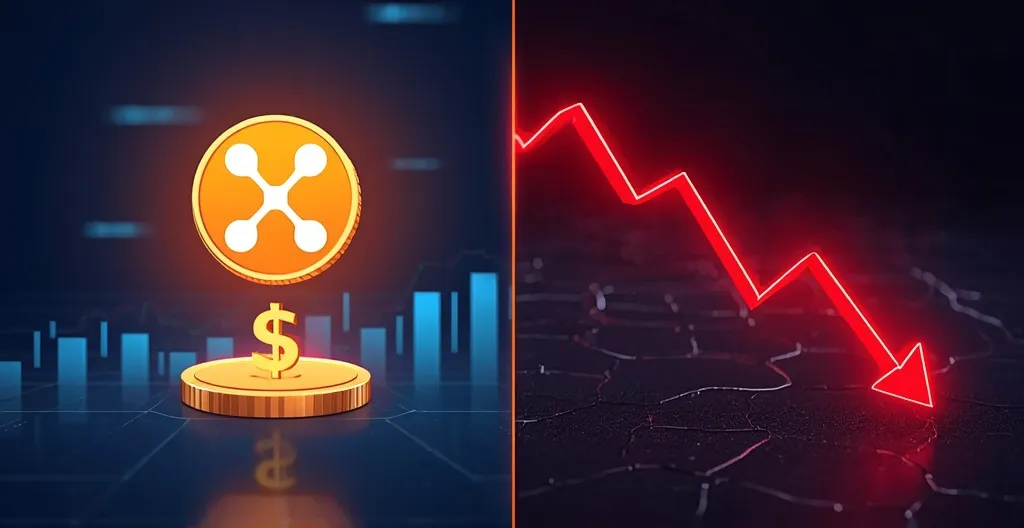
XRP currently has the cleaner recovery setup versus Cardano, but neither token has earned a victory lap. XRP has a more constructive technical structure and clearer near-term catalysts, while ADA still needs to prove its downtrend is actually over.
- XRP is holding near $1.00 with improving momentum signals.
- ADA remains weaker and has more work to do before bulls regain control.
- Fundamentals matter too: XRP has regulatory and institutional-access catalysts, while Cardano is leaning on upgrades and adoption that still need to show up in real usage.
XRP is trading around $1.0015 after sliding from roughly $1.35. That makes $1.00 the obvious line in the sand. Hold it, and bulls can argue a base is forming. Lose it, and the chart starts looking like a weak floor made of wet cardboard.
The technical case for XRP is not just about a round number. Its RSI is 41.10, which is still below the neutral zone but no longer screams aggressive downside momentum. More importantly, the chart shows bullish divergence: price made lower lows while momentum made higher lows. In plain English, selling pressure may be losing steam even though the price still looks ugly.
XRP’s Ultimate Oscillator is 52.47, which is above the 50 midpoint and leans more constructive than broken. Its market cap has also stayed in a relatively tight band between roughly $62.5 billion and $65 billion, suggesting the asset has held up better than a full-blown collapse. If XRP pushes above $1.05, the next area of interest is around $1.10 to $1.15.
That does not mean a clean run higher is guaranteed. Crypto has a special talent for pretending a breakout is real, then kicking traders in the teeth five minutes later. Still, XRP currently has more going for it than blind optimism.
The biggest reason is the legal backdrop. According to the U.S. Securities and Exchange Commission’s May 8, 2025 Statement on the Agency’s Settlement with Ripple Labs, Inc., the Commission announced a settlement with Ripple Labs, returning over $75 million held in escrow and vacating the injunction. The SEC also restated the history of the case: it sued Ripple Labs, Inc., Bradley Garlinghouse, and Christian in December 2020, the court found Ripple’s institutional sales of XRP were unregistered securities offerings, and a civil penalty of over $125 million was ordered.
That matters because legal clarity changes how markets price risk. It does not mean XRP is magically “fully cleared” forever, but it does remove one of the nastiest overhangs that shadowed the asset for years. That is a real shift, not just hopium in a suit and tie.
Commissioner Caroline A. Crenshaw dissented from the SEC’s settlement position, warning it could create a “regulatory vacuum.”
That dissent is worth noting because it reminds everyone that the regulatory fight over crypto is not neatly wrapped up with a ribbon on top. Even when one side claims progress, the internal disagreement over how crypto should be governed is still very much alive.
XRP also has potential demand catalysts beyond the courtroom. Spot XRP ETFs reportedly recorded more than $1 billion in net inflows during their first month in 2025, and Ripple is pursuing a U.S. banking license. If those developments continue to mature, they could strengthen the project’s institutional case. In crypto, access and distribution often matter almost as much as technology.
Cardano, meanwhile, is still fighting a different battle: proving that its long development runway can finally translate into market traction. ADA is trading around $0.1775 after falling from roughly $0.26. Its Ultimate Oscillator is 39.76, which is a weaker reading than XRP’s and still points to downside pressure.
The market structure is also less convincing. ADA’s market cap has moved between roughly $6.7 billion and $7.4 billion, with the latest range around $7.0 billion to $7.2 billion. If the token breaks below $0.16, the next major support zone sits around $0.14 to $0.12. To shift the tone, bulls would need to reclaim $0.18 and then break above $0.20 with strong volume. Until that happens, rallies are just rallies, not proof that the trend has turned.
That is the uncomfortable truth for ADA holders. Cardano remains one of the more ambitious smart-contract chains in crypto, but ambition is not the same thing as adoption. The project has long been praised for its methodical engineering, formal development approach, and emphasis on scaling. Fine. Respectable. But markets do not pay out for potential forever.
There is still meaningful work happening on the Cardano side. The Cardano Foundation’s June 2026 update highlighted support around the chain’s Dijkstra upgrade overview, with improvements intended to optimize PlutusV4, enable nested transactions, improve micropayments, and lower transaction costs. It also pointed to infrastructure work such as Yaci Store, Yaci DevKit, and interoperability efforts involving LayerZero.
That is real development. But development is not adoption. Better plumbing does not mean much if nobody is turning on the tap.
That gap shows up in the ecosystem metrics that actually matter to users. Cardano’s DeFi TVL has fallen about 87% from its peak to roughly $94 million. TVL, or total value locked, measures how much capital is deposited in decentralized finance protocols. It is a rough gauge of activity and liquidity. When it collapses that hard, pretending the ecosystem is thriving would be nonsense.
There are still reasons to keep Cardano on the radar. ADA ETF filings are said to remain active, with a decision window expected around October 23, 2026. Cardano’s Dijkstra upgrade is planned across late 2026 and Q2 2027, alongside scalability work such as Linear Leios, Nested Transactions, and Peras. If those changes land well and drive real usage, ADA could still stage a comeback.
Could that happen? Sure. Crypto is full of second acts. But right now, XRP has the better mix of technical strength and catalyst potential, while Cardano is more of a longer-shot turnaround trade. The patient builder can win eventually, markets just don’t hand out patience like it’s a community grant.
Whales reportedly accumulated more than 30 million ADA in one week, which is the kind of headline traders love to wave around when they want to sound bullish. Maybe that reflects confidence. Maybe it is opportunistic buying into weakness. In crypto, those two often look identical until the chart decides who was right.
Key takeaways
-
Which looks stronger right now, XRP or Cardano?
XRP has the cleaner setup at the moment. It is holding a key level near $1.00 and has more immediate catalysts, while ADA still needs to prove its downtrend is broken. -
Why does $1.00 matter so much for XRP?
It is the level bulls need to defend. Staying above it keeps the recovery case alive; losing it would weaken the structure quickly. -
What would confirm a stronger XRP move?
A break above $1.05 could open the door toward $1.10 to $1.15. Momentum improvement and volume confirmation would matter more than a quick spike. -
What does Cardano need to regain control?
ADA needs to reclaim $0.18 and then break above $0.20 with strong volume. Without that, the market is still treating it like a downtrend, not a breakout. -
Can XRP recover faster than ADA by 2027?
It can, but it is not guaranteed. Crypto prices are still heavily influenced by Bitcoin, liquidity conditions, and broad market sentiment. -
Is Cardano dead money?
No. It still has a credible long-term development story. But right now it has more proving to do than XRP, and the market is ruthless with assets that keep promising tomorrow.
The bigger lesson is simple: price charts matter, but they are only part of the picture. Regulation, access, developer execution, liquidity, and market sentiment all shape the outcome. XRP currently has the stronger hand. Cardano still has a path, but it needs the kind of follow-through that turns a roadmap into something people actually use.
If you want the blunt version: XRP looks like it has a path. ADA looks like it needs a few very strong catalysts to finally show up on time.
For a broader comparison, XRP or Cardano: Which Could Recover Faster By 2027? frames the same market question through a longer-term lens, while the Cardano: A Comprehensive Overview of Its Blockchain and chart keeps the ADA price action in context. Meanwhile, XRP watchers still love to speculate about institutional and settlement-driven catalysts, even if the market loves to humble everyone eventually.
That speculation often gets turbocharged by coverage of forecasts and rumors, including pieces like KIMI AI Crypto Forecasts 2026: XRP, Pepe, Cardano, Hype or and the occasional corporate ownership kerfuffle such as SBI Holdings Debunks $10B XRP Rumor, Confirms $4B Ripple. If nothing else, crypto always finds a way to keep the rumor mill fed and the exits crowded.
For Cardano specifically, the long game is still tied to execution: a stronger network, more builders, and real users, not just prettier governance diagrams. That is where Deepening the Infrastructure Developers Can Use matters, because infrastructure only becomes interesting when someone actually builds on it.
And for the regulatory crowd, the bigger fight over U.S. crypto legislation still sits in the background. The CLARITY Act Could Lift XRP, Solana, Cardano as Senate angle is exactly why this sector keeps grinding between legal ambiguity and market repricing.