A zero-knowledge proof lets you prove something is true without spilling the underlying data. That simple idea has become one of the most useful tools in crypto, powering privacy systems, scalable rollups, and selective-disclosure identity checks. If you want a broader primer, our Zero-Knowledge Proofs: Enhancing Privacy, Security, and breakdown covers the basics too.
- Prove without revealing
- SNARKs vs STARKs
- ZK rollups cut fees
- Privacy still has tradeoffs
At the core, a zero-knowledge proof is a cryptographic method that lets one party convince another that a statement is true without revealing anything beyond the truth of that statement. The verifier gets confidence. The private details stay private. That is the whole point, and it is why this stuff matters far beyond academic cryptography. For Ethereum-specific context, see Zero-knowledge proofs.
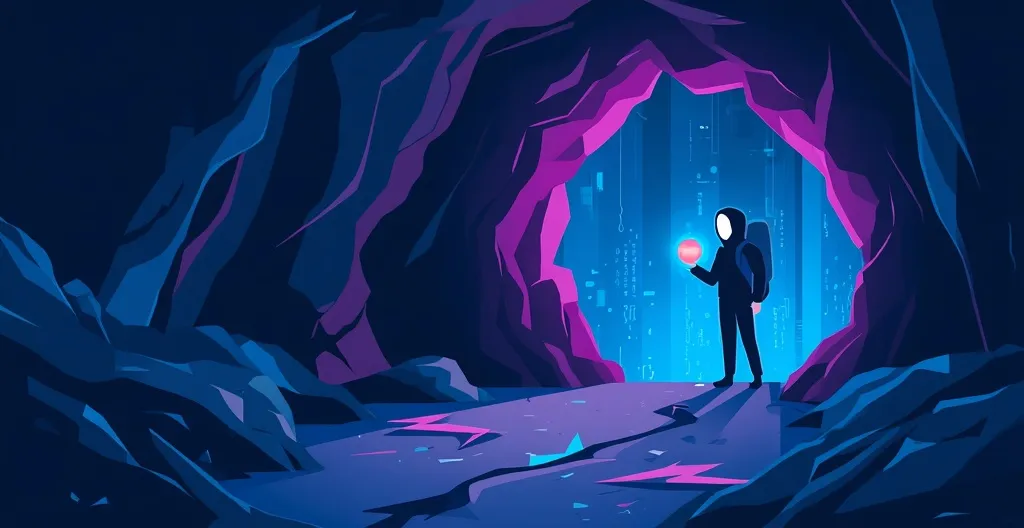
The classic explanation uses the cave analogy. Someone proves they know the secret path through a cave by emerging from the right exit on command, without ever showing the path itself. It is a clean mental model because it captures the weird beauty of zero-knowledge: verification without disclosure. For another plain-English explainer, Zero-Knowledge Proofs Explained is worth a look.
Three properties define a zero-knowledge proof. Completeness means true statements should be accepted when both sides follow the protocol. Soundness means false statements should be rejected except with negligible probability. Zero-knowledge means the verifier learns nothing beyond whether the statement is true. If you want a more technical reference, the research paper at Error extracting content digs deeper into the cryptographic foundations.
In blockchain systems, that combination is powerful because public ledgers are, by design, public. That is great for transparency and awful for privacy. It is also expensive when every node has to redo the same work. Zero-knowledge proofs give crypto a way to verify correctness without broadcasting the whole mess to the world. For a more general intro aimed at privacy and scaling, see What is a zero-knowledge proof? Privacy and scaling.
To make these proofs practical in blockchains, many systems use the Fiat-Shamir heuristic. In plain English, it replaces interactive random challenges with a hash function, turning a back-and-forth proof into something non-interactive that can be generated and verified onchain or offchain without live negotiation.
The blockchain world mostly talks about two proof families: zk-SNARKs and zk-STARKs.
zk-SNARK stands for Zero-Knowledge Succinct Non-interactive Argument of Knowledge. The “succinct” part is the headline: proofs are very small, often just a few hundred bytes, and can be verified in milliseconds. The “argument of knowledge” part means the system is computationally hard to fake. The catch is the setup. Many SNARK systems require a trusted setup, a ceremony that generates cryptographic parameters. If that setup is compromised, the security assumptions can go sideways fast.
That is the part that makes cryptography people stare into the middle distance.
Modern setup ceremonies try to reduce the damage by using multi-party computation, with hundreds or even thousands of participants contributing randomness. Zcash played an important early role in this model through its Powers of Tau ceremony. Newer SNARK constructions such as PLONK and its variants aim for a more flexible universal and updatable setup, which is a much less fragile arrangement than the old “please trust the magic box” approach.
zk-STARK stands for Zero-Knowledge Scalable Transparent Argument of Knowledge. The key word there is transparent: no trusted setup is required. That makes STARKs attractive for people who want fewer trust assumptions and a cleaner security model. The tradeoff is size. STARK proofs are typically much larger, often tens to hundreds of kilobytes, so they can be heavier on bandwidth and storage. A practical comparison is laid out in What Is a ZK Rollup? A 2026 Guide to Zero-Knowledge Scaling.
Different tools, different pain.
The underlying assumptions also differ. SNARKs rely on hard problems tied to elliptic curves, while STARKs rely on the collision resistance of hash functions. If those assumptions fail, the proof system fails with them. Cryptography is not powered by vibes. It is powered by math, and math is not sentimental.
The most important real-world use of zero-knowledge proofs today is probably ZK rollups on Ethereum. These are layer 2 systems that execute transactions offchain, batch them together, generate a validity proof, and then post the proof plus compressed transaction data back to Ethereum. Ethereum verifies the proof and uses the posted data for settlement and independent reconstruction of state. The Ethereum docs on How ZK-Rollups Work: Enhancing Ethereum's Scalability with break down the mechanics well.
That architecture is the reason ZK rollups can reduce fees so sharply. In favorable conditions, they can cut costs by an order of magnitude or more compared with direct mainnet execution. The user gets cheaper transactions. Ethereum keeps the settlement role. The chain avoids redoing every calculation. Everyone except the old fee market gets a little less smug.
Still, the shorthand can be misleading if it is taken too literally. Ethereum is not simply “checking one proof for thousands of transactions” in a vacuum. It is verifying the proof and relying on posted data so the state can be reconstructed and withdrawals can remain safe. The proof handles correctness. The data handles recoverability and censorship resistance.
That is where data availability comes in. If transaction data is not accessible, users and third parties cannot independently rebuild the rollup state. Ethereum.org is explicit on this point: data must remain available for permissionless verification, censorship resistance, and safe exits. A valid proof with missing data is not a success story. It is a great way to trap users in a system they cannot fully verify.
Major ZK rollup projects in production or late-stage development include zkSync Era, Scroll, Polygon zkEVM, Linea, and Taiko. The implementation details differ, but the goal is shared: make Ethereum cheaper and more scalable without throwing away the security model that gives it value in the first place. Our coverage of the XRP side of ZK experimentation, Ripple Unveils XRP Ledger Privacy Upgrade with, shows how this same tech is now spreading beyond Ethereum’s orbit.
Proving is still expensive, though the costs have fallen sharply over time. Proof generation that once took hours can now take minutes or even seconds in some setups, but that does not mean the bottlenecks are gone. Some production provers still need substantial memory, careful optimization, and specialized hardware. The math may be elegant; the infrastructure bill is not.
That burden creates a real centralization pressure. If only a few operators can afford to run serious proving infrastructure, then the system becomes operationally concentrated even if the cryptography itself remains sound. This is one of the less glamorous truths of ZK systems: they reduce trust in some places while raising the cost of participation in others.
Ethereum developers keep pushing on that front. Vitalik Buterin introduced the GKR protocol in late 2025 as a way to accelerate Ethereum zero-knowledge proof verification. The broader point is obvious enough: ZK systems are improving fast, but hardware and implementation still decide how much of that theory makes it into production.
Privacy is the other major reason zero-knowledge proofs have become such a big deal. Zcash, launched in 2016, was the first major blockchain to use zk-SNARKs for private transactions. In shielded Zcash transactions, the sender, receiver, and amount are hidden while the proof still prevents coin creation and double spending. That is what private crypto should look like: confidentiality without giving up integrity.
The same primitive also works for identity. A ZK system can prove someone is over 18 without revealing a birth date, prove citizenship without exposing a passport number, or prove possession of a credential without showing the issuing institution. Projects such as Worldcoin and Polygon ID use ZK-based identity verification in different ways. That selective-disclosure model is a lot saner than spraying personal data across every service that asks for it.
There is, however, a very real downside. Fully private transactions raise regulatory concerns around money laundering, sanctions evasion, and terrorist financing. Those objections are not imaginary. Privacy is a legitimate user right, but it is also a tool that bad actors love. The math itself is neutral; the misuse is the problem. That tension is not going away just because builders and regulators both wish it would.
Zero-knowledge proofs also have hard limits that get glossed over by people selling crypto fairy dust. They guarantee computational integrity, that a specific computation was performed correctly. They do not guarantee that the inputs were correct, that the computation was worth doing, or that the surrounding system is free of bugs. A proof can be perfect and the application can still be broken if the circuit encodes bad logic or the contracts around it are sloppy.
Several ZK rollup projects have already disclosed and patched critical bugs during audits and testnet deployments. That should surprise nobody. Complex cryptography plus complex software means mistakes happen. ZK does not repeal the laws of engineering, and it certainly does not make sloppy code safe by magic.
The same caution applies to the idea that ZK somehow solves everything. It does not eliminate the need for data availability. It does not erase the trust assumptions in the underlying code. It does not remove the need for audits, good clients, or sane operator design. What it does provide is a much sharper tool for proving correctness, preserving privacy, and compressing work that would otherwise be painfully expensive to verify onchain.
What does a zero-knowledge proof actually prove?
It proves that a statement is true without revealing the underlying data. In crypto, that often means proving a transaction batch was valid without replaying every transaction publicly.
Why do ZK rollups matter for Ethereum?
They let Ethereum verify offchain execution more efficiently while keeping settlement and data availability on the base layer. That can reduce fees substantially and preserve the security model that makes the chain useful.
What is the difference between zk-SNARKs and zk-STARKs?
SNARKs are typically smaller and faster to verify, but many require a trusted setup. STARKs avoid trusted setup and are more transparent, but their proofs are larger and usually heavier to handle.
Do zero-knowledge proofs make a system fully trustless?
No. They reduce trust in some places, but not everywhere. You still need correct circuits, data availability, secure contracts, and careful implementation.
Can ZK proofs protect privacy and still fit compliance needs?
Sometimes, yes. Selective disclosure systems can prove facts like age or credential ownership without exposing the full document, but fully private payment systems remain politically and legally contentious.
Zero-knowledge proofs are one of the most serious pieces of infrastructure in crypto because they do something rare: they make systems more private and more scalable without pretending tradeoffs do not exist. That is exactly the kind of engineering the space needs, less hand-waving, more cryptographic receipts.
The promise is real, but so are the costs. ZK can make blockchains cheaper, more private, and more efficient, yet it still depends on good design, strong assumptions, and hardware that does not come cheap. The math is powerful. The hype, as usual, should be kept on a short leash.
Further Reading
A useful XRP-ledger angle on the same ZK machinery: