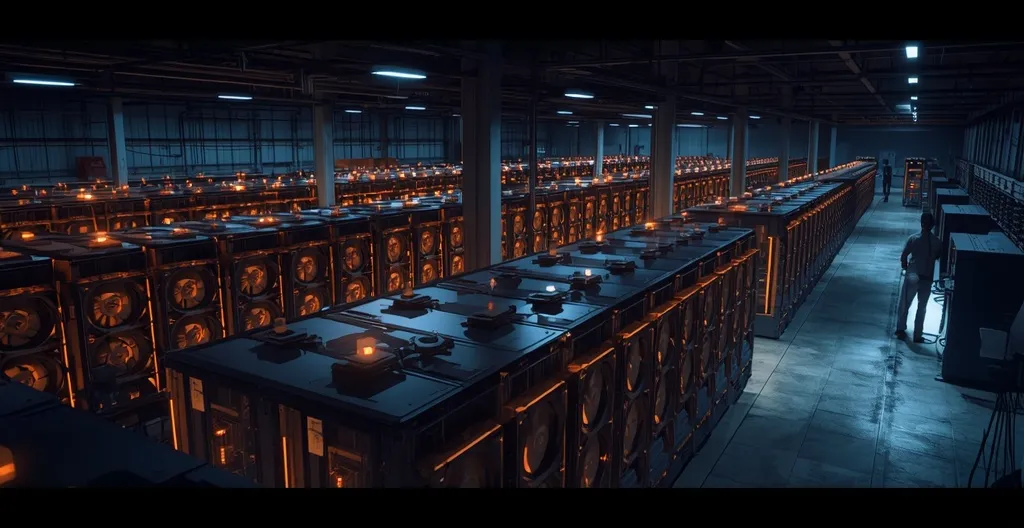
Bitcoin’s mining difficulty has dropped sharply, and that usually means a meaningful chunk of miners is feeling the squeeze. The network is doing exactly what it was built to do, but the stress under the hood is real.
- Sharp adjustment: Galaxy Research says difficulty is down about 18.5% from its peak, with a recent 10.09% network adjustment.
- Miner pressure: Falling BTC prices, older rigs, and high power costs are forcing some operators offline.
- AI pivot: Some mining infrastructure is being redirected toward AI and high-performance computing work.
Mining difficulty is Bitcoin’s self-correcting mechanism. It adjusts so blocks keep coming at roughly the network’s intended 10-minute pace, even when miners leave or new hashpower floods in. Hashrate is the raw computing power securing the network; difficulty is the target the protocol sets in response. One moves, the other follows. No magic, no drama, just code doing arithmetic. For live market context, Bitcoin Price Live and Trading Overview is the sort of dashboard traders obsess over while pretending not to.
Galaxy Research says the recent drop is one of the biggest since the 2021 “China ban”, when Beijing’s crackdown on mining triggered a massive hashrate collapse. That comparison is not casual. The 2021 shock was one of the sharpest mining disruptions in Bitcoin’s history, and it remains the cleanest benchmark for large-scale miner exit pressure. A broader look at the same dynamic has also been discussed in Bitcoin Mining Faces Challenges Amid Price Decline and, which reaches the same basic conclusion: cheap narratives do not pay power bills.
The mechanism behind the decline is straightforward. When Bitcoin’s price weakens, mining margins get compressed. Electricity bills do not care about bullish narratives, and older hardware with poor efficiency gets pushed toward the door first. Some miners shut down. Others sell coins to keep the lights on. A few do both, which is a particularly unpleasant hobby. For anyone tracking the hard numbers, BTC Diff 127.17T at Block 958422 captures the network’s difficulty level at a specific point in time, which is about as glamorous as accounting gets.
Galaxy’s research also ties the difficulty drop to the network’s recent block production slowdown. The protocol’s adjustment is designed to react after blocks start arriving too slowly, then ease difficulty so the average cadence returns toward normal. That is not Bitcoin “failing.” It is Bitcoin absorbing a supply shock in the mining layer and recalibrating. Similar pressure has been tracked before, including in Bitcoin Faces 11th-Largest Difficulty Drop as Miners Feel, which shows this isn’t some one-off panic event. It’s a recurring grind.
That distinction matters. A falling difficulty reading is not the same thing as a broken network. It is more like the system saying, “fine, fewer miners are playing, so I’ll make the puzzle easier until timing normalizes.” The whole point is resilience.
Still, the signal is not cheerful. Lower difficulty generally means miners are under pressure and some have powered down. The supplied materials point to a familiar pattern: less efficient operators and miners facing high energy costs are the first to capitulate. In mining, the weakest balance sheets usually get introduced to reality with a baseball bat. Another recent breakdown, Bitcoin Mining Difficulty Drops 2.12% Amid Market Downturn, showed just how quickly that pressure can build when markets sour and miners get cute with assumptions.
Some operators are responding by shifting infrastructure toward artificial intelligence and high-performance computing. That pivot makes sense in plain business terms. Mining income is highly exposed to Bitcoin’s price and network difficulty, while AI/HPC contracts can offer steadier cash flow. If you can rent out power, cooling, and compute capacity to a larger customer, that can look a lot better than grinding away for block rewards in a down market.
But the AI angle should not be oversold into a fairy tale. Not every mining setup can be cleanly repurposed, and actual Bitcoin ASICs are not general-purpose AI machines. The real opportunity is usually at the facility level: land, power access, cooling, and infrastructure can sometimes be adapted for different compute workloads. That is a useful business pivot, not a guaranteed rescue arc. Related coverage such as Bitcoin Hashrate Drops 15% Amid Prolonged Miner Capitulation underscores the same uncomfortable truth: the operators with the cheapest power and best balance sheets get to keep smiling.
Galaxy Research’s numbers show just how hard the network has been hit. The recent downward adjustment was 10.09%, from 138.96T to 124.93T, at block 953, 568. That made it the 11th-largest downward difficulty adjustment ever, according to the research summary. The current epoch stretched to 15.6 days instead of the usual 14-day target period, which is exactly the kind of lag you expect when too much hashpower leaves the network before the next retarget. A previous large move was also covered in Bitcoin Mining Difficulty Drops 10% in Second-Largest, reinforcing that these kinds of resets are rare, but not unprecedented.
For miners who remain online, the aftermath can actually improve economics. With less competition and a lower difficulty setting, the same amount of active hashpower earns a bigger slice of the fixed block rewards and transaction fees. That is why miner capitulation is often seen as both a warning sign and a contrarian setup: pain for the weak, better margins for the survivors. If you want the gory version of how one drop can move the math, Bitcoin Mining Difficulty Drops 18.5%: Here Is Why It explains why this adjustment is a big deal rather than just another sleepy metric.
Independent analyst Axel Adler Jr., cited in the materials, described the situation as a “stress zone” rather than full-blown capitulation. He noted that the Puell Multiple fell from 0.83 to 0.74 over ten days and suggested conditions would likely need to deteriorate further, including Bitcoin dropping below $55, 000 without another difficulty adjustment, before the picture looked truly ugly. That is a useful reality check. Bad, yes. Terminal, not obviously. There’s also a more recent market-specific update in Bitcoin Mining Difficulty Drops 2.12% Amid Market Downturn, which lands on the same basic point: miners are getting squeezed, but the floor has not collapsed.
The broader market backdrop is still soft. CoinGlass data showed Bitcoin open interest at $47, 923, 618, 227, while the broader derivatives market held steady enough to suggest traders are active but not decisively one-way. Open interest is the total value of outstanding derivatives positions, so it is a decent gauge of how much leverage is sitting in the system. If that number stays sticky while price weakens, the market usually finds a way to get unpleasant in a hurry.
Bitcoin’s price in the supplied material is roughly in the mid-$60, 000 range, depending on the timestamp used. That matters more than a tidy headline number because miners live and die by the spread between revenue and costs. When BTC weakens, the least efficient operators get squeezed first, and difficulty eventually reflects that pain. It is ugly, but it is also how the network clears out weak capacity and resets the economics.
There is a bigger structural point here too. Lower difficulty can help the network stabilize after a miner washout, but it can also accelerate consolidation. Bigger, better-capitalized miners tend to survive these shakeouts, which can improve efficiency while also raising long-term questions about concentration. Bitcoin is decentralized by design, but mining as a business has never been immune to scale advantages. The protocol does not care about your feelings or your spreadsheet.
That is the uncomfortable truth behind the current drop. Difficulty falling is not a fatal wound, but it is a clean signal that mining is under pressure and the industry is trimming excess. The network is adapting exactly as intended, yet the market conditions driving that adaptation are punishing enough to push weaker players out. That combination, a functioning system and stressed operators, is what a real shakeout looks like.
Key takeaways
-
Why does a difficulty drop matter?
Difficulty is what keeps Bitcoin block times near 10 minutes. A sharp fall usually means hashrate has dropped and miners are under financial strain. -
Is this a network failure?
No. This is Bitcoin’s built-in adjustment mechanism working as designed. Blocks slowed, difficulty adjusted, and the system kept moving. -
Why are miners getting hit?
Lower BTC prices, high power costs, and older hardware have squeezed margins. The least efficient miners are the first to shut down. -
Why is AI part of the conversation?
Some miners are repurposing infrastructure for AI and high-performance computing because those contracts can provide steadier revenue than mining alone. -
Should investors panic?
Not from difficulty alone. Miner stress is a real bearish signal, but it also tends to flush out weak operators and reset network economics for the survivors.
Bitcoin mining has always been a brutal business. The network keeps humming, but the operators behind it are fighting physics, power prices, and market volatility every single day. Right now, the message from difficulty is simple: the squeeze is on, and only the leanest miners are likely to enjoy the ride. If you want another angle on how the protocol keeps bending without breaking, Dormant 2011 Bitcoin Wallet Moves 30 BTC as Noah Doe Legal is a reminder that old coins, old assumptions, and old miners all have a habit of showing up when nobody asked.