
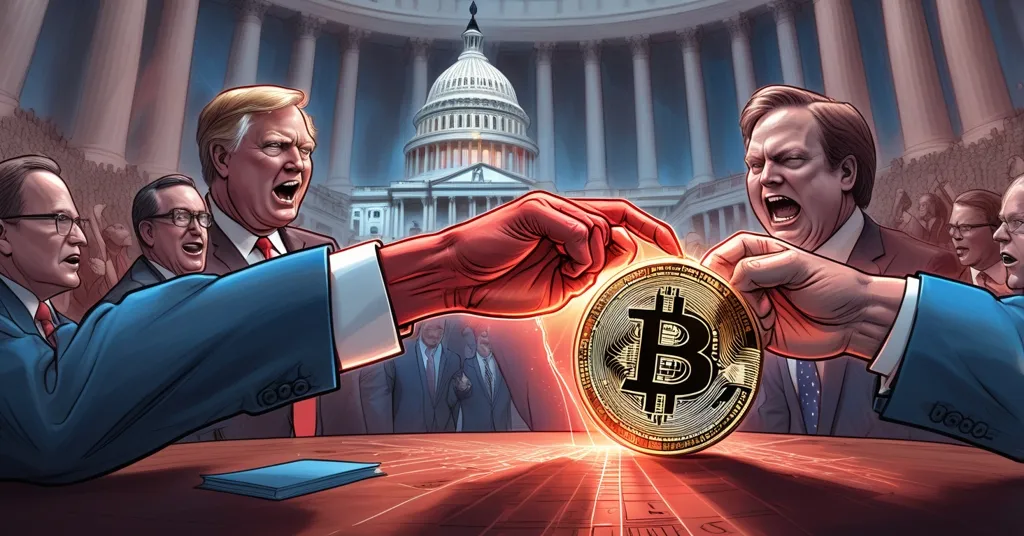
Bitcoin’s next big risk may not be the chart, macro data, or exchange blowups — it may be politics. As crypto gets pulled deeper into partisan fights in the U.S. and abroad, the real question is whether digital assets are becoming durable financial infrastructure or just another hostage to election cycles.
- Bitcoin politics is now a real market factor
- Spot Bitcoin ETFs, Wall Street adoption, and friendlier Washington still haven’t pushed BTC above six figures
- Regulatory divide is sharpening between Republicans and Democrats
- South Korea is showing the same politicized crypto pattern
- Stablecoin and market structure laws may matter more than another hype cycle
Why Bitcoin politics matters now
Bitcoin has been trading in the low-to-mid $60,000 range, roughly 40% below where it sat around a year ago, and that is not exactly the victory parade bulls were expecting after a string of supposedly massive wins. Spot Bitcoin ETFs got approved. Wall Street showed up. Washington sounded friendlier. And yet BTC still failed to hold six figures.
That should be a wake-up call.
The uncomfortable read is that much of the bullish news may already be in the price. The bigger concern now is that the next major risk for digital assets is not technological or macroeconomic, but political. Crypto is becoming increasingly tied to party identity, and that is a dangerous evolution for an asset class that argues it is neutral infrastructure rather than a partisan vehicle. If Bitcoin starts being seen as “the other side’s money,” the whole narrative gets messier fast.
This is where the market starts to look less like a neutral price discovery machine and more like a policy mood ring. One election result, one committee chair, one regulator’s warning — suddenly the whole sector reacts like it was built on spaghetti and wishful thinking.
Why Bitcoin has stalled despite bullish catalysts
Bitcoin should have had a cleaner breakout by now if every bullish headline translated directly into price. It didn’t. That does not make the asset weak; it just means markets are not dumb enough to pay twice for the same story.
Spot Bitcoin ETFs were a huge step. They opened the door for traditional investors, wealth managers, and retirement accounts that would never touch a self-custodied wallet or a sketchy offshore exchange. Wall Street participation added legitimacy. A more crypto-friendly tone from Washington gave traders another reason to lean bullish.
But price action is the final judge, and price action has been telling a more sober story. The reason may be simple: institutional access is not the same thing as institutional conviction. Big capital likes optionality, but it hates legal gray zones. If policy can flip with the next election, then long-term allocation models get a built-in discount.
That is the real issue behind the so-called political risk premium. Investors are not just pricing Bitcoin itself. They are pricing the chance that the rules around Bitcoin, stablecoins, exchanges, and custody can change with the political winds.
The U.S. regulatory divide is getting wider
In the U.S., the split is becoming harder to ignore. Republicans are generally framed as the pro-crypto camp, emphasizing innovation, economic liberty, and resistance to heavy-handed state control. Democrats, by contrast, tend to lean toward consumer protection, market oversight, and financial stability.
On paper, both instincts have a point. No one serious wants a financial free-for-all where scammers run wild and retail gets cleaned out. At the same time, if regulation becomes so aggressive that it smothers innovation, then the U.S. risks exporting opportunity and liquidity to friendlier jurisdictions.
The problem is not that one side is pure and the other is evil. That would be lazy nonsense. The problem is that crypto has become a political football. When regulation turns partisan, investors end up pricing in election cycles instead of legal certainty. That is bad for exchanges, bad for token projects, bad for stablecoin issuers, and ultimately bad for capital formation.
Buying Bitcoin today increasingly feels like an implicit bet that a supportive SEC, a supportive White House, and a supportive congressional balance will stay in place long enough for policy clarity to harden into something durable. That is not institutionalization. That is a temporary truce with a clock ticking in the background.
The SpaceX example shows how political this has become
The debate got even sharper around SpaceX’s high-profile Nasdaq debut on June 12 UTC. The transaction targeted a valuation of around $1.75 trillion and reportedly raised roughly $75 billion at a fixed offering price of $135 per share. On the surface, that looked like a massive capital-markets event.
In practice, it became another flashpoint in the growing fight over governance, regulation, and power.
Senator Elizabeth Warren pressed SEC Chair Paul Atkins to delay the listing, criticizing the Trump administration’s SEC over governance concerns tied to Elon Musk’s voting control. That is not a Bitcoin story in the narrow sense, but it is absolutely part of the same political machinery. It shows how quickly major market events can become ideological battlegrounds when regulators, lawmakers, and founders collide.
It also shows why crypto markets cannot pretend regulation is some boring side issue for lawyers to handle in the background. It is part of the price action. It shapes whether institutions lean in or sit on their hands. It determines whether a crypto-friendly policy becomes law or dies in committee. It decides whether a digital asset looks like a legitimate financial rail or a target painted on by whichever side is out of power this month.
What the GENIUS Act and CLARITY Act actually matter
There has been real progress, and it should not be ignored.
The GENIUS Act, a stablecoin bill passed in July 2025, is one major sign that lawmakers can still move actual crypto legislation when they want to. Stablecoins are crypto assets designed to hold a stable value, usually by being tied to a fiat currency like the U.S. dollar. They are the plumbing of crypto markets: used for trading, payments, remittances, and settlement. If stablecoin rules get clearer, the market gets a little less chaotic and a little more usable.
The CLARITY Act, a market structure bill, also cleared the House and moved to the Senate Banking Committee. Market structure law is basically the rulebook for who regulates what. It helps answer the annoying but crucial question: is a token a security, a commodity, something else, or a regulatory headache with a website? For exchanges, issuers, and developers, that distinction is everything.
In other words, the GENIUS Act and CLARITY Act are not just beltway acronyms. They are the difference between a sector that can build with confidence and one that keeps getting told to “figure it out later” while regulators sharpen the knives.
Still, the path is far from smooth. Prediction markets are reportedly showing increased odds of Democrats retaking the House in the 2026 midterms, and some investment banks think the CLARITY Act could be delayed until after the midterms. That kind of uncertainty matters because the executive branch still has meaningful influence over crypto policy even under divided government. A presidential pledge becomes a trading theme; a regulator’s warning becomes a sell cue.
That is a fragile foundation. Markets can survive volatility. They can survive bad headlines. What they do not love is a policy regime that depends on who happens to be in office and whether that person feels generous toward digital assets this quarter.
“the next major risk for digital assets is not technological or macroeconomic, but political.”
“Bitcoin is perceived—fairly or not—as aligned with one side of that divide.”
“That is a dangerous evolution for an asset class that argues it is neutral infrastructure rather than a partisan vehicle.”
South Korea is showing the same pattern
This is not just an American problem. South Korea is another example of crypto policy getting pulled into the political arena.
The Lee Jae-myung administration is said to support spot crypto ETFs, a won-denominated stablecoin, tokenized securities legislation, a comprehensive digital asset framework act, and a presidential digital asset committee. That is an ambitious agenda, and some of it could meaningfully expand digital asset adoption in one of Asia’s most active markets.
But there is also a catch.
The Bank of Korea is reportedly cautious about a won stablecoin because of monetary stability concerns. That is not unreasonable. A stablecoin tied to the national currency can speed up payments and reduce friction, but it can also create new pressure points around capital flows, reserve management, and the central bank’s control over money. Central banks are not known for embracing innovations that make their own job harder. Shocking, really.
The broader lesson is the same as in the U.S.: if crypto policy depends too much on one administration, one party, or one leader’s priorities, then it stays politically fragile. Durable markets need rules that are difficult to reverse. Otherwise, every election becomes a referendum on whether crypto gets to keep breathing.
The real issue: regulation that survives politics
The optimistic case for Bitcoin remains intact. It is still the cleanest, hardest monetary asset in crypto. It still benefits from scarcity, decentralization, and global portability. BTC does not need a permission slip from a bank to exist, and that matters a lot more than most policy people want to admit.
But the infrastructure around Bitcoin — exchanges, ETFs, stablecoins, custody, and market access — does need rules. That means the sector cannot just cheer when the “right” party is in charge and panic when the “wrong” one wins. If crypto wants to be treated like serious financial infrastructure, it has to survive serious politics.
There is also a devil’s-advocate case here worth making. Maybe politics is not Bitcoin’s biggest risk. Maybe the bigger risk is still the market itself: over-leverage, speculative excess, weak projects getting dragged along by the BTC brand, and a crowd that confuses ETF inflows with permanent adoption. Political support helps, sure, but it does not immunize the market against bubbles, bad actors, or plain old overconfidence.
That said, the warning is valid. If policy support remains too dependent on election outcomes and individual administrations, the sector remains fragile rather than truly institutionalized. The risk premium rises not because of a new protocol exploit or a surprise inflation print, but because the policy foundation has not been fully embedded in stable institutions.
Bitcoin’s next major inflection point may be less about the chart and more about whether the regulatory trajectory becomes durable — or keeps changing every time voters decide to swap managers.
Key questions and takeaways
What is Bitcoin’s biggest risk right now?
Political risk. The more crypto gets tied to elections and partisan identity, the more unstable the regulatory backdrop becomes.
Why hasn’t BTC broken above six figures?
A lot of the bullish catalysts — spot Bitcoin ETFs, Wall Street adoption, and friendlier Washington — may already be priced in. Markets are not infinite hype machines.
Why does the regulatory divide matter?
Because uncertainty hits everything: exchange behavior, institutional allocation, ETF flows, stablecoin adoption, and long-term building in the sector.
What does the SpaceX Nasdaq debut show?
It shows how major capital-markets events can become political flashpoints when governance, SEC approval, and ideology collide.
What do the GENIUS Act and CLARITY Act do?
The GENIUS Act helps define stablecoin rules, while the CLARITY Act tries to clarify crypto market structure and who regulates what.
Why is South Korea relevant?
Because it shows the same pattern outside the U.S.: crypto policy can become tied to a specific administration instead of lasting institutions.
What would make crypto regulation more stable?
Clear laws, transparent oversight, and enough bipartisan agreement to survive the next election cycle without throwing markets into chaos.
Is this bearish on Bitcoin?
Not structurally. Bitcoin still has strong long-term fundamentals. The warning is that political dependence is a real vulnerability, and pretending otherwise is just sloppy thinking.


