
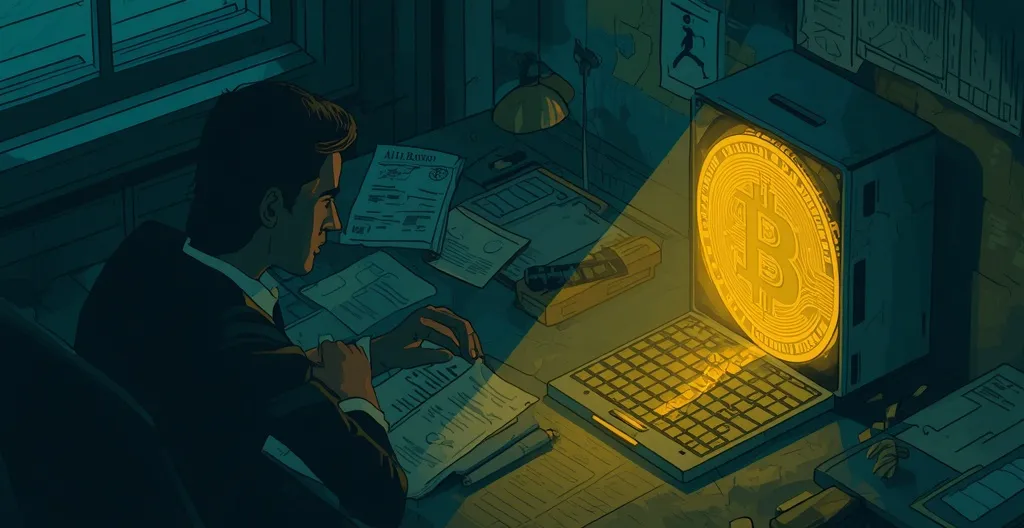
A British Bitcoin investor has reportedly gotten 61 BTC back more than 12 years after losing access to coins bought through one of the U.K.’s earliest exchanges. The catch: the recovery is being reported mainly by the law firm that handled it, so the public proof is still thin.
- 61 BTC returned after a 12-year wait
- Recovered value: about £3.3 million, or roughly $4.5 million
- Old bank records helped alongside blockchain tracing
- Big caveat: no public court filing, settlement, or tracing report
CEL Solicitors says it recovered 61 bitcoin for a British investor identified only as Chris. According to crypto.news, the coins are worth about £3.3 million, or roughly $4.5 million. Chris originally bought the bitcoin in December 2011, spending around £1, 500 when BTC traded below $4.
That’s a ridiculous return on a tiny purchase, and a sharp reminder of why forgotten crypto still matters. But the headline comes with a serious asterisk: this is a reported recovery, not a publicly documented one. CEL has not disclosed the wallet address, a full tracing report, a court judgment, a settlement agreement, or the exact legal mechanism that returned the coins.
In other words, the claim looks plausible, but readers should not treat it like independently verified gospel. Crypto has enough fairy tales already.
CEL says the case was completed in about four months and that it was handled without law-enforcement intervention. The firm says it combined blockchain tracing with old-school off-chain evidence: banking documents dating back almost 15 years, exchange emails, account-registration messages, deposit confirmations, and customer-support correspondence.
That distinction matters. Blockchain tracing can show where coins moved on-chain, but it cannot, by itself, prove who legally owns a wallet. Bitcoin’s ledger is public; identity is not. To recover old exchange-held funds, you usually need records outside the chain that connect a real person to an account, deposit, or claim. The blockchain can map the trail. It cannot sign the paperwork.
Chris put the emotional side of it plainly:
“The worst thing was seeing Bitcoin grow and knowing what I could have done with the money, ”
Anyone who has ever lost access to an old exchange account, a forgotten password, or a dead inbox can understand that feeling. The money is there, the price is there, and the access is gone. That gap is where a lot of early crypto pain lives.
The original purchase was made through Britcoin, an early U.K. exchange that later became Intersango. According to crypto.news, Intersango announced it would stop U.S. dollar trading in October 2012, and its website was offline by early 2014. That timeline fits the messy, underbuilt era of early Bitcoin exchanges, when custody was often loose, recordkeeping was weak, and users were trusting platforms that looked more like improvisation than infrastructure.
That’s the uncomfortable truth behind a lot of early crypto success stories: Bitcoin itself did what it was supposed to do. The custodians did not.
The case also shows why so many old exchange claims are impossible to prove today. A decade is a long time in crypto. People lose emails, banks purge records, companies vanish, domains die, and server backups become archaeological artifacts. If enough off-chain evidence survives, a claim can sometimes be rebuilt. If it doesn’t, the coins may be real but the legal path back to them is dead.
CEL’s sister company, The Crypto Tracing Experts, has taken the story further by claiming it identified a wallet containing more than 5, 500 BTC that it believes is linked to former Intersango users. At a bitcoin price of $76, 500, that would be worth about $420.75 million.
That figure is eye-catching, but it is not the same thing as confirmed recoverable value. The wallet address has not been publicly disclosed, the tracing methodology has not been published, and no distribution timetable has been announced. So for now, this is a tracing claim, not a verified payout pool.
There’s a big difference between tracing and recovery. Tracing means following movement on the blockchain. Recovery means actually getting the asset back into someone’s control through legal, technical, or custodial means. Plenty of firms can point to a cluster of transactions and call it discovery. Far fewer can turn that into a returned balance.
CEL has framed the case as part of something bigger, saying there may be other former Britcoin/Intersango users with recoverable claims and that no formal deadline has been announced for people to submit records. That may be true, but it is also how recovery businesses talk when one success story creates a fresh pipeline of hopeful claimants.
Still, the underlying point is real. Old bank statements, exchange emails, deposit confirmations, and customer-support logs can matter a lot in disputes involving early custodial Bitcoin. Modern users are used to polished dashboards, segregated custody arrangements, and cleaner account statements. Early exchange customers often got a much rougher deal. In many cases, they were lucky if the platform had a functioning website and a help desk that answered twice a month.
That’s also why this case should not be confused with a seed-phrase recovery. A seed phrase is the backup code for a self-custodied wallet. This appears to have been a custodial access case involving an old exchange account, not a lost self-custody wallet. You cannot derive private keys from a public address, and you cannot reverse a confirmed Bitcoin transaction. Once the access path is gone, proof becomes everything.
The comparison to Mt. Gox is useful, but only up to a point. Mt. Gox claimants went through a formal rehabilitation process. This Intersango recovery, based on the public reporting available, does not appear to involve an equivalent public insolvency procedure. That difference matters. One is a court-supervised claims framework. The other is a firm saying it got the job done, with details still kept largely behind the curtain.
That doesn’t make the claim fake. It just means readers should keep their skepticism switched on. Crypto recovery services can do real work, but they also love a good headline. “We found the coins” sounds a lot better than “we stitched together old bank records, exchange correspondence, and legal leverage and finally got a result.” The second one is less flashy, but it’s the part that actually matters.
Chris says he is not planning to dump everything back into fiat either:
“I want to keep some Bitcoin to see if the value rises again, ”
That’s a very Bitcoin response: take some life-changing gains, keep some skin in the game, and let the market do what the market does. Sensible, if slightly heroic. Bitcoin has a way of turning people into long-term optimists whether they asked for it or not.
For the industry, the bigger lesson is simple. Bitcoin is durable, but human recordkeeping is not. The chain can preserve transaction history for decades. It cannot preserve a user’s memory, a company’s archive, or a bank’s tolerance for ancient paperwork. That is why old exchange claims sometimes die, and why a few, against the odds, can be revived.
Key takeaways
-
Can old exchange bitcoin really be recovered after 12 years?
Sometimes, yes. But only if enough off-chain evidence still exists to prove ownership and support the legal return of the assets. -
Did blockchain tracing alone prove Chris’s claim?
No. CEL says the recovery relied on blockchain tracing plus banking records and exchange correspondence. On-chain data can help, but it does not identify a real-world owner by itself. -
Is the 5, 500 BTC wallet confirmed and ready for distribution?
Not publicly. CEL’s sister company says it traced a wallet linked to former Intersango users, but the wallet address, methodology, and any payout plan have not been disclosed. -
What should people keep if they ever used an old exchange?
Bank statements, deposit confirmations, exchange emails, account-registration records, and customer-support messages can all help prove a claim years later. In crypto disputes, boring paperwork can be worth more than hope. -
Why does this matter for Bitcoin more broadly?
It shows the upside of Bitcoin’s permanence and the downside of early custodial mess. The coins may still exist, but without proof, access can be gone for good.
The takeaway is not that lost Bitcoin always comes back. Most of the time, it doesn’t. The real lesson is harsher: if you used early exchanges, proof matters, records matter, and custody models matter even more. Bitcoin can survive bad institutions. Your claim to it might not.
Further reading
A few related pieces that add context on old Bitcoin recoveries, exchange-era messes, and the darker corners of crypto enforcement.
- Bitcoin investor recovers $4.5m after 12-year wait
- Why is the crypto market down today?
- British Investor Recovers $4.5 Million in Bitcoin After 12
- A Chunk of the $400, 000 Retirement-Community Entrance Fee
- Gemini Enterprise Agent Platform
- Bitcoin recovery unlocks potential $432M Intersango hunt
- British Investor Recovers 61 Bitcoin Worth $5 Million After
- Bipartisan House Bill Seeks Federal Task Force to Crack
- U.S. Seizes $560, 000 in Crypto Linked to Hamas Fundraising


