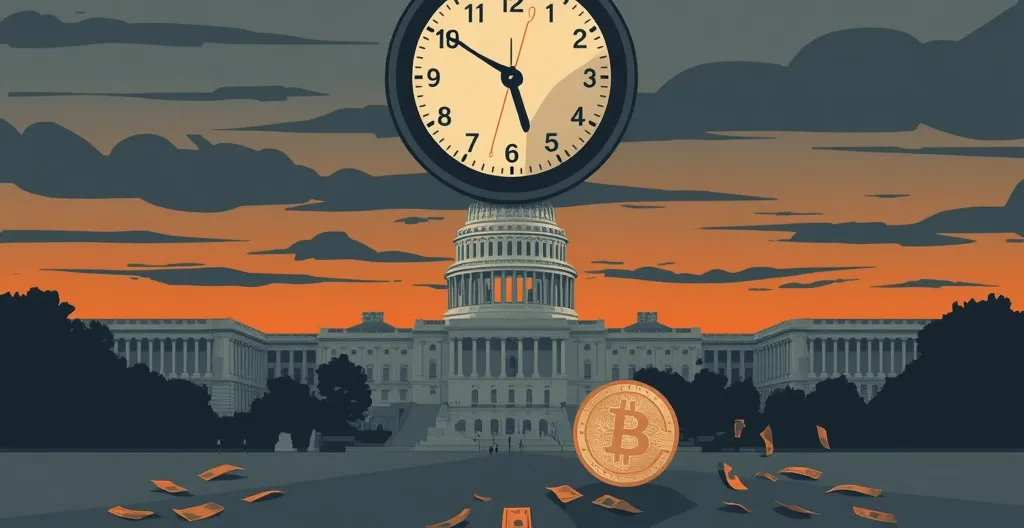
A crypto market-structure bill can survive a rough markup. It has a much harder time surviving a House calendar with the floor time ripped out of it.
- House voting days were cut
- Sept. 15 Senate action is procedural, not final
- Stablecoin rewards remain a major fight
- Prediction markets still look skeptical
The CLARITY Act, the House’s digital asset market structure bill known as [H.R. 3633](https://www.congress.gov/bill/119th-congress/house-bill/3633/text), is running into a very old Washington problem: too many steps, not enough days, and a Senate process that can turn a “major priority” into a slow-motion pileup.
House Republican leaders have cut eight voting days from September, including the weeks of Sept. 21 and Sept. 28, and the chamber is scheduled to leave Washington on Sept. 17. After lawmakers return from Labor Day, they will have only four voting days before heading out again. If the Senate changes the bill, the House may not have enough time left to approve those changes or negotiate a compromise.
That timing squeeze is the whole game. Congress can hype “momentum” all it wants, but bills don’t pass on vibes. They pass when both chambers have the time and votes to grind through the mess.
The Senate is expected to hold a cloture vote on Sept. 15 on the motion to proceed to the CLARITY Act. That is a procedural step meant to move debate forward. It is not final passage, and it is not even the end of the procedural hassle. Cloture requires support from at least 60 senators, which means Senate Republicans cannot get there without Democratic votes.
Once that hurdle is cleared, lawmakers would still have to debate the bill, potentially amend it, and then send any revised version back to the House. That is where the shortened calendar starts to matter in a very real way. Fewer voting days means less room for the two chambers to reconcile differences before the schedule runs out.
The bill’s core goal is straightforward enough: split oversight of the U.S. digital asset market between the Securities and Exchange Commission and the Commodity Futures Trading Commission. In plain English, it tries to answer the question U.S. crypto has been dodging for years, who regulates what, and when does a token look like a security versus a commodity?
That question matters because regulatory confusion is not some abstract headache for lobbyists. It affects exchanges, token issuers, developers, investors, and anyone trying to build without getting sued into the ground first. Many bitcoin-first readers welcome anything that reduces legal chaos, though some remain wary of bills that mainly tidy up the broader crypto industry while leaving Bitcoin to carry the “sound money” load on its own.
Still, clarity can cut both ways. A clean rule set can help legitimate builders. A sloppy one can lock in old gatekeepers and create new layers of nonsense with better branding. Washington has a gift for taking a simple need and turning it into a 900-page compromise casserole.
One of the sharpest unresolved fights involves stablecoin rewards. These are incentives, yields, or perks tied to using or holding stablecoins, tokens designed to track the value of a fiat currency like the U.S. dollar. In practice, that can mean exchange rewards, cashback-style perks, or yield-like payments that look a lot like bank products, which is exactly why banks hate them.
The Senate text would prohibit payments based solely on holding a payment stablecoin balance, while still allowing certain rewards tied to transactions or other activity. That is a very Washington way of saying: you may have incentives, but not those incentives.
Banks argue crypto firms should not be allowed to offer deposit-like perks without bank-like regulation. Crypto companies say the banks are protecting their turf and dressing it up as consumer protection. Both sides are, as usual, defending their own business model while pretending to be guardians of the public interest. A classic. The fight has even drawn fire from within the administration, as the White House Crypto Advisor slams banks over stablecoin rewards in the CLARITY Act fight.
There are other unresolved issues too: ethics rules for officials, anti-money laundering safeguards, state enforcement powers, and decentralized finance. Those are not small technical footnotes. They go to the heart of whether the bill creates a workable market framework or just another thick stack of political compromises that everyone claims to dislike and then votes for anyway.
While Congress stalls, the SEC is not sitting quietly on its hands. In August, the agency proposed Regulation Crypto Assets, a 402-page framework that includes fundraising exemptions and added disclosure requirements. One exemption would allow eligible issuers to raise up to $5 million over 12 months, while another would permit offerings of up to $75 million under extra investor-protection rules.
That matters because it shows the agency is still trying to shape the market even as lawmakers fight over the statute itself. Regulators rarely wait for Congress to finish. They fill the gap, define the edges, and leave everyone else to argue about whether that was responsible governance or just bureaucratic freelancing with a seal on it.
SEC Chair Paul Atkins said he hoped the Senate would advance the legislation within two weeks. Hope is nice. Floor time is better. In Washington, optimism without a calendar is just performance art.
The political odds are not exactly encouraging either. Miller Whitehouse-Levine, CEO of the Solana Policy Institute, previously put the bill’s chance of becoming law before the midterms at 10%. On Polymarket, traders now place the chance of enactment in 2026 at about 17%. At one point, that contract showed roughly 20% odds, with more than $7.2 million wagered.
Those numbers are not official forecasts. They are trader sentiment, useful as a measure of market skepticism, but not a crystal ball. Prediction markets can be informative, and they can also be noisy little weirdos when liquidity shifts or traders decide to chase a headline.
Another Polymarket contract puts Democrats’ chance of winning the House at about 90% and taking the Senate at roughly 52%. If those odds hold, the legislative picture after the election could look very different, which is why a lame-duck session, the period after an election but before a new Congress is seated, may become the last realistic shot for the bill.
That is the ugly truth here: delay itself can become policy. If lawmakers cannot move quickly enough, the bill does not just “wait.” It may land in the political freezer, where unfinished business goes to survive, die, or get Frankensteined into something barely recognizable by the next round of negotiators. The latest market read from JPMorgan says the CLARITY Act faces fading odds as the Senate crypto fight intensifies.
Key questions and takeaways
-
Why is the CLARITY Act delayed?
House Republican leaders cut eight September voting days, which leaves very little time for House action if the Senate amends the bill. A separate report also notes that the CLARITY Act faces delay as House cuts September sessions. -
Does the Sept. 15 Senate vote finish the bill?
No. It is only a cloture vote on the motion to proceed, which would let debate move forward. Final passage would still require more votes and likely more negotiations. -
Why does the House calendar matter so much?
If the Senate changes the text, the House has to accept those changes or work out a compromise. Fewer voting days make that much harder. -
What is the biggest policy fight still hanging over the bill?
Stablecoin rewards. Banks want tighter limits, while crypto firms want room to offer incentives tied to stablecoin use without getting boxed out. Senate drafting has kept the pressure on, including in Senate Banking’s new text and the broader ethics-and-stablecoins fight. -
Is the SEC waiting for Congress?
No. The SEC has its own crypto rulemaking track, including a proposed framework with fundraising exemptions and disclosure requirements. -
Do prediction markets tell us what will happen?
Not exactly. They reflect trader sentiment and risk appetite, which can be useful, but they are not official forecasts and can change fast. -
What happens if the bill misses this window?
It could slip into a lame-duck session or get pushed into the next Congress, where the politics and the text may both look very different.
The bigger picture is pretty clear: U.S. crypto policy is still being shaped by procedural bottlenecks as much as by substance. Congress is trying to draw the map. The SEC is still writing around the edges. And the market is watching the whole thing with a healthy amount of doubt.
For an industry that has begged for regulatory clarity for years, that delay is not just annoying. It is the policy.
Further reading
A few unrelated but useful resources if you’re skipping between crypto headlines and real-world logistics.