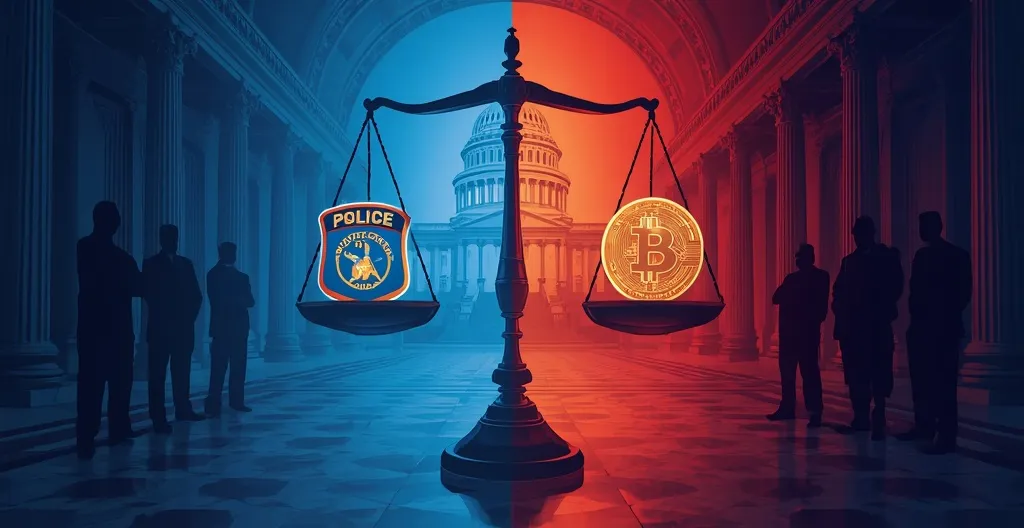
CLARITY Act wins police backing as odds fall to 30%
Police support for the CLARITY Act is growing, but the bill still has to survive the Senate’s favorite hobby: turning crypto policy into a trench war over ethics, stablecoins, and regulatory turf.
- MCCA backs revised text: law-enforcement concerns eased
- Still stuck on ethics, DeFi protections, and stablecoin rewards
- Polymarket odds: 30% for Trump signing it in 2026
The Major Cities Chiefs Association (MCCA) has endorsed the latest draft of the CLARITY Act in a letter to Senate Banking Committee Chair Tim Scott and ranking member Elizabeth Warren. That is a notable shift. The bill spent months drawing criticism from police groups and prosecutors who said earlier language gave crypto developers and decentralized finance platforms too much room to dodge accountability.
MCCA said the revisions addressed those concerns, including added law-enforcement provisions and the inclusion of state and local agencies in Sections 10203, 10204 and 10309. The group wrote:
“The inclusion of these provisions represents a meaningful step toward improving the ability of law enforcement to investigate financial crimes involving digital assets.”
That endorsement matters, but it does not magically clear the runway. It only means one major constituency is less unhappy than it was before. In Washington, that counts as progress.
Why the police shift matters
The CLARITY Act is a U.S. crypto market structure bill. In plain English, it is trying to answer the question that has haunted U.S. crypto regulation for years: who regulates what, and under what rules?
That matters for builders, exchanges, and users because classification drives oversight, liability, and compliance. If a crypto activity is treated one way, the SEC may have a say. Treat it another way, and the CFTC may be the better fit. Get it wrong, and the result is not “innovation.” It is years of legal mud wrestling.
The police backing suggests lawmakers revised the text enough to make it more acceptable to law enforcement. But the bill is still balancing two competing goals: protect legitimate software development and preserve real enforcement powers against fraud, laundering, and other crimes.
That was the core conflict around non-custodial crypto developers, developers who write software but do not hold or control customer funds. Supporters argue those builders should not be treated like money transmitters just because someone else uses their code. Critics warned the earlier language was too broad and could let DeFi operators, mixers, and similar services sidestep registration and accountability.
The revised draft appears to narrow that risk. According to the reporting, developers may still face prosecution when they knowingly or intentionally facilitate money laundering and other crimes. That is the right line to draw. “I just wrote the code” is not a moral force field.
The shift in police support also followed earlier endorsements and position changes. The National Organization of Black Law Enforcement Executives was the first major police association to endorse the bill. The Federal Law Enforcement Officers Association later offered conditional support, asking for stronger rules on accountability in decentralized finance. The National Fraternal Order of Police, which represents more than 382, 000 officers, reversed its previous opposition after reviewing revisions to the Blockchain Regulatory Certainty Act provisions. The Major County Sheriffs of America withdrew its formal opposition and moved to a neutral position.
That is a real political win for supporters of the bill. It also shows the text has been tightened in ways law enforcement can live with. But “can live with” is not the same thing as “problem solved.”
The stablecoin fight is still ugly
The next battle is over Section 10404, and banks are not pretending this is a small issue.
Section 10404 restricts stablecoin issuers from paying interest, but it leaves room for certain rewards tied to payments, memberships and other activities. Banks argue that could be used as a workaround, a way for exchanges or other firms to offer returns that look a lot like interest on stablecoin balances.
A coalition of 134 banking association officials and senior bank executives asked the Senate to strengthen the section. The American Bankers Association and five other financial trade groups also called the bill an important step toward federal crypto regulation, but said Congress should prohibit passive returns tied to the size or duration of stablecoin holdings while preserving legitimate transaction-based rewards.
Their warning is straightforward: if stablecoins become a backdoor savings product, deposits could move away from regulated banks, which could reduce funding for mortgages, agricultural credit and small-business loans.
That concern is not fake. Banks do rely on deposits as the fuel for lending. But let’s not pretend this is pure consumer advocacy either. Incumbents tend to discover the public interest whenever new competition starts nibbling at their margins.
White House crypto adviser Patrick Witt pushed back, arguing the banking industry is really trying to protect itself from competition rather than improve consumer safeguards. That clash is classic Washington: banks call it systemic risk, crypto people call it rent-seeking, and everyone pretends their motives are made of marble.
Ethics may be the real bottleneck
Even if the bill resolves the law-enforcement and banking disputes, there is still a political landmine sitting in the middle of the path: ethics.
Democrats led by Senator Catherine Cortez Masto, along with several prosecutors, want further changes to the developer-protection language. At the same time, Democrats are pressing for restrictions aimed at financial interests in crypto held by elected officials and their families.
Republican Senator Thom Tillis has said he will not support the bill without an acceptable ethics provision. He reportedly plans to send a bipartisan ethics proposal to the White House for President Donald Trump’s approval, which tells you just how much this fight has spread beyond the usual committee-room knife work.
The schedule adds pressure, though not a formal death sentence. The Senate has until its scheduled Aug. 7 recess to get an agreement moving, and leadership appears skeptical that all the pieces will fall into place that quickly. Without a bipartisan compromise, the bill may struggle to reach the 60 Senate votes needed to beat a filibuster.
That is the part that matters most. A bill can have momentum, endorsements, and a polished talking-point deck. It still dies if the Senate math is bad.
What the 30% odds actually mean
Polymarket traders currently place the chance of Trump signing the CLARITY Act in 2026 at 30%. That is not a congressional whip count and certainly not divine revelation from the crypto gods. It is simply a market signal showing that traders think the path is still rough.
That lower probability makes sense given the number of unresolved fights:
- how far to protect non-custodial developers,
- whether stablecoin reward language leaves a yield loophole,
- and what kind of ethics rule can actually hold together a Senate coalition.
Police support helps. It gives the bill more credibility and weakens the argument that it is simply handing criminals a gift-wrapped escape hatch. But it does not solve the Senate’s three-way tug-of-war between enforcement, banking interests, and political ethics.
If anything, the latest endorsement shows the shape of the compromise: keep open-source builders from being treated like money transmitters by default, preserve criminal enforcement against bad actors, and make the text less vulnerable to accusations that it creates loopholes for illicit finance.
That is the right direction. Whether Congress can stop fighting long enough to finish the job is another question entirely.
Key questions and takeaways
-
Why does the MCCA endorsement matter?
It shows the bill’s revised language addressed major law-enforcement concerns. That gives the CLARITY Act more political credibility, even if it does not guarantee passage. -
What changed for crypto developers?
The bill’s revised language is meant to protect non-custodial developers, people who build software but do not hold customer funds, while still allowing prosecution if they knowingly or intentionally help money laundering or other crimes. -
Why are banks fighting Section 10404?
Banks think the stablecoin reward exceptions could be used to create yield-like products that drain deposits from regulated banks and weaken lending capacity. -
What is the biggest political obstacle now?
Ethics. Democrats want restrictions tied to crypto interests held by elected officials and their families, and Senator Thom Tillis has said he will not back the bill without an acceptable ethics fix. -
How likely is passage?
Not very, based on current prediction-market pricing. Polymarket traders put the odds of Trump signing the bill in 2026 at 30%, which is a useful sentiment gauge, not a guarantee. -
Does the Aug. 7 recess kill the bill?
No. It is a pressure point, not a hard legal cutoff. If the Senate misses that window, the bill can still move later, but momentum may fade and negotiations may reset.
The bigger lesson is familiar: U.S. crypto policy can win over police, then hit a wall with banks, then get tangled in ethics, then stall because the Senate demands 60 votes and nobody wants to blink first. That is not a bug in the process. It is the process.
If the CLARITY Act eventually advances, it would be an important step toward a more workable U.S. market structure framework, clearer treatment for developers, more explicit law-enforcement authority, and a sharper line between stablecoins and bank-like products. If it stalls, it will be another reminder that Congress can talk about crypto regulation all day and still struggle to pass rules that are both sane and politically survivable.
Further reading
A few related pieces that help round out the legal and policy fight around the CLARITY Act:
- CLARITY Act Wins Police Backing as Odds Fall to 30%
- Law Enforcement Organization Reverses Position on Clarity
- Senate Banking Committee Advances Crypto Market
- GENIUS Act
- CLARITY Act: Senate Banking Releases New Text ...
- White House Moves to Resolve Law Enforcement Concerns Over
- White House Crypto Advisor Slams Banks Over Stablecoin
- JPMorgan Says CLARITY Act Faces Fading Odds as Senate