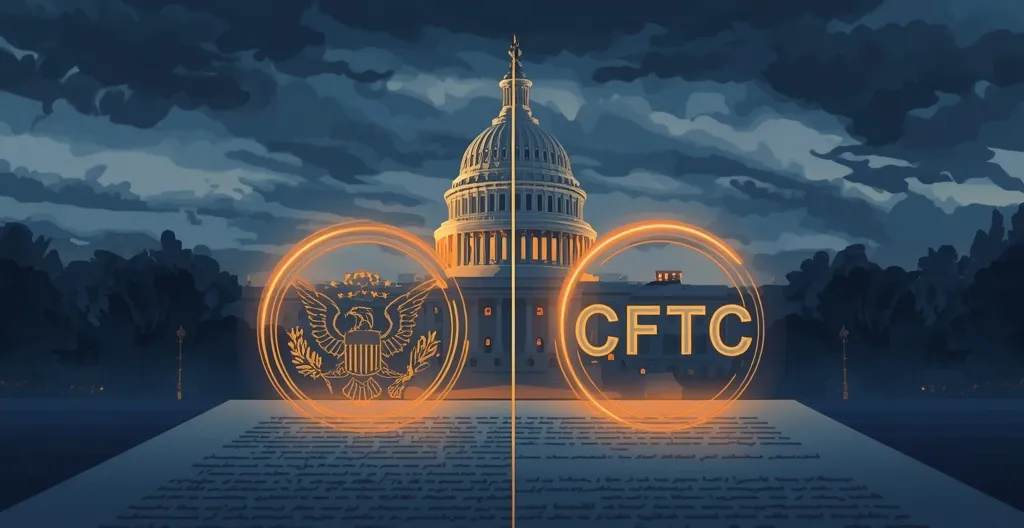
The CLARITY Act eyes Senate vote before August recess, but its path before the August recess is narrow, messy, and very much not a done deal.
- Senate action is still possible, but not guaranteed
- The bill would split crypto oversight between the SEC and CFTC
- Ethics language, White House approval, and floor timing remain unresolved
- Treasury Secretary Scott Bessent wants the Senate to vote “NOW”
The CLARITY Act, the Digital Asset Market Clarity Act of 2025, is Washington’s latest attempt to stop pretending crypto can be regulated by vibes, lawsuits, and agency turf wars. The bill passed the House in July 2025 and would create a market structure framework for digital assets, mainly by dividing oversight between the Securities and Exchange Commission and the Commodity Futures Trading Commission.
That matters because the current U.S. setup is a regulatory circus. One agency often treats tokens like securities, another leans toward commodities, and builders are left guessing which rulebook applies until someone gets subpoenaed. The CLARITY Act is meant to cut through that chaos by spelling out who regulates what, including exchanges, brokers, and token issuers.
Sen. Cynthia Lummis says the Senate still has a shot at moving the bill before the August recess. Speaking to crypto journalist Eleanor Terrett, Lummis said:
“Senator Thune has kept a place for the Clarity Act on the agenda before the August recess for many, many weeks now, ”
“I believe he does intend to go through with it.”
Maybe he does. The Senate also has a long, proud tradition of treating deadlines as a soft suggestion rather than a binding concept, so nothing is locked in until it is actually on the floor.
Senate Majority Leader John Thune has reportedly reserved floor time for the crypto market structure bill, but the chamber’s calendar is crowded with nominations, continuing resolution talks, and votes tied to Iran and Russia-Ukraine sanctions. That makes it harder to fit in a major crypto bill that still has unresolved language attached to it.
One sticking point is ethics language for federal officials and digital tokens. According to the reported negotiations, Sen. Thom Tillis and Sen. Ruben Gallego submitted revised language to the White House that would let state authorities enforce a ban on federal officials issuing or sponsoring digital tokens. The alternative would have put enforcement solely in the hands of the U.S. Attorney General, and some Democrats objected because that would leave the executive branch policing itself.
The White House said on July 22 that it had accepted extensive federal ethics restrictions after talks with Republican Sens. Lummis and Bernie Moreno, but it did not release the final text or explain how enforcement would work. That missing text matters. In Washington, “we’ve agreed” can mean anything from “this is basically done” to “we are still fighting over the commas and everyone hates each other.”
The vote math is also unforgiving. Republicans hold 53 Senate seats, so the bill would likely need at least seven Democrats to reach the 60-vote procedural threshold, assuming full attendance and no Republican defections. That is the part where optimistic press releases run straight into the actual Senate.
The House already moved its version of the CLARITY Act in July 2025 by a 294-134 vote, with 78 Democrats backing it. That is not a trivial show of support. It suggests market structure reform can attract bipartisan interest when the text is broad enough and the politics are not completely poisoned.
Still, the Senate has its own habits, and they are rarely graceful. The chamber can take a bill that sailed through the House and turn it into an endless negotiation over jurisdiction, carve-outs, and whose ego gets the final paragraph.
At its core, the CLARITY Act tries to answer a basic question the U.S. has dodged for years: is a digital asset a security, a commodity, or something in between? The answer determines which regulator has authority, what registration rules apply, and how exchanges and issuers are allowed to operate.
For readers who do not live and breathe this stuff, “market structure” is just the plumbing of a market: the rules that say who can list assets, who oversees trading, how brokers behave, and what disclosures are required. It is not glamorous, but it is the difference between a functioning market and a legal minefield with a price chart.
The SEC and CFTC have spent years circling the same territory. The SEC generally handles securities, while the CFTC handles commodities and derivatives. Crypto has exposed the cracks between those two mandates, and the result has been a mess of overlapping claims, enforcement actions, and policy ambiguity that has helped nobody except lawyers.
Treasury Secretary Scott Bessent is pushing hard for movement. He called for an immediate vote this week and wrote on X that the Senate needed to vote “NOW.” Bessent argued that more delay could weaken U.S. competitiveness in digital assets, a point that is hard to shrug off. If the U.S. keeps stalling, companies building serious infrastructure will keep looking at friendlier jurisdictions with fewer bureaucratic landmines.
That said, speed is not automatically a virtue. A sloppy “clarity” bill can create new loopholes, muddy the definitions it is supposed to fix, or hand regulators fresh excuses to harass builders later. Crypto has seen enough half-baked lawmaking to know that rushed legislation often produces expensive confusion dressed up as progress.
There is also a separate fight over stablecoin rewards and yield that has complicated broader crypto negotiations. That issue is not the same thing as the CLARITY Act itself, but in Congress these debates tend to bleed into each other until everything becomes one giant bargaining pile. One unresolved fight becomes the excuse for delaying three others.
The broader picture is straightforward: the House has acted, the Senate wants a shot at a real crypto market structure bill, and the clock is ticking toward recess. Whether the Senate gets there depends on the final ethics language, White House comfort with the enforcement setup, and whether enough Democrats are willing to help move a bill Republicans cannot advance alone.
If the Senate misses the August window, the bill does not vanish. It just gets shoved deeper into the pile of “we’ll handle it later” legislation, which in Washington is often where good ideas go to sit under a layer of dust and talking points.
Key questions and takeaways
-
What does the CLARITY Act do?
It aims to create a U.S. crypto market structure framework by defining how digital assets are regulated and by which agencies, mainly the SEC and CFTC. -
Why does this bill matter to crypto users and builders?
Clear rules would make it easier for exchanges, issuers, brokers, and developers to operate without guessing which regulator will show up next. -
What is blocking Senate action?
The main hurdles are unresolved ethics language, a crowded Senate calendar, and the need for bipartisan support to clear the 60-vote threshold. -
Why is Scott Bessent pushing so hard?
He argues that delay hurts U.S. competitiveness and risks pushing crypto innovation offshore before Congress gives the industry a usable rulebook. -
Is the bill already finished?
No. The House has passed its version, but Senate negotiations are still ongoing and several details remain unresolved before anything can become law. -
What happens if the Senate misses the August recess?
The bill likely gets delayed, possibly for months, and may have to be revisited later through another round of negotiation or reconciliation with the House.
The real test is not whether Washington can issue another statement pretending progress is inevitable. It is whether lawmakers can actually deliver a rulebook that gives exchanges, issuers, and developers enough certainty to build in the U.S. without living under constant SEC surprise attacks.
Further reading
A few useful primary sources and policy trackers for the CLARITY Act’s latest twists and turns:
- House bill text for the Digital Asset Market Clarity Act of 2025
- Clarifying the CLARITY Act: what to know
- CLARITY Act glossary and definitions
- Updated CLARITY Act text and related SEC/CFTC developments
- Senate Banking Committee advances CLARITY Act oversight split
- Senate races to merge CLARITY Act amid SEC-CFTC fight
- CFTC Chair Selig urges Senate to pass the CLARITY Act