
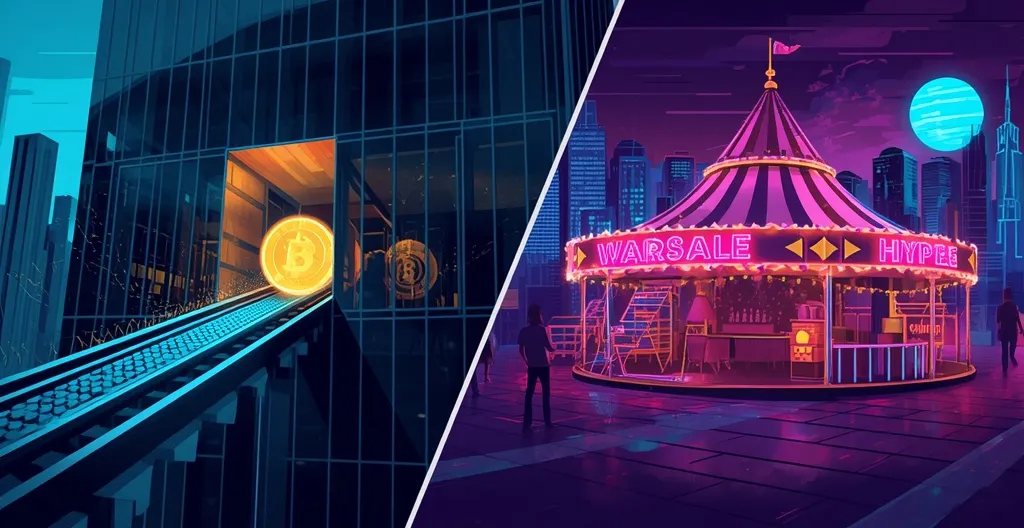
Amundi’s tokenized fund on Solana is a real sign of institutional movement. Pepeto’s presale pitch is a much louder reminder that crypto still attracts more carnival barkers than sober adults. The Crypto News That Will Actually Build Wealth in 2026 Is
- Solana gets a real-world adoption boost from tokenized finance
- XRP still has life, but the numbers need caution
- Pepeto is a high-risk presale dressed up with big promises
- Big upside claims are not the same thing as proof
The more meaningful headline here is not the shiny presale hype. It is that Amundi, one of Europe’s biggest asset managers, is tied into a tokenized money market fund on Solana with Spiko. That matters because tokenization is moving beyond theory and into actual financial plumbing. Not hype plumbing. Real plumbing.
Solana Surpasses Ethereum to Become the #1 Blockchain by reported that Spiko brought SAFO, described as Europe’s largest tokenized money market fund, to Solana. The same reporting says this connects €1.8 trillion in assets under administration across 3, 300 asset managers and 66 countries to the network. The $2.6 trillion figure sometimes attached to Amundi should be treated carefully unless separately sourced. The cleaner point is that a major traditional finance player is using Solana rails for a regulated product.
That is not a meme. That is infrastructure.
Solana’s RWA numbers back up the adoption angle. According to SolanaCompass, and using data from RWA.xyz, Solana had 285, 971 unique wallets holding on-chain real-world assets as of June 19. The network’s total RWA market value reached $3.4 billion on July 2, up from $2.8 billion in May. In plain English, real-world assets like funds or Treasury-like products are actually being represented and held on-chain, not just discussed in conference panels by men in branded hoodies.
For a deeper look at why this matters, see Real World Assets on Solana: A Comprehensive Overview. It is one thing to talk about tokenized finance. It is another to map out the mechanics of how these assets fit onto a public blockchain without the whole thing turning into a compliance circus.
That said, it is worth being precise about what these figures do and do not prove. A bigger RWA footprint does not magically make SOL a guaranteed moonshot. It does show that Solana is becoming a serious venue for tokenized finance, which is far more useful than another round of “number go up because vibes.”
Solana also has the practical profile that institutions tend to like: fast settlement, low fees, and a network that is already used by a broad mix of builders. For tokenized funds and other financial products, those are the boring details that actually matter. Traditional finance does not need a chain that tweets well. It needs one that works.
On the market side, the supplied figures place SOL at $81.58 on CoinGecko, up 10% on the week, after defending the $72 support zone three times this year. Resistance is said to sit near $88. Technical levels like support and resistance are just trader shorthand for price areas where buyers have previously shown up, or where sellers tend to press back. Useful? Sometimes. Gospel? Absolutely not.
XRP sits in a similar bucket: enough activity to keep the crowd interested, not enough certainty to call anything cleanly settled. The notes say XRP added nearly 5, 000 new wallets in a single day, which was described as the strongest network growth in three months. They also put XRP at $1.15, up 8.58% on the week, with support at $1.00 and resistance at $1.28.
Those figures are directional, not sacred. The wallet-growth and price data were not independently confirmed in the materials provided here, so they should be treated as market chatter rather than hard fact. XRP can absolutely move when sentiment turns, especially around regulatory headlines and payments narratives, but wallet growth alone does not equal lasting adoption. A lot of chains can flash a pulse for a day or two. That does not make them a healthy patient.
The source also references Standard Chartered’s $2.80 year-end target for XRP and a delayed CLARITY Act Could Lift XRP, Solana, Cardano as Senate. Both may be relevant to traders, but neither should be read as a prophecy etched into stone. Regulatory timing in crypto is a moving target, and analyst price calls are often just educated guesses wearing a tie.
Now for the part that deserves the hardest side-eye: Pepeto.
Pepeto has crossed $10, 381, 000 in committed capital, according to the figures provided, with a presale price of $0.000000188. The project claims its contracts passed a SolidProof audit, staking offers 170% APY, and PepetoSwap is already live with zero-cost trades. It also claims a bridge across Ethereum, BNB Chain, and Solana, plus an AI scanner aimed at detecting drain functions, hidden mints, and supply manipulation.
That is a very busy sales deck.
Busy does not mean bad, but it does mean you should separate verified functionality from promotional gloss. A live interface, a staking page, and a bridge claim are not the same as meaningful adoption. They may show the project exists. They do not prove people actually use it, that liquidity is deep, or that token holders will benefit in any durable way. Plenty of crypto projects have polished front-ends and back-ends held together with hope and caffeine.
The promotional case leans hard on pedigree. The materials describe the project as tied to the cofounder behind the original $7 billion Pepe token, and they also mention a Binance developer building the exchange. That is not the same as independent verification of a standout team. The notes also contained conflicting Pepe valuation claims, including an $11 billion version tied to 420 trillion tokens. The cleaner, sourced figure in the provided materials is the $7 billion reference. When the numbers wobble, the hype starts to smell like paint over rust.
And then there is the claim that Pepeto could deliver 100x to 300x returns. That is marketing, not analysis. Maybe the project has a functioning product. Maybe the presale buyers get lucky. But a multiplier thrown around in bold type is not evidence. It is bait. In crypto, the distance between “early” and “exit liquidity” can be one ugly chart candle.
The rumored Binance listing should be treated the same way: as speculation unless Binance confirms it. A possible listing is not a confirmed listing. That distinction matters because a lot of presale narratives are built on exactly that kind of assumption. “Maybe later” gets sold as “basically soon, ” and suddenly people are pricing in a future that has not arrived and may never show up.
For more on the kinds of speculative setups that keep getting pitched as the next great wealth machine, see Solana, XRP, Pepeto: Altcoin Surge or Speculative Traps in and Solana, XRP, Pepeto: Crypto Recovery Bets for 2026 or Risky. If a token’s entire thesis sounds like “trust me bro, but with APY, ” it probably deserves a head tilt, not a market order.
That is the real split in this market right now. On one side, you have blockchain infrastructure being used by real asset managers for real products. On the other, you have a presale machine promising the moon, the moon’s cousin, and a private jet home if you buy before the listing.
Solana’s tokenized finance story is grounded in observable activity. Pepeto’s upside story is grounded in claims, promotions, and a lot of wishful thinking. Those are not equal categories, no matter how confidently the marketing department shouts.
Bitcoin still sits above the noise as the cleanest monetary asset in the room, but the market around it continues to be shaped by these side currents: tokenized funds, payments rails, network growth, meme speculation, and a never-ending parade of projects trying to convince buyers that utility and multiplication are the same thing. They are not.
There is also a broader trend worth watching beyond the token charts: fraud and manipulation keep getting more sophisticated, especially in regulated environments where trust is the whole game. A good example is Kord raises £6.4m to fight AI fraud in regulated sectors, which shows how defensive infrastructure is becoming part of the financial stack too. In a market full of shiny nonsense, anti-fraud tools are not boring. They are survival gear.
Key questions and takeaways
-
Does Amundi’s move on Solana matter?
Yes. A major asset manager tied to a regulated tokenized fund on Solana is real validation for blockchain rails. It shows that public networks can handle more than memes and speculation. -
What does Solana’s RWA growth actually show?
It shows actual on-chain use. SolanaCompass reported 285, 971 unique wallets holding RWAs and $3.4 billion in RWA market value, which supports the case that Solana is being used for real financial products. -
Are the XRP numbers enough to get excited?
Not by themselves. The wallet-growth and price figures were not independently confirmed here, and wallet growth alone is weak evidence unless it leads to sustained usage. -
Is Pepeto a serious wealth opportunity?
It may have some functioning features, but the big claims are still promotional. The 100x to 300x talk is speculation, not a credible forecast. -
Should a Binance listing be assumed?
No. Unless Binance confirms it, it remains rumor territory. In crypto, “expected listing” is often just another way to say “please buy now.”
The bottom line is simple: Solana is showing verifiable institutional utility, while Pepeto is still mostly asking buyers to trust the pitch. One is a network getting used. The other is a presale trying very hard to sound inevitable.
If you want to understand how analysts and promoters keep dressing up speculation as inevitability, the usual suspects are never far away. Just look at the endless parade of “next cycle” narratives like Crypto News: Pepeto Staking at 170% APY as the BNB Price and the broader market optimism wrapped into Spiko brings its tokenized money market fund to Solana. One side is grounded in usage. The other is mostly selling you a dream with a stopwatch.
And if you are trying to separate actual opportunity from pure vapor, the difference often comes down to whether the thing is producing value now or just promising it later. That is why pieces like Solana, XRP, Pepeto: Crypto Recovery Bets for 2026 or Risky keep mattering: the market loves a comeback arc, but it loves a grift even more. The trick is not confusing the two.
Further reading
A few useful angles for tracking where tokenized finance is actually landing versus where the usual crypto hype machine starts smoking.


