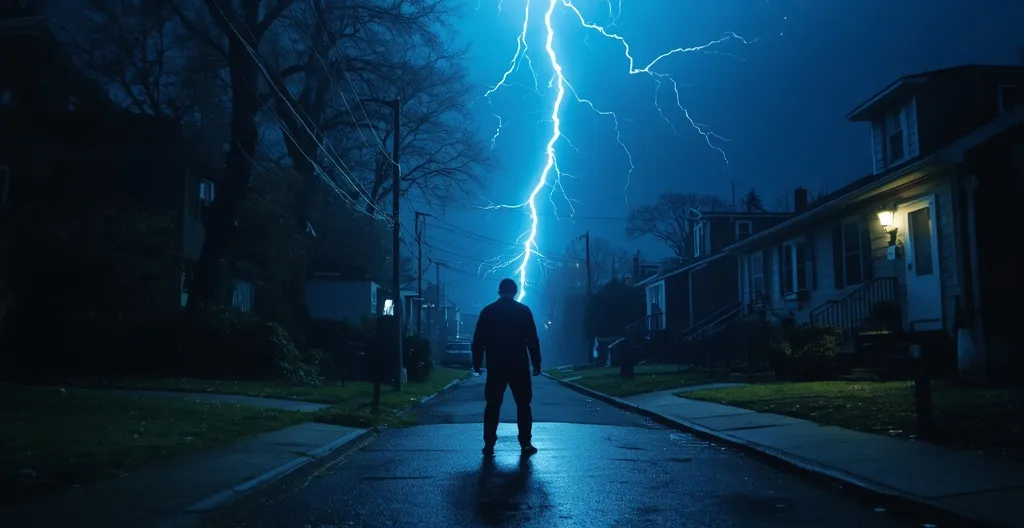
A Staten Island man survived a lightning strike caught on a doorbell camera, then walked away with no burns after an overnight hospital stay. It’s the kind of freak event that looks fake until the footage proves otherwise.
- Thomas Fahmy was struck on Todt Avenue in Staten Island on August 27.
- Doorbell video captured the strike and his fall.
- He spent the night at Northwell Staten Island University Hospital and went home the next day.
- Lightning can cause serious internal injury even when the skin looks fine.
ABC7 New York reported that Thomas Fahmy was walking toward his car for a dentist appointment when lightning hit him on a residential street in Staten Island. The doorbell footage shows him dropping to the ground, then getting back up and calling for help. A neighbor called 911.
He was taken to Northwell Staten Island University Hospital, where he spent the night. According to the reporting, he went home the next day with no burns.
Fahmy described the aftermath in stark terms:
“This very intense burning sensation. Tingling, numbness, pain, severe pain, in both my feet.”
That detail matters. Lightning injuries are often deceptive. A person may not have obvious burns and can still suffer nerve damage, hearing problems, confusion, heart rhythm issues, or even cardiac arrest. In other words, looking okay is not the same as being okay. Lightning is not a polite little warning system. It’s a violent discharge that can scramble the body in ways the skin doesn’t always advertise.
The video makes the event especially clear. Home security footage has turned a lot of once-arguable moments into documented facts, and this one leaves little room for debate about how fast things can go sideways. One second someone is walking to their car. The next, they are on the ground because the sky decided to throw a fit.
There is one important point to keep straight: the available reporting describes this as a close-range lightning strike, not necessarily a confirmed direct hit. That distinction matters. A direct strike means lightning physically hits a person; a close-range strike can still injure someone through nearby impact, side flash, or ground current. Either way, the outcome can be severe, and nobody should be splitting hairs about which flavor of awful they prefer.
The National Weather Service has long called lightning an “underrated killer.” Its safety materials say U.S. lightning fatalities have dropped from about 55 per year to less than 30, thanks in part to better awareness and people sheltering sooner. That’s a real improvement, but it also means storms still catch people the old-fashioned way: because they assume they have more time than they do.
The basic safety rule is simple. If thunder is close enough to hear, shelter is close enough to matter. A sturdy enclosed building is best. A hard-topped vehicle is also a solid option. Open fields, isolated trees, and water are bad ideas when the sky is throwing lightning around like it’s angry at the whole neighborhood.
For those who want the official safety rundown, the National Weather Service’s Lightning Safety Awareness Week guidance is worth a look, and local public safety handouts such as this Lightning Safety Info sheet spell out the basics without the fluff. If you’re wondering whether there’s any neurological follow-up on patients with head trauma or electrical injury, medical references like Grand Rounds exist for a reason: lightning can leave a person technically standing while still doing messy work under the hood.
Fahmy’s response after the strike was understandable: gratitude. He later went to church on Sunday to say thank you and reportedly bought a lottery ticket. After surviving a lightning strike, that kind of reaction makes sense. If the universe has already tried to delete you, a quick stop at the convenience store feels almost reasonable.
For anyone wanting another view of the incident, New York Man Survives Direct Lightning Strike Unharmed and the clip of the Staten Island man miraculously survives close-range strike both show how quickly a normal day can turn into chaos when storms are ignored or underestimated.
Key takeaways
-
Was this a direct lightning strike?
The reporting available here says it was a close-range strike. That is not the same thing as a confirmed direct hit, so the wording should stay careful. -
Can someone survive lightning without burns?
Yes. Lightning can leave no visible burns while still causing pain, tingling, numbness, or deeper internal injury. -
Why does the doorbell video matter?
It provides unusually clear visual proof of how sudden and violent a lightning strike can be, which makes the event easier to verify and harder to dismiss. -
What should people do during a thunderstorm?
Get inside a sturdy building or a hard-topped vehicle right away. Do not wait outside because the storm “doesn’t look that bad yet.” Lightning can strike far from the center of a storm. -
Why is this survival noteworthy?
Lightning strikes are often deadly or severely injurious. Walking away with no burns after an overnight hospital stay is unusual enough to stand out, but it should also be a reminder that luck is not a safety plan.