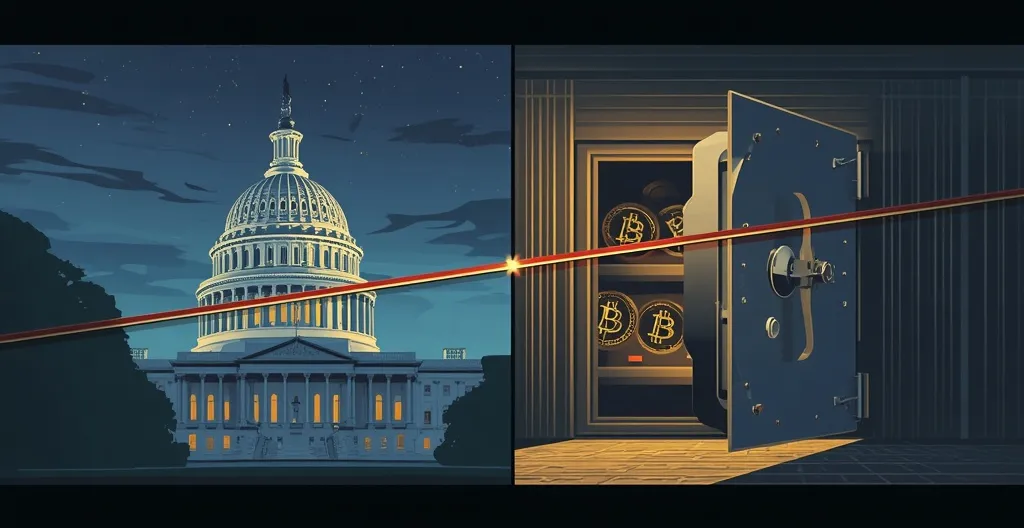
Washington is still arguing over who gets to set the rules for banks and crypto: Congress, or the regulators who actually police the banking system.
- Congress has advanced the CLARITY Act
- Regulators still control bank supervision
- Banks want legal certainty, not guesswork
- Crypto policy remains split across agencies
The fight over U.S. bank crypto rules is not really about whether crypto exists. It is about who gets to define the rules of the road. Congress can write those rules into law. Regulators can interpret them, enforce them, and make life miserable for anyone who gets too creative.
That divide matters because banks do not operate on vibes. They need to know what they can custody, what they can offer, what capital and compliance requirements apply, and which agency might decide next quarter that yesterday’s okay is today’s problem.
Congress is trying to draw clearer lines
The biggest legislative marker here is the Digital Asset Market Clarity Act of 2025. According to Congress.gov, the bill has passed the House and would create a framework for digital commodities under a new set of rules.
In plain English, the bill aims to separate certain crypto assets from the securities bucket and give the CFTC a larger role in overseeing them. That is a big deal because one of the longest-running headaches in U.S. crypto policy has been the SEC-CFTC turf war. One agency tends to view many tokens through a securities lens. The other is more likely to see them as commodities. The industry ends up stuck in the middle, taking fire from both sides and trying not to step on a land mine.
Congress.gov says the bill would assign broad oversight over digital commodity exchanges, brokers, and dealers to the CFTC. It would also preserve SEC jurisdiction in certain market settings, including some activity involving brokers and dealers on alternative trading systems and national securities exchanges.
That is not a free pass. It is a boundary-setting exercise. The goal is to reduce the current fog, not erase regulation altogether. Anyone expecting “crypto without rules” should probably take a lap and cool off.
What “digital commodity” means here
The phrase digital commodity can sound broader than it really is. In this context, it is not a casual label for anything with a blockchain logo on it. It refers to digital assets the proposed framework would treat as commodities rather than securities.
Congress.gov’s summary says the bill would set conditions for trading these assets, including whether the blockchain is mature or has decentralized control, or whether the issuer files certain reports. That language matters because U.S. crypto law still hinges on classification. If a token is treated more like a security, the SEC gets more involved. If it is treated more like a commodity, the CFTC takes a bigger role.
That classification fight is not academic. It decides which laws apply, which disclosures are required, and which agency can come knocking with a subpoena, an enforcement action, or both.
Regulators still run the bank side of the house
Even if Congress clarifies the market structure, regulators are not going away. Banks remain subject to prudential supervision, which is the formal way of saying they are monitored for safety, soundness, and resilience. They also remain under Bank Secrecy Act and anti-money-laundering rules, plus the usual supervisory scrutiny over capital, liquidity, operational controls, and consumer protection.
The key agencies matter in different ways. The SEC and CFTC are central to how crypto assets are classified and traded. The OCC, Federal Reserve, and FDIC oversee banks themselves and care about whether crypto activity creates risk the institution cannot handle.
That distinction gets lost a lot in public debate. A bank can have a product that looks legally interesting on paper and still be told, in effect, “No, not in our building.” That is because bank permission is not just about whether something is lawful in the abstract. It is also about whether regulators think the bank has the controls, capital, and risk management to do it safely.
And yes, banks notice. They are not eager to build a custody service, token platform, or crypto-adjacent payments product if the regulatory response might range from cool indifference to a supervisory headache with teeth.
Why the split keeps hanging around
The United States has a habit of regulating crypto through overlapping authority and then acting surprised when the result is confusion. Congress writes laws slowly. Regulators move faster, but often through guidance, supervision, and enforcement instead of clean statutory language. That leaves firms trying to interpret shifting signals from multiple directions at once.
That is why “clarity” gets repeated so often in crypto policy debates. It is not just a buzzword. It means firms want to know:
- which agency has the final word,
- what qualifies as a security versus a commodity,
- what banks may do without second-guessing later, and
- how far existing banking rules reach into digital assets.
Without that clarity, banks tend to default to caution. That is not cowardice. It is rational risk management. One enforcement action can do more damage to a bank than a thousand optimistic pitch decks can repair.
Why this matters for banks right now
The practical impact shows up in everyday decisions. Can a bank custody bitcoin for customers? Can it work with a stablecoin issuer? Can it offer token settlement services? Can it partner with a crypto firm without getting trapped in a compliance mess?
Those questions are exactly why legislative movement like H.R. 3633 gets attention. If Congress defines the asset class more clearly and gives agencies a cleaner lane, banks may be more willing to build products instead of sitting on the sidelines with their arms folded.
But there is a catch. Even a better statute does not magically remove bank supervision. If a bank wants to touch crypto, it still has to satisfy AML requirements, operational risk controls, capital expectations, and whatever else its examiners decide is relevant. That is the price of playing in regulated finance. Nobody gets to freestyle with depositors’ money.
The bigger problem is still fragmentation
The real issue is not just one bill. It is the fact that U.S. crypto policy is split across agencies with different missions and different instincts. Congress can try to redraw the map, but the banking system still runs through a maze of regulators that were built for a much older financial world.
That fragmentation creates a familiar outcome: delay. Banks hesitate. Crypto firms lobby. Agencies talk past each other. Innovators look offshore. Lawyers stay employed. It is a very American solution, if by solution one means “prolonged administrative trench warfare.”
To be fair, regulators also have a legitimate job here. Crypto has shown plenty of scams, compliance failures, weak controls, and outright fraud. The industry does not exactly need a choir of angels to explain why supervision exists. But there is a difference between prudent oversight and a system so fractured that serious firms cannot tell which rulebook applies.
That is where Congress has a role. If lawmakers want banks to participate responsibly in digital assets, they need to write rules that are specific enough to matter and durable enough that banks can rely on them.
Key questions and takeaways
-
Who is supposed to set the rules for banks and crypto?
Both Congress and regulators have a role. Congress writes the law, while agencies like the SEC, CFTC, OCC, Federal Reserve, and FDIC interpret and enforce it in their own lanes. -
What is the CLARITY Act trying to do?
According to Congress.gov, H.R. 3633 would create a framework for digital commodities, give the CFTC broad oversight, and preserve certain SEC powers in specific market settings. -
Does the bill mean banks can do whatever they want with crypto?
No. Even with clearer market-structure rules, banks would still face bank supervision, AML/BSA obligations, and safety-and-soundness requirements. -
Why do banks care so much about clarity?
Because building crypto services without a stable legal framework is a bad business bet. Banks need to know what is allowed before they commit money, staff, and reputation. -
What does the split between Congress and regulators create in practice?
It creates overlap, delay, and caution. That is manageable for lawyers and regulators, but it slows down banks and firms trying to build real products. -
Is this just a political fight?
No. It is also a structural problem. Crypto sits between old banking law and modern digital markets, and the U.S. still has not cleanly decided how to fit the two together.
The bottom line is blunt: Congress is trying to define the game, but regulators still hold the whistle, the penalty flag, and most of the practical power over banks. Until those two forces line up, U.S. crypto policy will keep rewarding caution and punishing speed.
That may frustrate builders, but it also explains why the smartest money in finance keeps demanding something the system has been weirdly stingy with: a clear yes, a clear no, or at least a rule that does not change the moment everyone starts following it.
Further reading
A few relevant pieces for anyone tracking the tug-of-war over U.S. crypto rules and market structure:
- U.S. Bank Crypto Rules Remain Split Between Congress and Regulators
- Built for Modern Trading
- 119th Congress (2025-2026): Digital Asset Market Clarity Act text
- Clarifying the CLARITY Act: What To Know About the Bill
- Arthur Hayes Says CLARITY Act Should Be Vetoed as May 21 Deadline Looms
- CLARITY Act Advances as U.S. Crypto Market Structure Fight
- Senate Banking Committee Advances CLARITY Act to Split Crypto Oversight Between SEC and CFTC