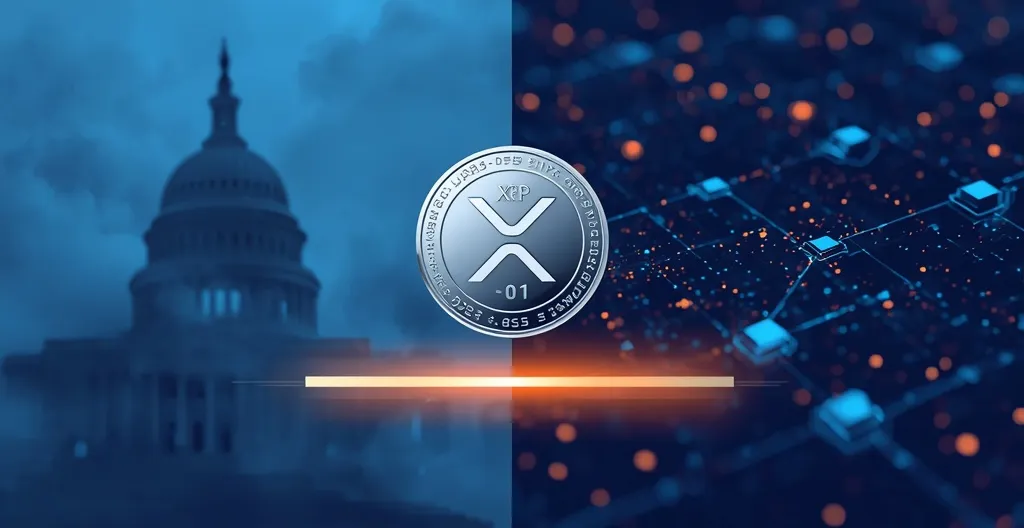
XRP is holding just above $1 while U.S. policy delays and XRPL upgrade plans pull in opposite directions.
- Price pressure: XRP was trading at $1.0430 as of Aug. 9, 2026 at 17:17 UTC, according to CoinMarketCap.
- Policy drag: Senate delays around the CLARITY Act have kept regulatory uncertainty alive.
- XRPL push: Version 3.3.0 includes six proposed amendments, led by Confidential Transfers.
- Institutional angle: Ripple is still positioning XRPL for tokenized funds, bonds, and other real-world assets.
- Reality check: The long-term case may be improving, but the market is not handing out participation trophies.
XRP was down 0.31% over 24 hours and 3.44% over the past week, according to CoinMarketCap. Over longer stretches, it was down 5.38% over 30 days, 6.28% over 60 days, and 29.04% over 90 days.
That kind of action says plenty. Traders are not exactly charging into XRP with both fists in the air. The market is weighing near-term uncertainty against the longer-term pitch that Ripple and the XRP Ledger are becoming more useful for institutional finance. One side is politics. The other is infrastructure. Right now, politics has the louder megaphone.
The immediate headwind is the delayed CLARITY Act. The U.S. Senate pushed consideration of the bill beyond the August recess and into September, leaving digital asset markets stuck with the same old uncertainty. The CLARITY Act is meant to draw clearer lines between securities and commodities in crypto, which sounds dry until you remember that regulatory clarity is exactly the sort of thing institutions want before they commit real money.
That matters for XRP because the token is still sensitive to policy mood swings, even if the long-running Ripple-SEC conflict has largely moved off center stage. When lawmakers stall, altcoins usually do not get a victory lap. They get thinner liquidity, softer bids, and a chart that starts looking like it missed its morning coffee.
Volume is not doing XRP any favors either. CoinMarketCap showed 24-hour trading volume at about $583 million, down 34.6% from the prior day. When volume dries up, price moves can get choppy fast. Support at the $1 handle starts looking less like a foundation and more like a table with one bad leg.
Still, there is more going on here than a weak tape.
The XRPL community proposed version 3.3.0 on Aug. 7, and the package includes six amendments. The main feature drawing attention is Confidential Transfers. That feature uses zero-knowledge proofs, or ZKPs, to let the ledger verify that a transfer is valid without exposing every detail of the transaction to the public.
In plain English, ZKPs let a system prove something is true without revealing the underlying data. For institutions, that matters because public blockchains can be a nightmare if every transfer size, balance shift, or position adjustment is visible to anyone with a block explorer and too much free time.
Confidential Transfers for Multi-Purpose Tokens on the XRP is aimed at selective disclosure. That means transaction details can be hidden from the public while still being available to approved parties such as issuers, auditors, or regulators, depending on how the workflow is set up. It is not full anonymity, and it is not a privacy maximalist fantasy. It is the more realistic kind of privacy financial institutions actually tend to use: enough secrecy to keep sensitive information out of the open, but not so much that compliance teams start sweating through their shirts.
That distinction matters. Institutions usually want privacy, but they also want controls, reporting, and auditability. In crypto, those goals often collide with the culture-war version of “decentralization, ” which sometimes treats every compromise as betrayal. In the real world, financial rails are built with tradeoffs. Boring? Yes. Necessary? Also yes.
Ripple’s broader pitch for XRPL is tied to tokenization. That means issuing digital representations of real-world assets on a blockchain, such as funds or bonds. The promise is faster settlement, easier transfer, and more efficient market plumbing. The catch is that most tokenization pitches sound great right up until someone asks how much actual usage exists beyond the press release.
CoinDesk reported that XRPL is already seeing meaningful activity in this area. According to CoinDesk’s reporting, RWA.xyz tracked about $1.38 billion of distributed real-world assets on XRPL, including $845.7 million of RLUSD, Ripple’s dollar-pegged stablecoin. The same breakdown included $212.6 million from Ondo, $116.1 million from VERT Capital, $55.4 million from Archax, and $11.6 million from Societe Generale.
That is real traction, not just vaporware with a suit on. But it is also concentrated. A large share of the visible activity is tied to a relatively small number of issuers and asset types. That means XRPL has a functioning on-chain asset base, but it is not yet proof of broad, organic, institutional-scale adoption across the board.
RLUSD is especially important to Ripple’s setup. The company appears to be positioning the stablecoin as the liquidity and stable-value layer, while XRP handles transfer and settlement functions. That role split makes sense on paper. If it works in practice, RLUSD provides the grease and XRP provides the rails. If it does not, then it remains a neat theory looking for a lot more real-world confirmation.
There is also a bigger business story floating around Ripple itself. FXLeaders reported that Ripple raised $500 million at an implied valuation of $40 billion. If accurate, that would suggest investors still see value in Ripple’s infrastructure ambitions, even if XRP traders are less enthusiastic in the short term.
But that kind of fundraising headline should be read carefully. A reported valuation is not the same thing as proven demand for XRP. Corporate financing can tell you something about investor appetite for the company. It does not automatically tell you that the token market is ready to moon, no matter how much social media wants to slap rocket emojis on it.
Some commentary has thrown around upside ranges between $1.10 and $2.50. That should be treated as speculation, not analysis. Price targets are easy to print and hard to respect. A clean technical setup is not the same thing as a durable fundamental move, and crypto is full of people who confuse the two every single day.
The more useful question is whether the pieces line up over time. If the CLARITY Act advances in September, it could improve sentiment for XRP and other major altcoins by reducing one layer of regulatory ambiguity. If XRPL 3.3.0 progresses from proposal to actual validator support, Confidential Transfers could make the ledger more attractive to issuers that need privacy with compliance hooks. And if RLUSD keeps growing, Ripple may end up with a more credible financial stack than the usual “number go up” circus that passes for strategy in too much of crypto.
That still does not guarantee XRP breaks out and stays there. It does mean the market is dealing with a split-screen setup: policy friction on one side, product development on the other. The short-term price may keep wobbling, but the longer-term debate is more serious than the average bagholder fantasy and a lot more grounded than the usual shameless moonshot chatter.
Key questions and takeaways
-
Why is XRP stuck near $1?
Regulatory uncertainty, softer trading volume, and broader market caution are all weighing on sentiment. The token has not had enough strong buying pressure to break that pattern. -
What does the CLARITY Act delay mean?
It removes a potential short-term policy catalyst. If lawmakers move the bill forward in September, that could improve sentiment across XRP and other major altcoins. -
What is Confidential Transfers on XRPL?
It is a proposed privacy feature that uses zero-knowledge proofs to hide transaction details while still allowing the network to verify that transfers are valid. It is designed for selective disclosure, not full anonymity. -
Does XRPL already have real tokenized-asset activity?
Yes. CoinDesk reported about $1.38 billion of distributed real-world assets on XRPL, with RLUSD accounting for the largest share in the tracked data. -
Is RLUSD part of Ripple’s core strategy?
It appears to be. Ripple is positioning RLUSD as a stable-value liquidity layer, while XRP is meant to serve transfer and settlement use cases. -
Are the upside calls between $1.10 and $2.50 reliable?
Not by themselves. Those ranges are speculative and should not be confused with grounded fundamentals. Crypto traders do love a heroic number, though.
For XRP, the real test is not whether it can hover around $1 for a few sessions. It is whether policy clarity, institutional-grade privacy features, and actual tokenized-finance usage can line up in the same direction. That is a much harder job than posting a chart with a green arrow, but it is also the only one that matters.
Further reading
For a tighter look at XRP’s policy pressure, XRPL privacy upgrades, and the tokenization angle, these resources cover the moving parts.
- XRP Holds Near $1 as Policy Uncertainty Counters XRPL
- XLS-0096: Confidential Transfers for Multi-Purpose Tokens
- XRP Ledger proposes Confidential Transfers to e
- XRP Surges 15% as Ripple Unveils Bold DeFi Roadmap for XRPL
- XRP Holds $1 as CLARITY Act Delays and XRPL Adds
- XRP Doesn’t Need CLARITY Act as Adoption and Legal Clarity